
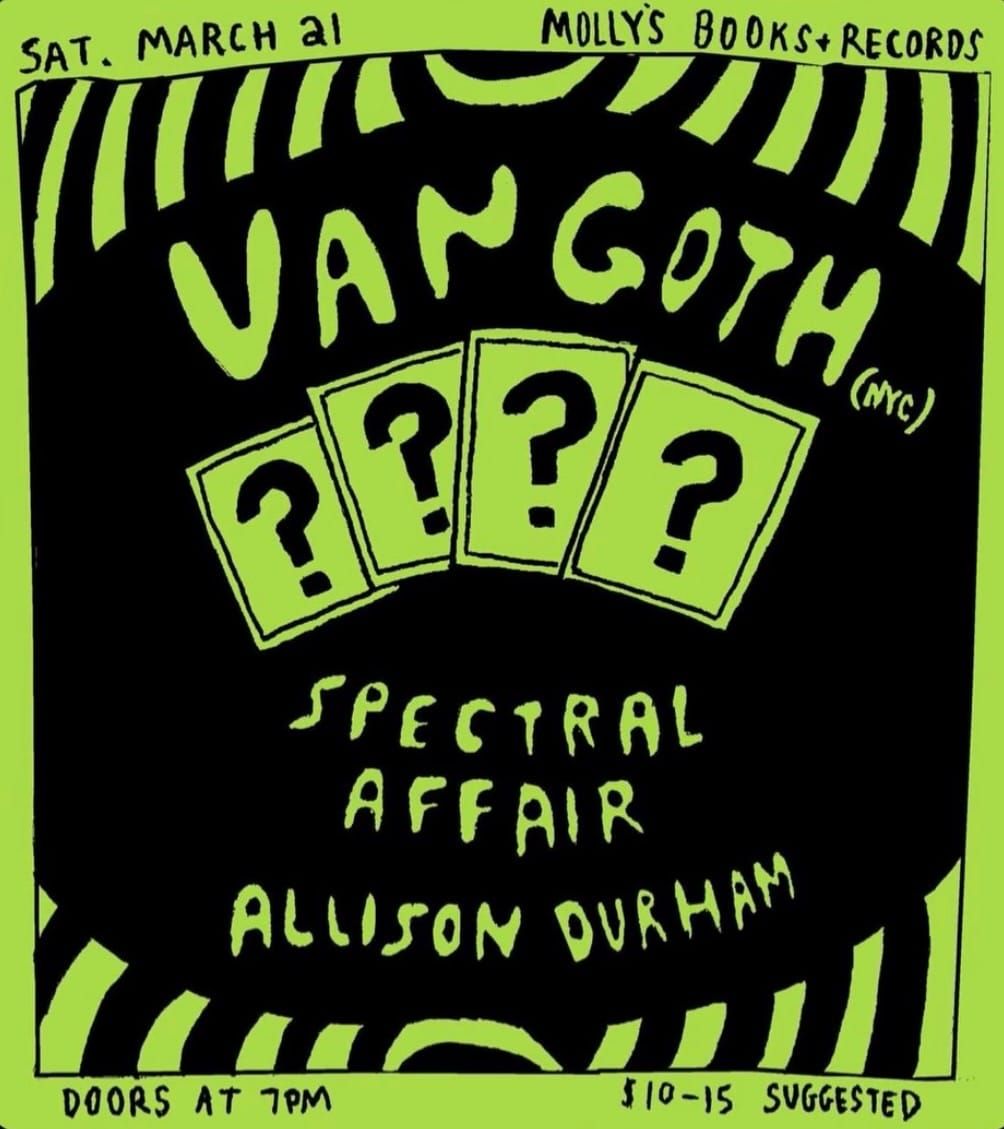
Van Goth, Allison Durham, Spectral Affair
Molly’s Books & Records
1010 S 9th St.
Philadelphia
March 21, 2026
If you haven’t been to Molly’s Books & Records, right in the heart of Little Italy, it’s a great little shop, perfectly suited for letting an hour or more slip away if you’re in a browsing mood, especially for someone like me, for whom music and writing are twin interests. (If they’re not conjoined, they’re definitely neighbors.) To my knowledge, the shop hasn’t hosted shows often or ever really before; I hope the vinyl shelves that usually take up the main floor space are on wheels, for the sake of whoever got tasked with moving them. The room was cleared for a standing-room early-evening, sun-slowly-setting gig with locals Allison Durham (of the great punk rock band MESH, playing solo) and Spectral Affair (a mysteriously re-named iteration of Big Picture, who I saw at Abyssinia a week ago), and Van Goth, a post-punk duo from New York, on tour and arriving – their words, not mine – “sweaty and disgusting” from a long drive from Carrboro, North Carolina.
Van Goth was excellent fun. Sydney Salk (bass, vocals) and Simon Schadler (guitar, synth, glockenspiel, drum machine) have an attitudinally-consistent adherence to style: sparse and rudimentary, with post-punk-y, single-note downpicked guitar lines and thumpy, four-on-the-floor electronic kick marking the grid, so minimal and lean that I don’t think I ever heard a single chord. Their sound was all straight, single-string melody lines, in unison or call-and-response style, like dancers shuffling around on goth night, no hip-swinging whatsoever. (Except, of course, when they played “DDB," a song whose chorus goes “Dance! Dance! Boogie!” At least a few of us answered the call.)
They referred to their set-up as “the lo-fi version” of what they usually do, and aside from the actual bells and whistles – cascades of ringing glockenspiel melodies, long-tail synth notes decaying slowly, filter sweeps and knob-fiddling – the bare-bones instrumentation locked in with their casual, unaffected dual vocals. Salk was especially committed to the bit, eyes hidden behind dark gas-station safety shades. They had a great sense of humor and were a total united front, like in “Circles” where Schadler sings, “Letterbox’d / Edward Yang / I don’t want to hear about your BFA” and Salk plays the pretentious critic in question, answering snidely, “I like his early work better.” I loved when that song ended and Salk pumped their fist with an emphatic “yes!” as Schadler said on-mic, “That’s the best we’ve ever done it!”
Throughout the show I thought of author Annie Dillard’s proclamations about presence in Pilgrim at Tinker Creek, her thoughts on the being-here-now of it all: “The present is a freely given canvas. That it is constantly being ripped apart and washed downstream goes without saying; it is a canvas, nevertheless.” Of course, I think of going to shows as a great, ceremonial way to get out of my head, to get away from the phone or other screens and engage in real life with real people – to get lost in the brushstrokes, as it were – but when social anxiety is debilitating or I’m hitting the show alone, I’m happiest if I remember to bring a book along, so I’m not just trying to kill boredom with even more screen time. If only in that regard, Molly’s is a treasure trove, and when my eyes weren’t curiously scanning the shelves for handsome editions of books and albums and art, I was nose-deep book worming on whatever grabbed my attention. I managed to read the entirety of the Raymond Carver short story “The Student’s Wife” in stolen un-social minutes between sets. It’s been years since I’ve read it; it’s as sad and great as ever, if not more so. Come for the ephemeral, stay for the ephemera, I suppose.


