
“Apartment House 1776”
Detroit Opera
Cranbrook Art Museum
39221 Woodward Ave., Bloomfield Hills
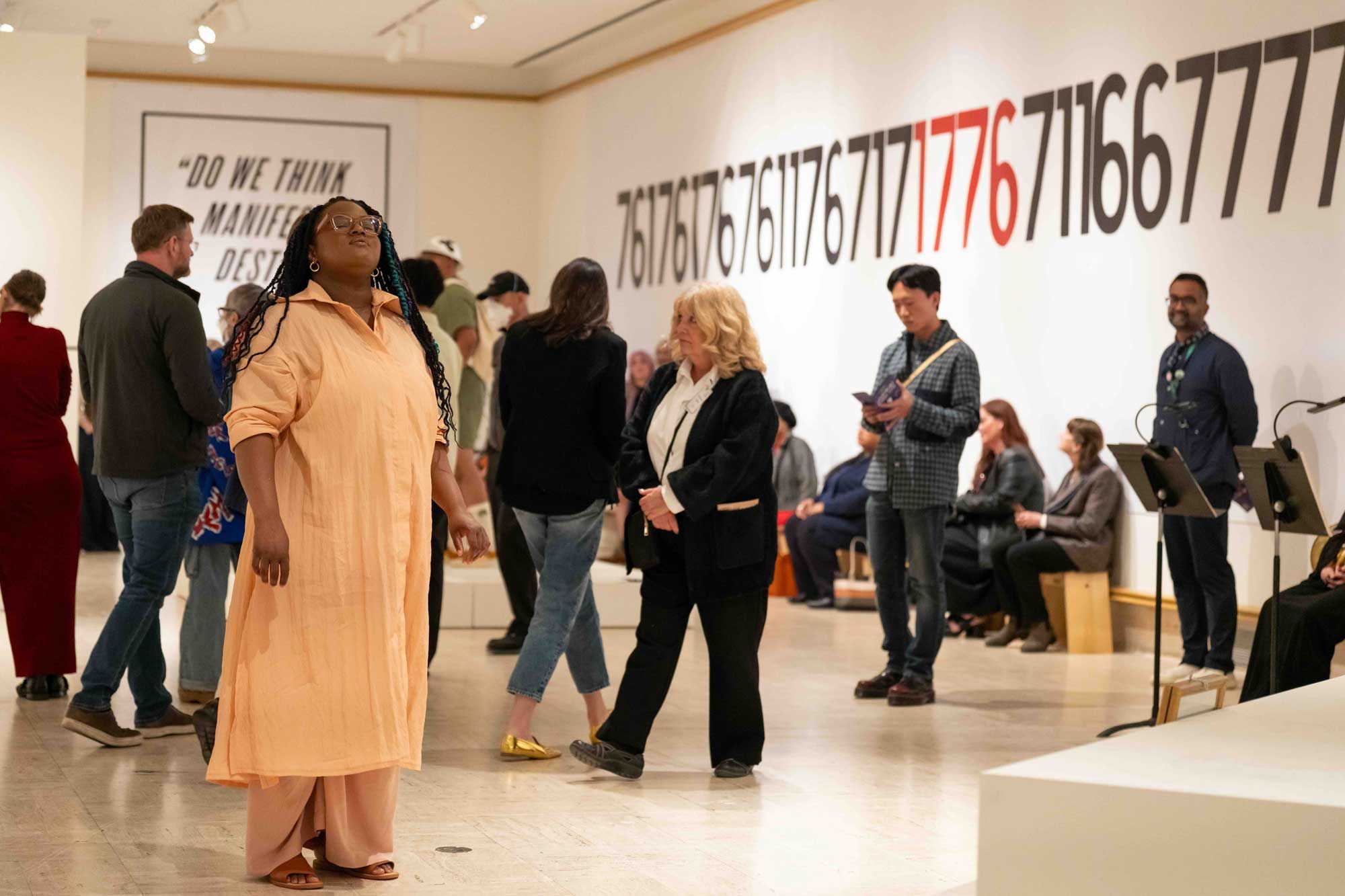
Chaotic. Beautiful. Overwhelming. Moving. Those were the four words I wrote down to describe my experience at “Apartment House 1776” at Cranbrook Art Museum post-show. The experimental John Cage opera took over a wing of the museum, presented by the Detroit Opera, May 21-24, and I’m still trying to produce a coherent thought about it.
“Apartment House 1776” was written for America’s bicentennial in 1976. It tells the experience of four cultural and ethnic groups — African American, Native American, Sephardic Jewish, and Protestant — during that time period, represented by opera singers Brianna J. Robinson, Selena Kearney, Mia Mandineau, and Travis Leon Williams. The singers chose the songs they would perform throughout the opera, while a cacophony of members from the Detroit Opera Orchestra situated across four rooms played selections of Cage’s arrangements of Revolution-era music.
The experience starts with a sullen monologue by Alexander Sulen Gedeon, who directed the Opera House production. He talks about all the sounds converging in a car ride — the hum of the engine, sounds of music from your car and others, noises from the wind, and people, places, and things, being passed by. “Apartment House 1776” is like turning the volume on the world up. Every singer and musician is their own radio station, and you’re turned into every single one at once.
Audience members start in separate areas, assigned to one singer who acts as their guide. They can follow their guide for the duration of the performance, or move across the space as they see fit. It’s a “choose your own journey” setup through a chaotic maelstrom of voices and sounds. I found myself overstimulated, feeling like my head would explode, and having to fight the intuitive urge to run away and cower in a corner with my head in trembling hands. The singing doesn’t match the music. A quartet is in one corner, a solo violinist plays across the room, and a snare drum snaps military licks that crack like lightning from down the hall.
The instructions given are to let your intuition guide you during the 32-minute journey. You don’t have to stay with the character you started with. Will you follow them when they leave the room and stay invested in their story? My intuition told me my date for the evening was not going to join me for this strange experience before arrival. That was the only clear thing I could have predicted about the evening.
I started with Mia Mandineau, representing the Jewish voice, as my guide. She started by neatly packing her suitcases and then fumbling with the weight of them for the journey ahead. Years with historical significance are written on the wall: 1791, when the bill of rights was passed; the passage of the 13th amendment in 1865; 1920 when women were given the right to vote; 1964, the year the Civil Rights Act was passed; 1971, when the voting age was lowered from 21 to 18 to match the age you could be drafted.
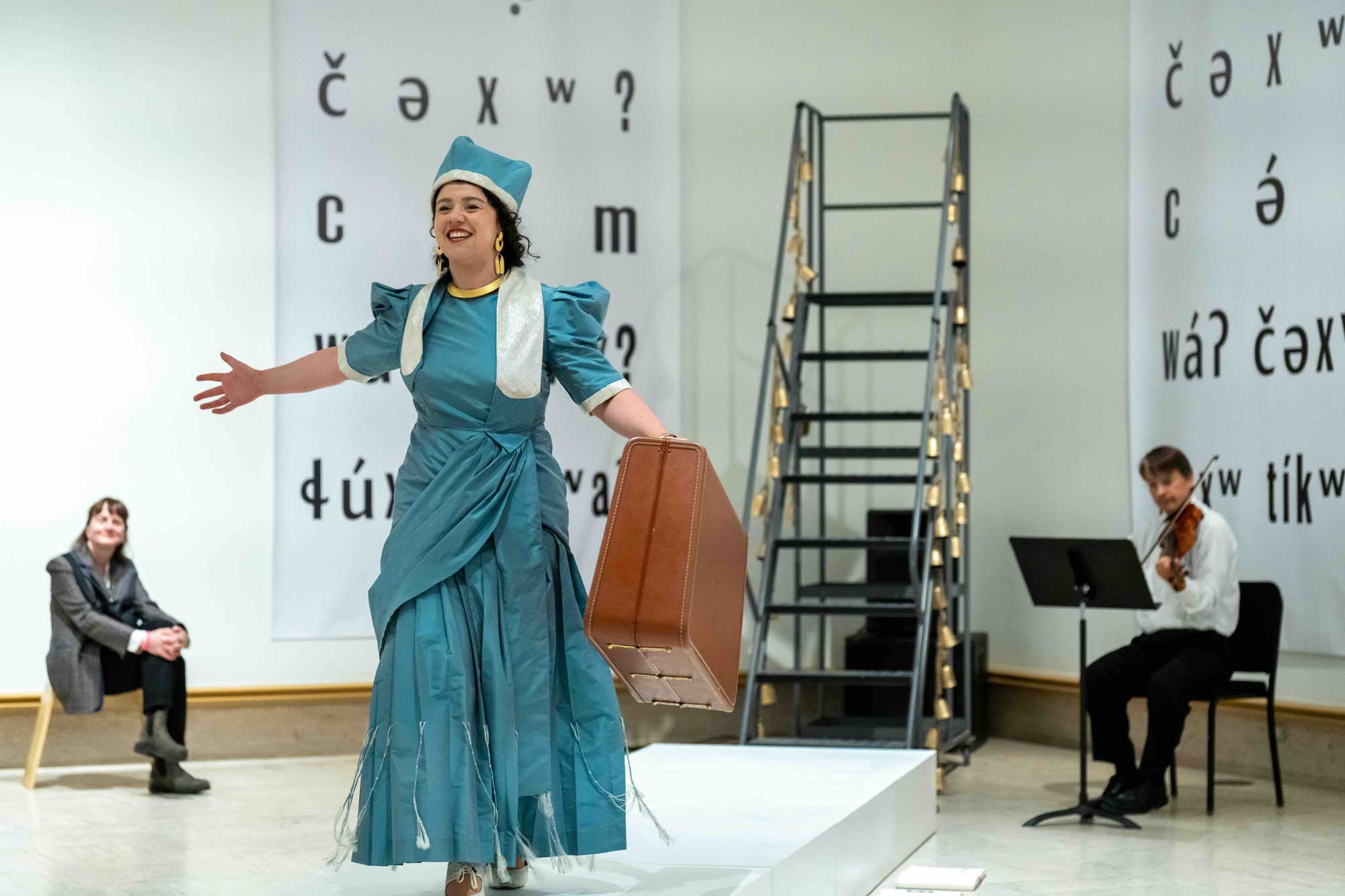
Once Mandineau left the room, I followed behind her, eager to see where her story would lead, but as soon as I reached the next room, where music notes crashed against my body like ocean waves, all bets were off. I was completely swept into the confusion of it all.
Selena Kearney, the Native American voice, had set the stage with bundles of cedar in each corner of a raised platform marking the four directions, and I knew this consecrated space was where all four would end up.
Leon Travis Williams walked around cautiously with his knife out, always on the defense. Looking for something that he couldn’t seem to find, he sang African American hymns like “We Shall Overcome,” “Amazing Grace,” and “Life Every Voice and Sing.”
I was caught by the spell of Kearney’s stoic expression as her black and red cape swept the floor behind her calculated steps. But even more by Brianna J. Robinson who, unlike the others, seemed fully aware of all the attendees in the room with her. Several times she locked eyes with me, and I could feel her sorrow. She held up a mirror both to herself and to others so that we may face our own reflections and ask whether the versions of ourselves in our heads match what other people see.
It ended with the four standing atop the raised platform together in unity with bowed heads. My grief is strangely replaced with joy that leaks out from my eyes at Robinson’s final song, “Music for Black People,” which she is still singing after the others have stopped. All the chaos was worth this final moment of coming together, each person’s experience being seen as sacred. I could only utter the word, “wow,” as tears of wonder reached my smile.
As 2026 marks the 250 year anniversary of the Declaration of Independence, the opera reminds us that everyone has a story, a life experience that varies vastly from everyone else’s. This is especially true across racial and cultural lines, and with our current fascist administration emboldening bigots, it feels like we are unable to reconcile (or hell, even acknowledge) these differences.
President Donald Trump’s administration has created a $1.776 billion “Anti Weaponization Fund” to provide payouts to people who claim they were victims of government “weaponization,” including Jan. 6 insurrectionists. $1.776 billion. 1776. The year America was founded. Two hundred and fifty years later and these American voices are still clashing — separate, simultaneous, bleeding together in confused cries. But is anybody listening? Can you even hear them? Or are you tuned into the dog barking down the street instead of the humming engine?
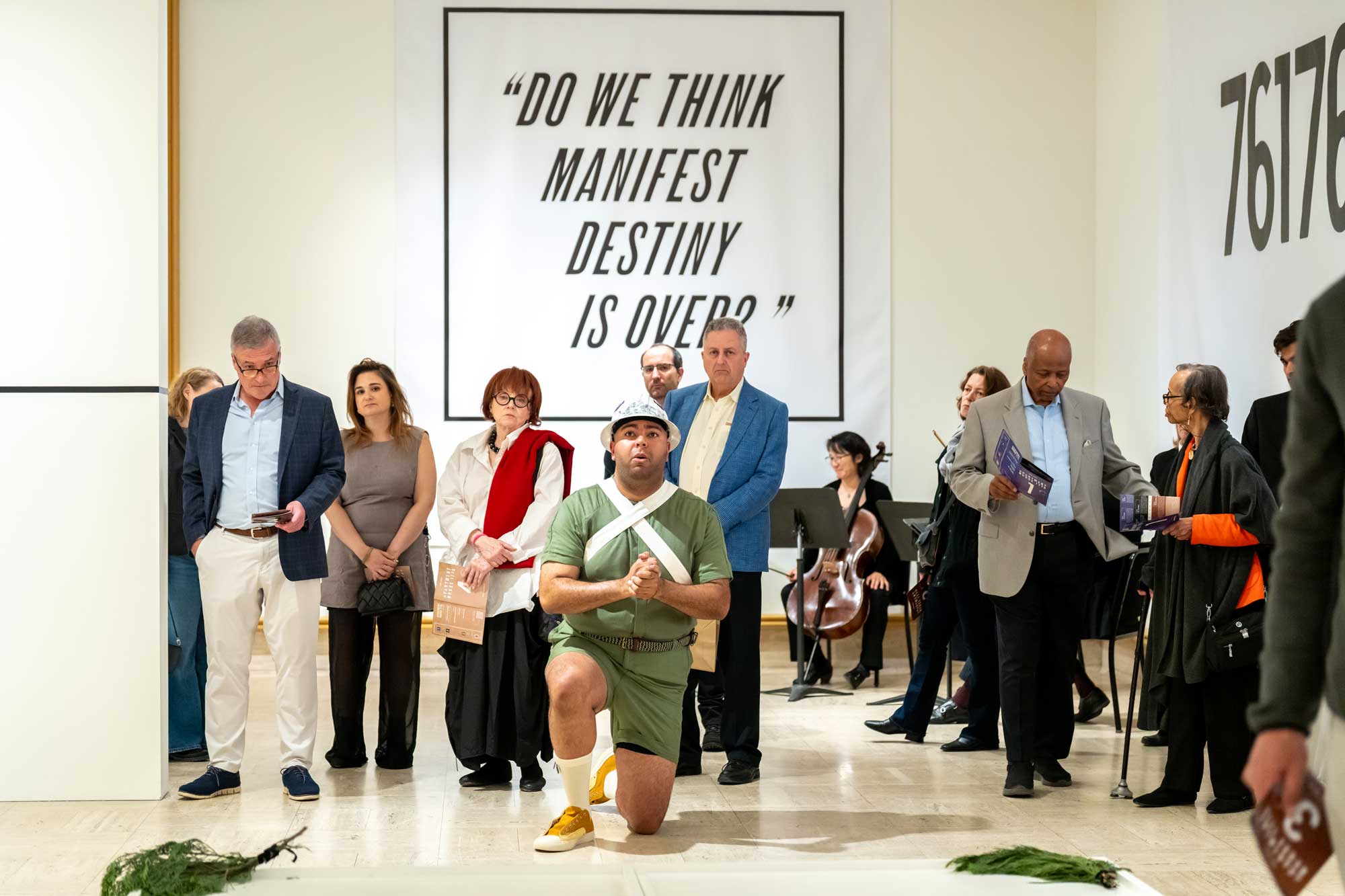
Are you willing to find the beautiful moments of harmony and connection, or will it overwhelm you to the point that you tune everything out that isn’t your own voice? The walls of Cranbrook seem to bend and melt from the frenzied vibrations, confronting us with what it means to be an American. My heart sinks at one sentiment written on the wall, a response given by one of the performers to the question, “What does 1776 mean to you?” It reads, “Do you think Manifest Destiny is over?”
Published in conjunction with Detroit Metro Times.


