
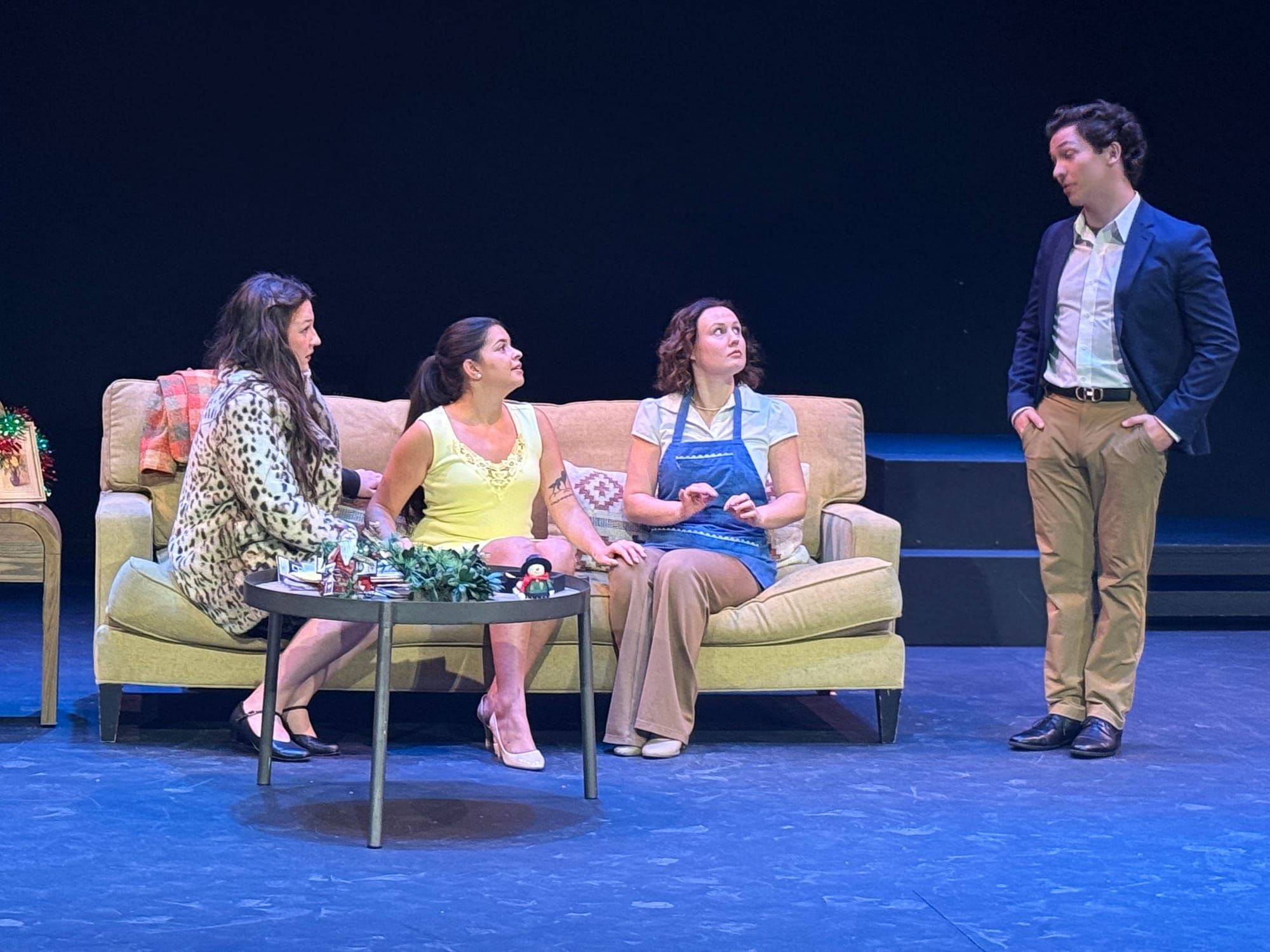
El Jay Productions and the Edison Foundation: "Ahead of Their Time"
Tulsa Performing Arts Center, Liddy Doenges Theatre
September 10, 2026
It felt like a true homecoming last Thursday evening at the Tulsa Performing Arts Center. As the lights dimmed to start the first performance of the regional premiere of Ahead of Their Time, a near-capacity, electric crowd chatted, hugged, and waved at each other from across the house of the Liddy Doenges Theatre.
And it was, in fact, a homecoming. Playwright, director, and Edison High School graduate Jameson White brought her original play to her hometown after two stagings in New York: one at Molloy University, where she earned her BFA in 2025, another at the New York Theatre Festival. A Tulsa production makes sense, as this is a deeply personal story for White, one that, per her director’s note, “has existed within me since I was born.”
Beginning in 1893 on a boat to Ellis Island and spanning more than 100 years to Tulsa in 2022, the play chronicles a collection of family stories that span four generations of women on White’s mother’s side: Italian immigrant Rose, her daughter-in-law Eleanor Jane (or EJ), EJ’s daughter Rosa Jane, and Rosa Jane’s daughter Diane, who is the playwright’s mother. In a tight script with no time to waste, a series of vignettes shows key moments in these women’s lives as they navigate family, work, and love.
Indeed, White’s family history practically writes the story itself. We meet an immigrant who has to choose between a stable green card marriage and the sudden, impractical blossom of love with a fellow Italian; a widow who has to make some smart business decisions and an unfortunate relationship decision to provide for her daughter in the 1940s; an artist who drops out of college to follow her college sweetheart to Japan; a budding young journalist trying to listen to her heart while grieving a tragic loss.
A polished ensemble of actors, some joining local talent from the play’s New York engagements, confidently brought this 90-minute story to life. L’aria Krautter brought the energy and showed great duality as EJ’s firecracker sister-in-law Josephine and the standoffish receptionist. Drew Sears was deeply believable as 1950s fraternity boy Charley, Rosa Jane’s eventual first husband; his performance grounded me in the time period throughout the show. Katie Blackwell and Scott Bratton had a lively, humorous rapport as brother-sister duo Diane and Jimmy.
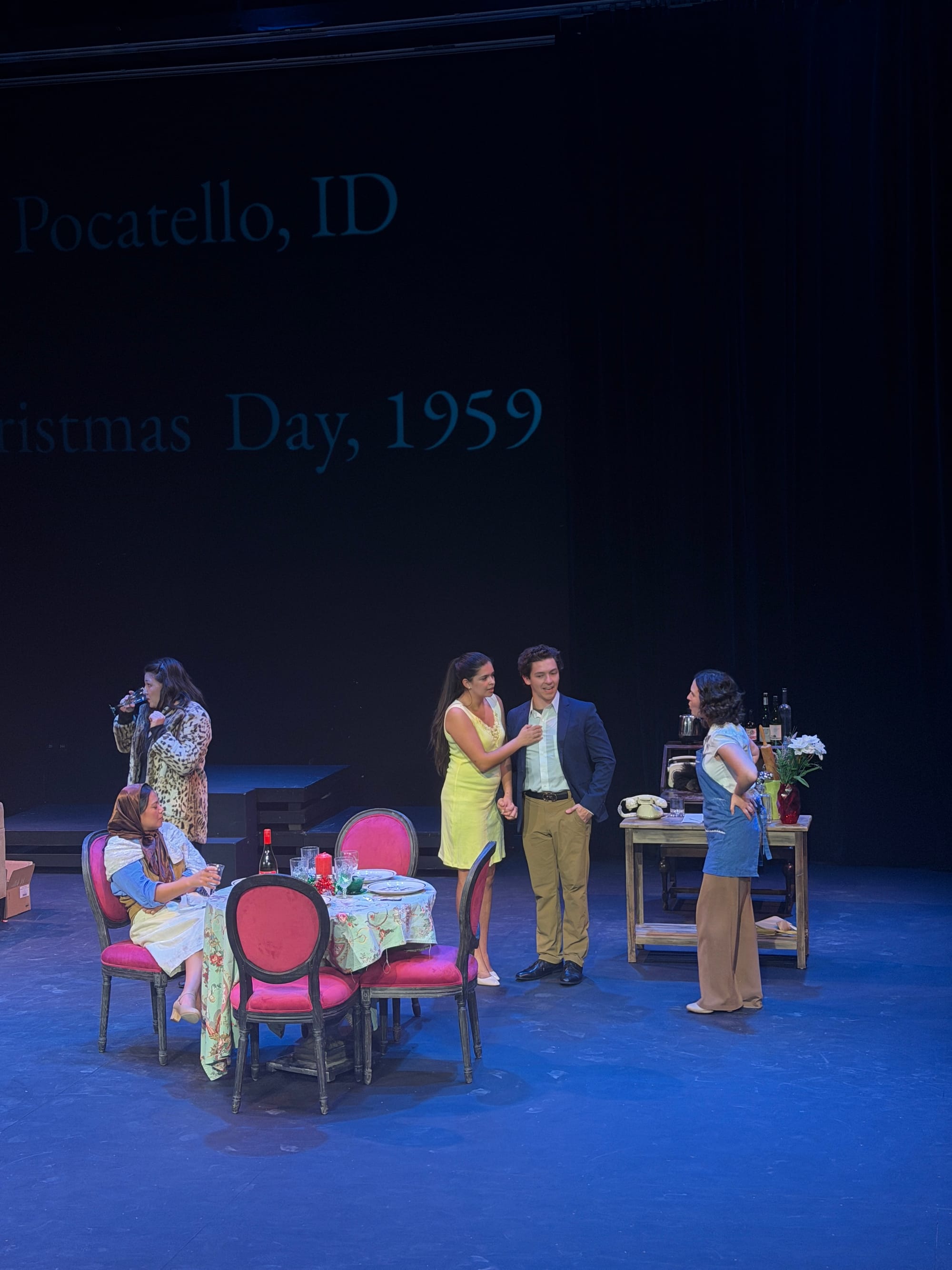
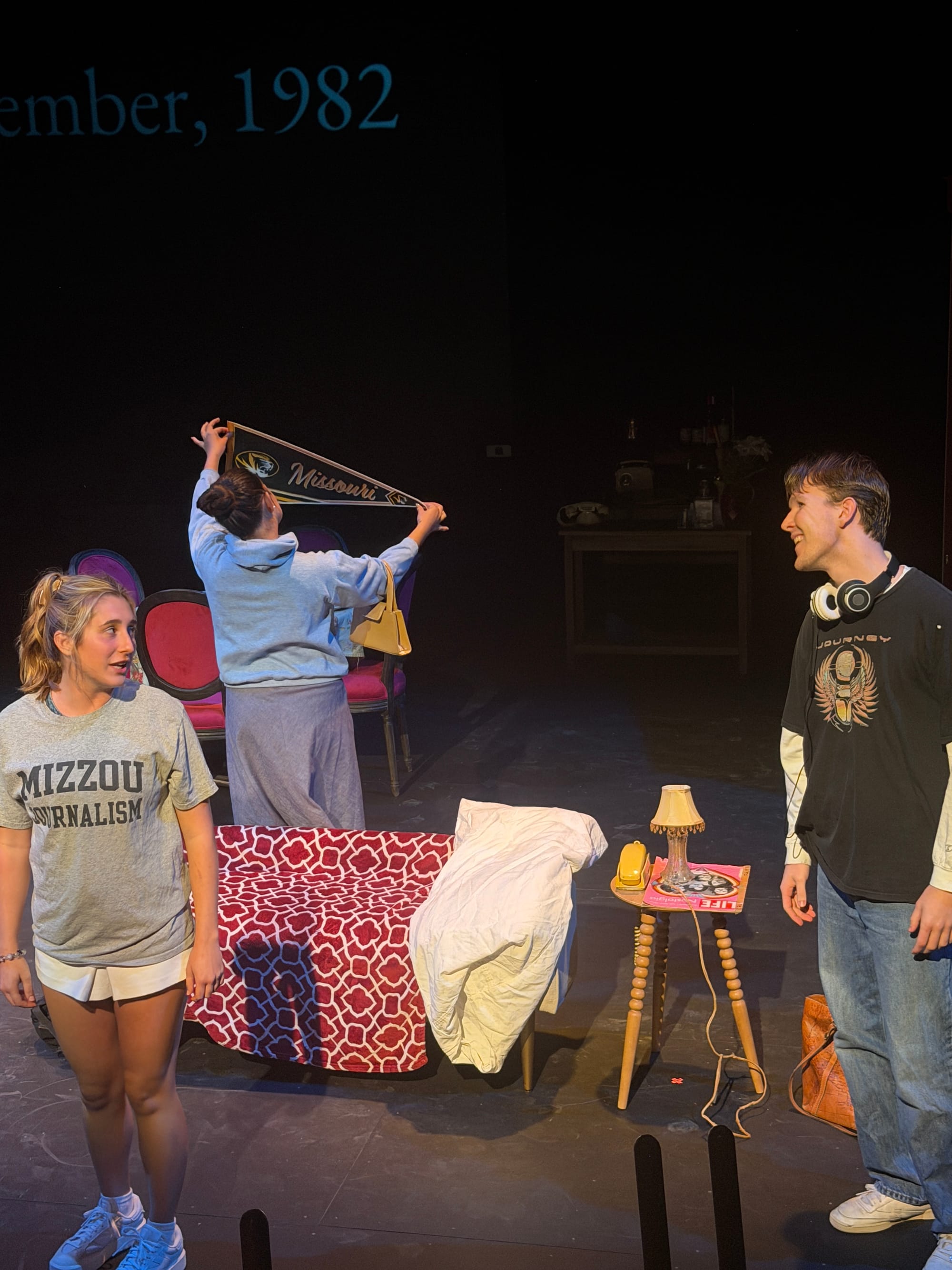
L: Rosa Jane (Mikaela Bonilla) and Charley (Drew Sears) tell EJ (Jenna Davis) and that they are moving to Japan. R: Rosa Jane (Mikaela Bonilla) and Jimmy (Scott Bratton) move Diane (Katie Blackwell) into her college dorm room | photos courtesy of Jameson White
Some of these actors had the additional task of playing characters at a vast variety of ages. Giovanni Antonio incorporated a great physicality shift from teenage to elder Dale, Rosa Jane’s high school boyfriend, whom she encounters at a reunion decades later. Mikaela Bonilla had the biggest lift as Rosa Jane, portraying her from age eight all the way through her 60s. Her purposeful alteration to her posture, walk, and voice throughout the play was subtle but effective in evoking aging without “playing old.”
White’s creative directing, paired with Nina Sadowski Smith’s stage managing and Mallory Lindsay’s lighting design, made great use of the space. Even though the story jumps around in time and location as the family grows and moves across the nation and the world, the set is largely static. While occasional beds and benches make brief appearances, home furniture staples serve as the backdrop in all locations, from a 1940s family home in Idaho to a sorority house in Ohio. But White utilizes this simplicity with intention, orchestrating movement and moments in specific spaces to create a sense of déjà vu as we watch history repeat itself, or almost repeat itself, showing just how uncanny the strength of familial bonds can be.
White’s deliberate placement of the actors when they are not actively in a scene adds to this ghostly (but no less cozy) sensibility. A single row of chairs flanks the set. When the play begins, the actors enter and take the seats on the left side of the stage. As the characters they played either passed away or left the family through circumstances like divorce, the actors move to the chairs on the right side of the stage, watching on lovingly, and sporadically rejoining the action to emphasize key emotional moments. And emphasize effectively, I might add: I could hear audible gasps and murmurs of worry as one scene built up to a violent confrontation and scattered sniffles during moments that concerned a rather tragic character death.
Specific blocking also plays a key role in the scene transitions. Because the story spans more than 100 years in only 90 minutes, White uses the set changes to fill the gaps between time jumps with pertinent information. With period-appropriate music warming the stage, the audience sees families grow, elders die, relationships sever, and love blossom. The execution on opening night was seamless; in a tight show, these moments did as much to tell this story as the spoken ones did.

Packing so much history into so little time has a few drawbacks. The script brings the audience in and out of these women’s lives at key moments; we get just enough to establish characters, but not enough to let us get to know them very far beyond their utility within a scene, which creates a lack of the intimacy you’d expect in a family play. While establishing characters at all in such a brief space is a testament to White’s writing construction and her ability to craft interesting personalities, I wanted to settle in with these characters and their relationships more.
Additionally, the bite-size nature of the vignettes meant conflict resolved quickly, typically within the scene itself or the next. Whether characters were advocating for an executive position in the 1940s or shooing a husband to the curb for abominable behavior, arguments and tense situations always ended quickly and neatly before things got too messy. While appropriately employed via a “fade to black” just before a sexual assault, this approach cut the tension during other big moments. The way the women succeeded in the play was enjoyable to watch but didn’t necessarily feel realistic given the context of the story and the time periods, so the presented resolutions didn’t give the sense of satisfaction that comes with being well-earned.
Reflecting on this show, I couldn’t help but think of my own grandmothers and the stories they’d tell at holiday dinners—how generations of separation turn a story that, on paper, could be in a Scorsese drama into a comedy of errors that has the whole table in stitches. This show had me ruminating on how our brains work with memories: how we create them, how we hold them, how we pass them on and see them unfold in our own lives.
Ahead of Their Time feels like a testament to the memories that persist when love truly remains at the forefront of our values. As Gio says on the boat to Ellis Island in the first scene of the play, “a life without love isn’t real, no?”


