
Precision Dreaming: Dalia Ramanauskas | Works Across Fifty Years
Creative Arts Workshop
Through Jan. 24
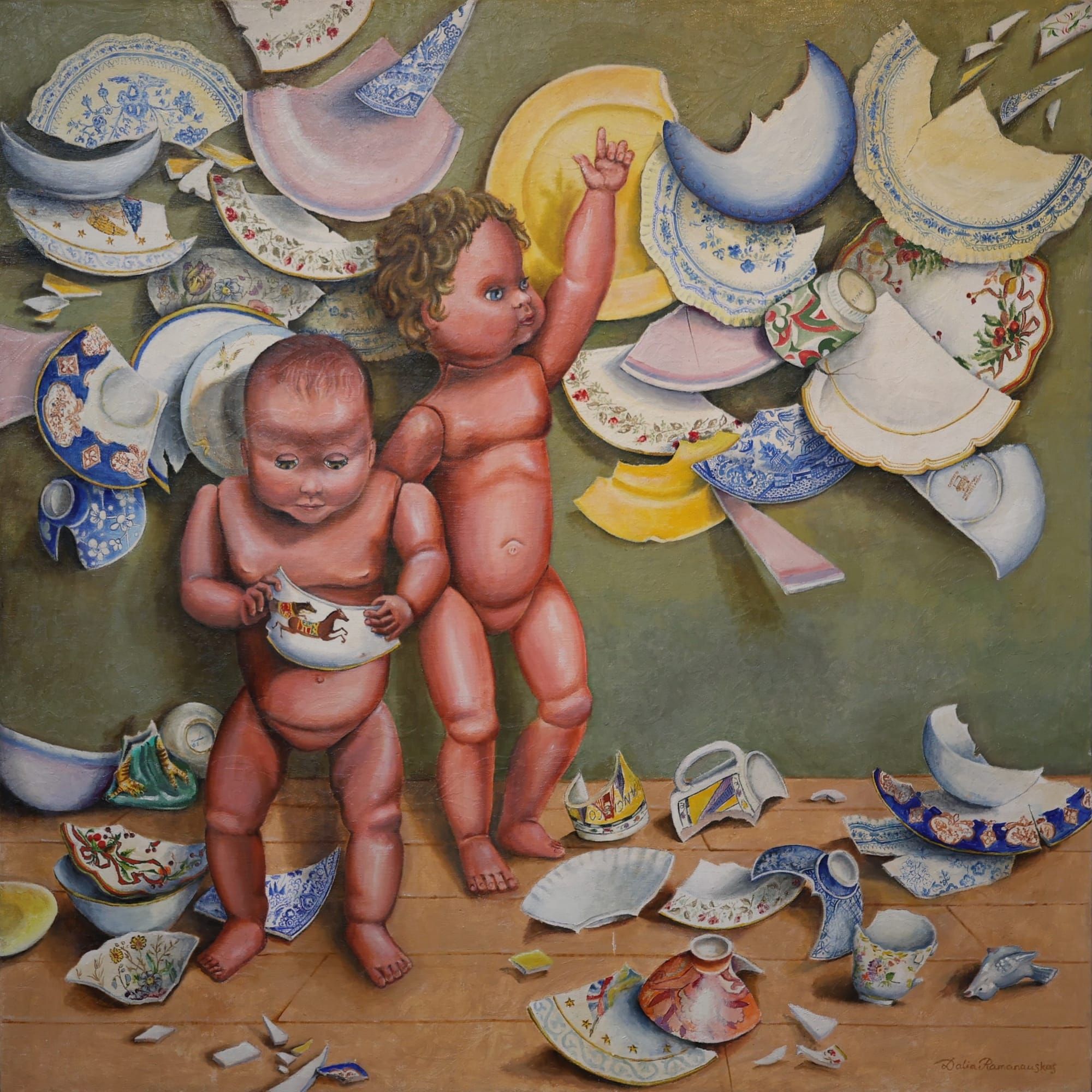
The image is surreal, perhaps equal parts funny and unsettling. Two baby dolls appear to have come to life, and are in the process of exploring a world of broken china, filled with jagged edges. Paradoxically, it's hard not to feel that the dolls are at risk. Even if they're dolls, aren't they still babies? It gets weirder: the longer you look, the less sense the image makes. One surface in the image is the floor, the other one a wall. How are the pieces of broken china staying stuck to the wall? It should all come crashing down, but it doesn't. The dolls are in such danger of being hurt, but they're not. Everything is fine. Isn't it?
Some Might Be China is one of numerous captivating images in "Precision Dreaming: Dalia Ramanauskas | Works Across Fifty Years," curated by Eric Litke and running now at the gallery at Creative Arts Workshop through Jan. 24. Even if you didn't know that Ramanauskas has had a successful career as an artist, with works in multiple museum collections across the country and a string of commentary written about them in leading art publications, you would know from the work itself. On their faces, the pieces evince a truly riotous imagination; What sets Ramanauskas apart from other deeply imaginative artists is that her unbridled images are married to considerable technical skill — which makes the images hit that much harder.
Born in Kaunas, Lithuania, in 1936, "Ramanauskas immigrated to the United States with her family in 1949, arriving in New Haven five years after being forced to flee Lithuania and move through a series of resettlement camps and temporary shelters. After completing high school and college locally, she eventually settled in Ivoryton in 1966 with her husband, sculptor Leo V. Jensen (1926-2019)," an accompanying note relates. "In 1961, Ramanauskas left her teaching career to pursue life as a full-time artist — a decision that led to national recognition for her meticulously rendered pen-and-ink drawings rooted in still-life observation. Her work was exhibited widely in New York and across the country for more than four decades and is held in major museum collections, including the Yale University Art Gallery, which has generously lent works for this exhibition."
The show also "highlights a period of spirited renewal in the early 2000s, when Ramanauskas — then in her mid-sixties — embraced oil painting with the same exacting detail and sense of wonder that define her earlier works. This body of work reveals an artist who continued to evolve creatively, even after decades of success."
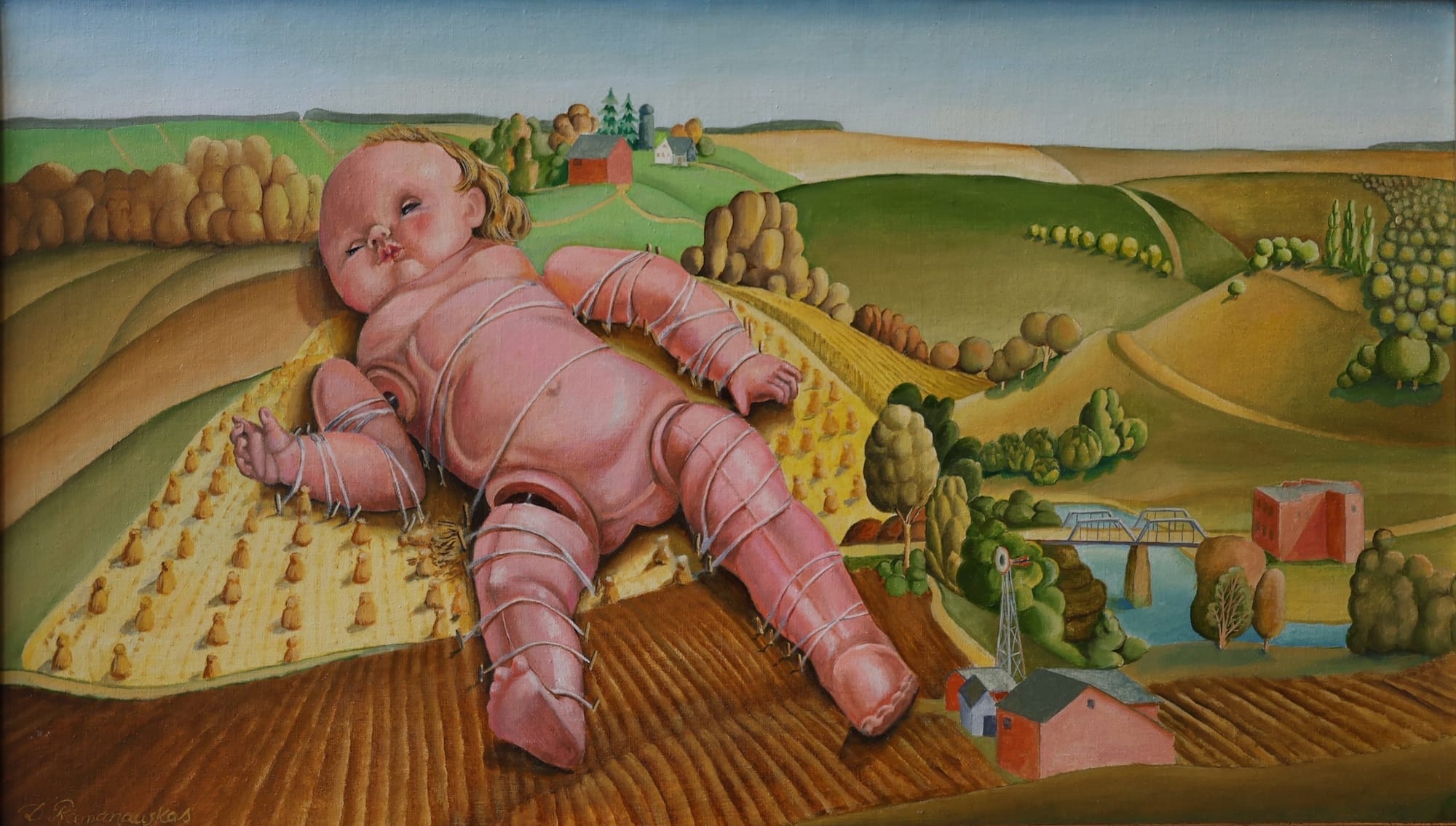
This spirited renewal, if the show is any indication, involves a fixation on dolls that Ramanauskas justifies through the sheer number of scenarios she dreams up for them. There are dolls piled against the wall in a way that is eerily reminiscent of firing squad victims. Another giant dolls is discovered lumbering around a construction site at night. Still another sits in front of a mirror, cradling a doll skull, as if in contemplation of its toy mortality. And then there is the doll tied Gulliver-style down to an otherwise bucolic landscape, the scale of the image so vast that the fleeing farmers might be invisible to the eye.
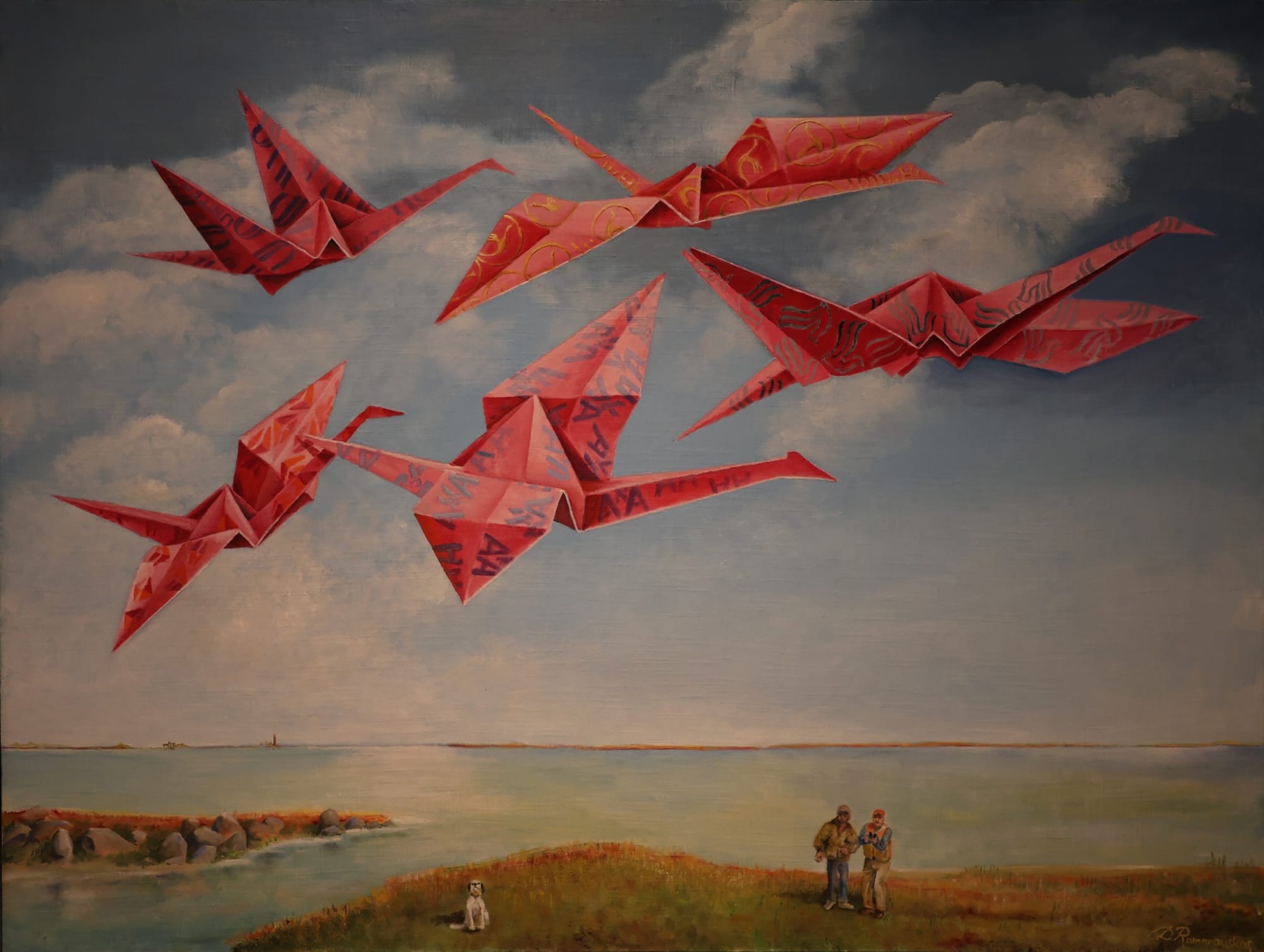
As one might expect from the above, Ramanauskas has many muses, whether it's a flock of origami cranes flying over a seascape, another paper crane in flames, falling through the sky, or an old man fighting a small dragon in his garden with gardening tools while younger people — presumably his family, there for a picnic perhaps — stand idly by and watch. In every case, the subjects are rendered in the same mostly realistic, matter of fact style, somewhere in the realm of portraiture or an accomplished children's book, and all to the effect of lodging many of the images in the memory, not soon to be forgotten.
The second floor of the gallery, meanwhile, devotes itself to Ramanauskas's pen and ink works. In them, she displays the same technical achieve, put to somewhat different ends. She centers often on still lifes of objects that others might consider trash: cardboard boxes, bottles, egg cartons. She lavishes attention on each of the boxes individually, but also often arranges them into larger shapes suggestive of, say, buildings in craggy landscapes. Sometimes she takes it a step further and populates these drawings with people, to make sure that the visual holds.
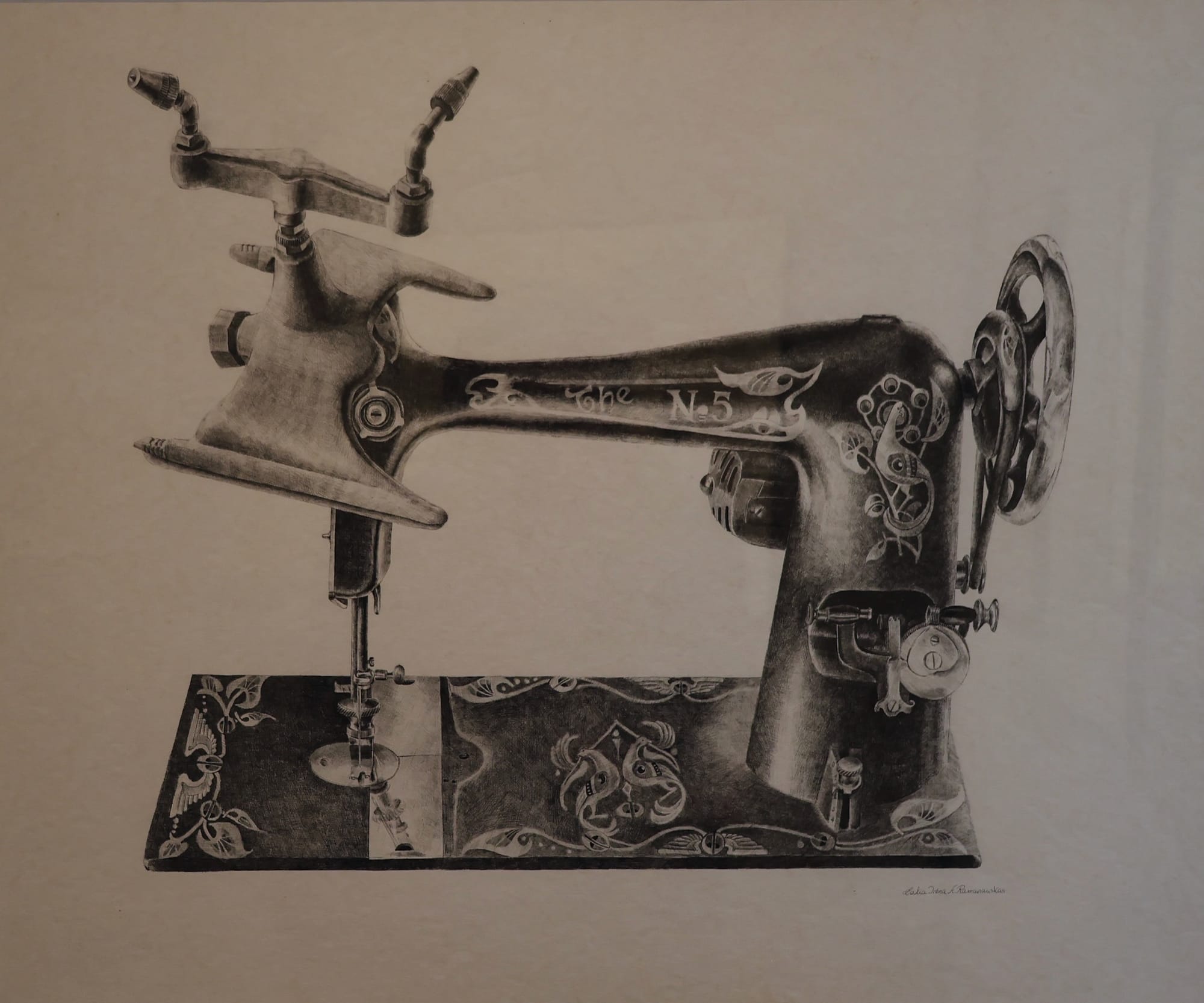
But in the end, the visuals that stuck with this viewer the most were those in which Ramanauskas took inanimate objects and made them resemble living creatures. Under her hand, a sewing machine is rendered bovine, and this one looks perhaps a little smarter than the average cow. It's inquisitive, curious. Somehow, as you look at it, you get the sense that it's returning your gaze. It's a good question which one of you figures out the other first.


