
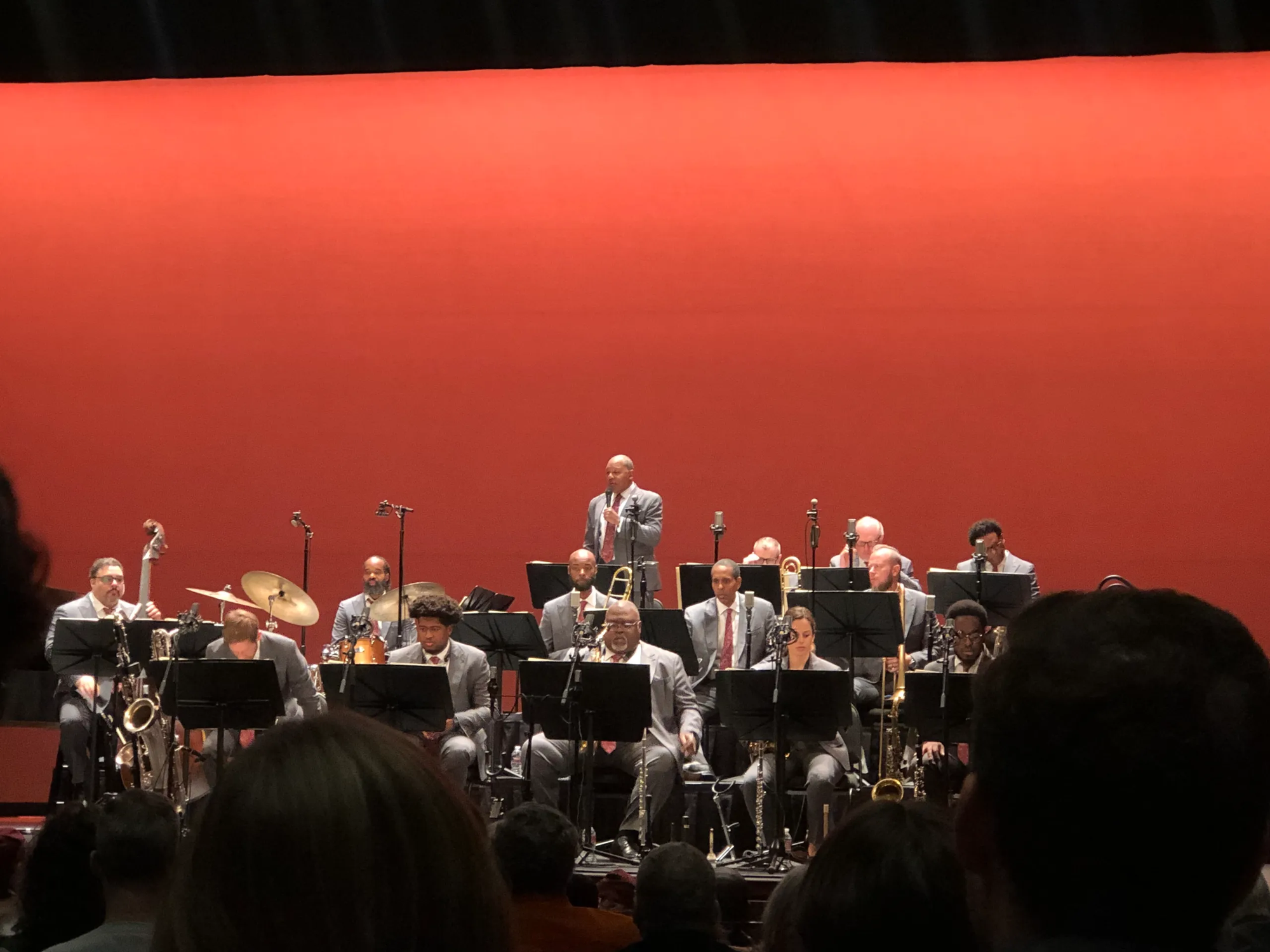
You might have missed it, but in 2019, Oklahoma State University built one of the most beautiful performing arts centers in the state. The McKnight Center for the Performing Arts, built on University Avenue on the sprawling OSU campus, contains a 1100-seat auditorium, and lately, they’ve been bringing in heavy hitters like Esperanza Spalding, The New York Philharmonic, and The Seoul Philharmonic. Last Sunday afternoon, trumpeter and bandleader Wynton Marsalis, with the Jazz at Lincoln Center Orchestra, played a two-hour concert at the McKnight Center that made a moving case for global and multi-generational music-making.
Led by Marsalis, the Orchestra, a 15-person group of some of the finest jazz players in the country, took us on a tour of traditional jazz with tunes old and new, from sources both American and international. Marsalis himself grew up the son of a prominent New Orleans pianist and music educator; he was playing his first gigs at age six. He went from there to Juilliard, and launched his career as a sideman with Art Blakey & The Jazz Messengers. Marsalis was key in the creation of the Lincoln Center’s jazz program in the 1980s; the Orchestra has since performed around the world, last visiting Oklahoma in 2021 during the centennial commemoration of the Tulsa Race Massacre.
Marsalis was a congenial bandleader, talking to the crowd from the back of the bandstand where his trumpet section sat, grabbing the mic between songs to tell stories of the Orchestra’s selections, such as the last movement of the 12-part “Vitoria Suite,” a speedy, Basque-inspired piece called “Menditzorrotza Swing” featuring himself on trumpet. While the job of jazz is surely commonplace to someone who’s been doing it professionally for 40 years, Marsalis still hopped up and down on his chair as he trilled out a frenetic and melodically dense bebop solo, his excitement palpable.
His musicians were equally skilled. Saxophonist Chris Lewis took on hosting duties for the second half of the show, which had a surprising sports theme: songs about volleyball, basketball, and track and field were featured. Especially interesting was “Tamakhóčhe Theȟíla,” a song dedicated to the Oglala track star Billy Mills, composed by trumpeter Kenny Rampton, which featured a dynamic solo back-and-forth between Rampton and saxophonist Abdias Armenteros that mimicked the breathless pace of a track run. Drummer Obed Calvaire made the crowd gasp with his solo on the Marsalis tune “Timelessness,” disconnecting from the meter with a series of tight, rudiment-heavy sequences while keeping the time with his hi-hat foot: no easy feat, especially considering the complexity of the sequences he was playing. Pianist Dan Nimmer’s solo on “uNembeza,” a tune by South African Nduduzo Makhathini, was a masterclass on infusing soaring Vaughn Williams-style melodies with jazzy curiosity.
Much of the show functioned as a passing of the torch from Marsalis to the younger generation, who certainly proved themselves capable of holding up jazz’s legacy with or without him. I was reminded of Marsalis’s old collaborator Herbie Hancock, who used a similar tactic during his Tulsa PAC show last year, allowing his bandmates to take center stage multiple times during the show—though Hancock took far more time for himself than Marsalis, who seems more interested in education than glory. Still, I was happy to hear the little of Marsalis’ solo trumpet that I did.
Ultimately, this was a show more about Jazz with a capital J than it was about Marsalis himself. Jazz, after all, is a sort of euphoric dictation from God; why not let others have a chance to hear the voice? The massive talent on display at this weekend’s concert was a gift to the audience, who had the chance to hear one of the giants of jazz and his 14 accomplices spend two hours going through new and old material. Like most music, it was more about the journey than the destination.


