
Celebrity Attractions: Hadestown
Tulsa Performing Arts Center
January 13, 2026
I saw Hadestown on Broadway a few years ago, during a personal trial of gargantuan proportions, and it lifted me up in the way live musical theatre does so well: by giving us a dry run for our own emotions, letting us share joy and heartbreak in a safe space. The line “It’s a sad song, but we sing it anyway” changed my perspective, and I came out whole on the other side.
That hasn’t just been my experience. The popularity of Hadestown since it premiered off-Broadway in 2016, not to mention the success of its cast album, shows its potency across a huge spectrum. The Broadway touring company brought the musical here for nearly a week of performances in 2022, and the Tony Award-winning show came to vivid life again last week in a two-night-only run at the TPAC’s Chapman Hall.
Most of the audience consisted of bubbly, effervescent young people, in a colorful range of styles from goth to harajuku to formal, with lots of neon hair and lace. I felt both over- and under-dressed. Unlike at classical music concerts, where my partner and I tend to be the youngsters, we were some of the more senior audience members on this night. From the conversations I overheard, many people in the crowd were already well-acquainted with the show, quoting lines and telling anecdotes about their participation in past performances. We were among true devotees.
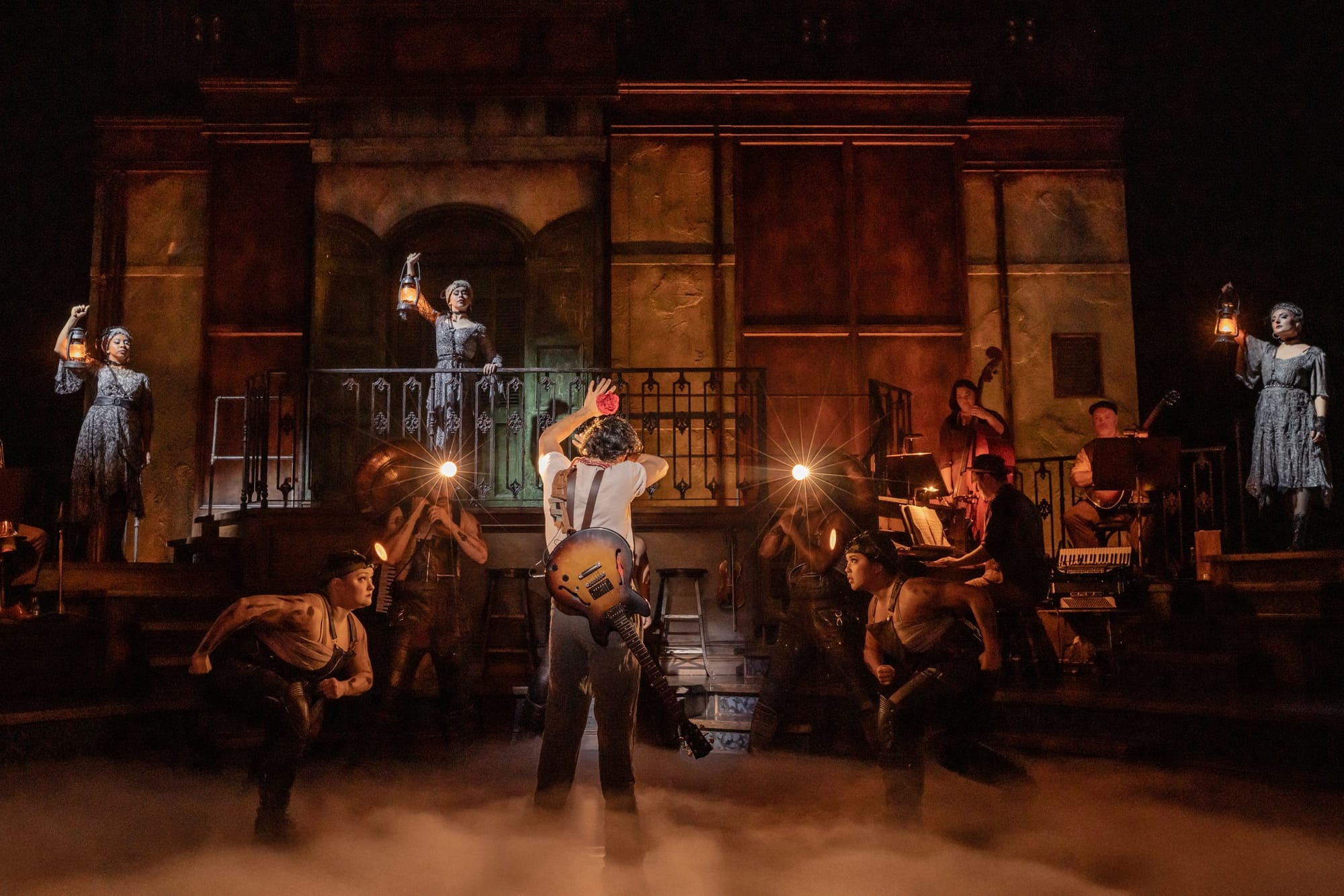
Hadestown tells the story of Orpheus and Eurydice, lovers trying to make it with all elements—from the whims of the gods to the grind of daily living—stacked against them. The musical is set in a 1920s apocalyptic scenario, with an on-stage jazzy band instead of a pit orchestra, which lets the instrumentalists participate in the action, leaving their seats to play solos or add to the drama. The set, lighting, instrumentalists, and costumes were exactly as I remembered them on Broadway, although the touring company does not use a rotating stage like the Broadway production does. Thanks to the rest of the scenery and the fluid movements of the actors, I never felt the lack. The whole production was funny and sad and tragic and energetic; the audience zeroed in with rapt attention, hoping for a happy ending even though we knew there wasn’t one.
Some of the soloists weren’t quite as virtuosic as their Broadway counterparts, which made the second half of the show drag a little, since it has longer, slower songs than the first half. No complaints about this production’s Hades (Nickolaus Colón): a seductive bass, confident in his rich-guy ability to get whatever he wants to run his underworld factory, he was everything I want from that role. I would have gone to hell with him, too, frankly. And as Eurydice, a homeless teenager struggling in the system, Megan Colton held my attention when she belted out her numbers.
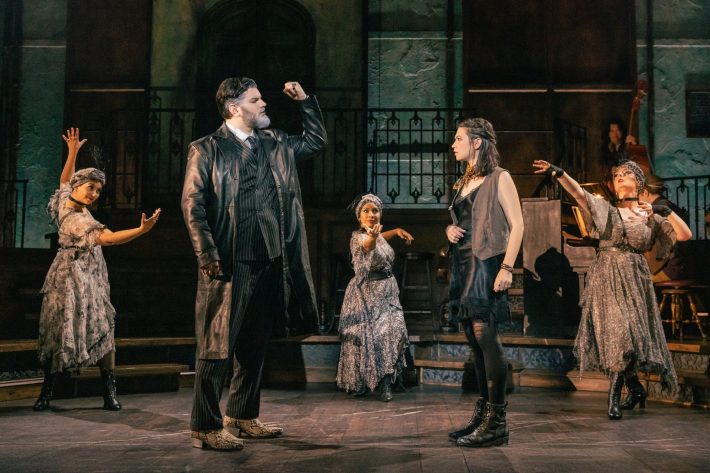
However, as Hades’ wife Persephone, Namisa Mdlalose Bizana had a thin vocal quality that didn’t carry too well. For a character who’s both Queen of the Underworld and Goddess of Spring—going back and forth between the underworld and ours and coping by drinking and meddling in the affairs of humans—I wanted a more abundant sound. Orpheus (Bryan Munar) was the biggest drawback for me. His part employs a lot of falsetto, a vocal range that should be high enough to cut through the rest of the group; his voice here sounded more heavily miked than the others and rendered his performance weak. I wanted to yell at Eurydice, “He brings nothing to your table! Keep looking!”
My favorite performances came from the Fates, three sassy women who manipulate humans in tight harmony. The chorus of five singer/dancers stunned me with their loosey-goosey dance moves and impeccable vocals. The secret star of the show? The trombonist. The orchestration in Hadestown is already more trombone-forward than most musicals, but on top of that, here the trombone is almost one of the actors, leaving the shadows to play and dance with the other performers. This isn’t your father’s trombone—it’s a gritty, sometimes nasty, sliding, raunchy horn situation. Played in the touring company by Emily Fredrickson, it made me feel off-balance, like when a character unexpectedly breaks the fourth wall, and increased the feeling of nothing-is-as-we-thought in this apocalyptic hellscape.
There’s nothing like seeing a Broadway show on Broadway, but this was a pretty spectacular second best. Watching performers reach deep and pull out that high note, or gather their bodies and explode into a dance move, or reappear in a different costume in seconds—all of that live theatre magic was on display here, showing us something beautiful about what humans can create, even when, as with Orpheus and Eurydice, the prevailing narrative is set against us. It gave me hope, as things go from bad to worse in our world each day, to see 2,000 Tulsans dress up and buy tickets to hear somebody sing:
And if no one takes too much, there will always be enough
[We raise our cups] to the world we dream about, and the one we live in now


