
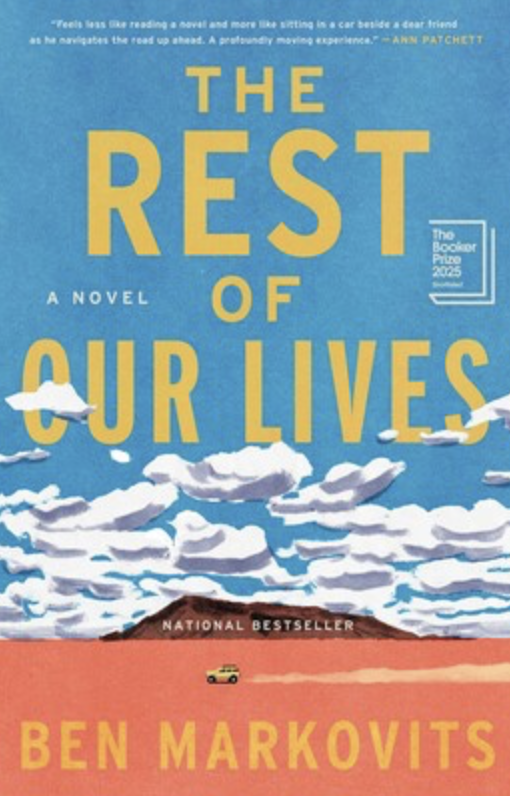
"The Rest of Our Lives"
By Ben Markovitz
Summit Books/Simon & Schuster
I’m not generally a woo-woo person, but sometimes, when I find a book that speaks to the exact life moment I’m in (or fast approaching), I wonder about things like fate and chance and coincidence.
Then again, one reason I plucked Ben Markovits’ latest novel “The Rest of Our Lives” from the shelves – besides critical acclaim and being shortlisted for the 2025 Booker Prize – is that it’s about a parent who’s pushing against the upper limit of middle age when he drops his youngest child off at college and takes a literal journey to his past, by way of a westward solo road trip. (My oldest daughter leaves for college this fall.)
And because I’m a sucker for a sharply wry narrative voice, Markovits won me over on "Rest"'s first page, when the main character (Tom) describes a man who’d had a brief affair with his wife (Amy) 12 years earlier: “On Sundays, he played guitar for the kids at Temple Beth and taught them Jewish songs, like ‘Spin Spin Sevivon’ – very pro-Israel, in a tree-planting, happy-clappy way. He was the kind of guy who danced with all the old ladies and little pigtailed girls at a bar mitzvah, so he could also put his arm around the pretty mothers and no one would complain. Even before I saw (him and my wife) holding hands, I didn’t like him.”
Tom and Amy’s marriage survived this affair but feels precarious. Amy’s guilt has long translated into anger toward Tom, and Tom, to see his job as parent through, has told himself that when Miriam (the youngest of the couple’s two children) leaves home for college, he can finally leave, too.
For while we may marry a person seeing mainly their potential, Markovitz writes, years of data collection result in certainty replacing mystery. Tom says, “If you continue to have illusions, that’s your fault. … It’s like being a Knicks fan. … What we obviously had, even when things smoothed over, was a C-minus marriage, which makes it pretty hard to score much higher than a B overall on the rest of your life.”
The Knicks allusion points to basketball’s supporting role in the novel. Tom played in college – mostly garbage time – and one of his road trip stops involves seeing an old friend and teammate, Brian, who’s just been fired from the Denver Nuggets organization.
Ostensibly, Brian provides a reason for Tom’s journey: Brian has asked Tom, an on-leave law school professor (who teaches a class on hate crimes), to talk to a player who wants to bring a class action lawsuit against the Nuggets for “systematic discrimination against white players.” Additionally, Tom occasionally trots out an old idea he once had about writing a book focused on playing pick-up basketball with strangers across the country.
So while going to a park to play with Brian, Tom notes, “I walked around taking pictures on my phone, and feeling like a fraud.”
But throughout Tom’s trip – including visits to a friend from grad school; his divorced baby brother; former teammate Brian; an old girlfriend; and finally, in California, his grown son Michael – signs of a serious medical problem worsen. His face is swollen and his eyes water each morning; he runs short of breath, feels pressure on his face, and eventually, he blacks out. Though his doctor had run tests and found nothing when the symptoms began, suggesting it might be long Covid, Markovitz provides one subtle hint of where Tom's journey will end while he snaps photos with Brian at the park: “So there’s a picture of me against the hoop at Lawson Park, standing next to Brian and Wayman. Brian has his arm around me; I’m trying to palm the basketball. Sometimes, sitting in the hospital chair, I think about that afternoon, and tell myself, maybe again.”
This is a bit of blink-and-you’ll-miss-it foreshadowing, and while you could argue that it’s a spoiler, I’d push back on defense.
For if there’s one thing this insightful, funny, and moving short novel demonstrates, it’s that the journey (and the people we choose to accompany us on it) will always be more important than the destination.


