
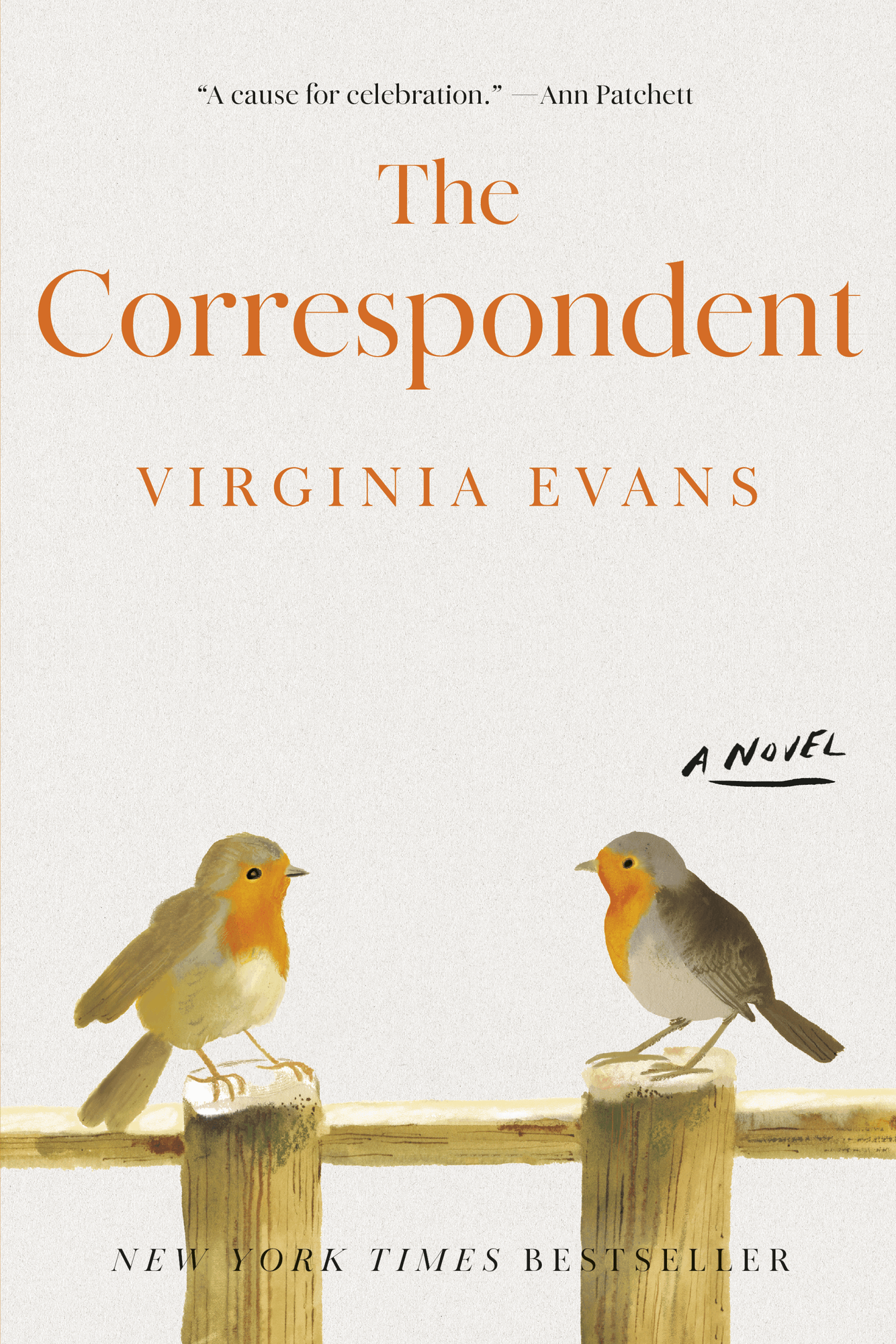
The Correspondent
by Virginia Evans
Crown Publishing Group
One of the most beloved sleeper novels of 2025, Virginia Evans’ “The Correspondent,” relays its story via letters and email messages, thereby embodying a literary paradox: The book’s a quick read (ideal for our short attention span era) and inspires nostalgia for life lived at a slower, postal-delivery pace.
This is, I would argue, one reason for the book’s runaway success. We live in a time when people want texts instead of phone calls, despite our collective, much-documented feelings of loneliness. As we get further removed from having face-to-face contact with people on a daily basis, letters and emails somehow feel both more comfortable – constructed thoughtfully and carefully when we’re alone – and more intimate, as we often veer into more personal, deeper territory while writing out our thoughts. (I'll not venture into the topic of AI and its negative impacts on human connection here, since Evans' novel also avoids it entirely.)
In “The Correspondent,” Sybil Van Antwerp, an elderly, prickly, divorced former attorney who lives alone in Maryland, makes a practice of writing letters – to authors (she’s a voracious reader), friends, relatives, academic gatekeepers, and sometimes, customer service representatives.
Like all of us, Sybil edits her stories and tone based on whom she’s addressing. For instance, though a car accident merits merely a postscript when writing her brother Felix (“It was nothing, really. I’m fine, but the Cadillac is in the shop. More of an inconvenience than anything else, honestly”), we read a far more candid account in her unsent letters to someone called “Colt”: “The vehicle is most likely irreparable, according to the mechanic. … I can’t remember (the accident) exactly, but what I think is that quite suddenly I couldn’t see. … I suppose it must be underway, Colt – the loss of vision. … I have known conceptually I would go blind, but as an eventuality.”
This concern is only one of many worries plaguing Sybil: She can't muster the will or courage to travel anywhere; her garden club seems to be going rogue under new leadership; a man she previously sparred with during her legal career, who lives in Texas, keeps asking to visit and take her out to dinner, at the same time a neighbor delivers fresh-cut roses from his yard on her birthday; she occasionally receives threatening, nasty notes from an unknown sender; her now re-married ex-husband in Belgium has been diagnosed with terminal cancer; she carries the grief of having lost a son at the young age of eight; she's submitted a DNA sample for genetic testing, though as an adoptee, she's both scared and ambivalent about what she might learn; a new English Department dean at the University of Maryland is suddenly denying Sybil permission to audit more literature courses; a former colleague's son, with whom she's corresponded for years, is struggling mightily in his adolescence; and Sybil's relationship with her grown daughter Fiona has gone from bad to worse, leaving Sybil's best friend (and Fiona's godmother) Rosalie caught in the middle.
So there's not a single dramatic question driving "The Correspondent." Instead, we follow Sybil as she reacts and responds to each challenge that arises, so that the arc of a long life's coda (rather than a conventional story) gradually takes shape.
Does "The Correspondent" succeed as a novel? Overall, yes. Though I think we, as contemporary readers, sometimes mistake "readability" for quality. Even as I compiled the list of worries plaguing Sybil above, I sensed that Evans had to put an awful lot on Sybil's plate to keep us engaged (and some storylines are weaker and less effective than others). "The Correspondent" mostly manages to marry the two. For when we pause to think about the many, many things we're all dealing with on a day-to-day basis (household and car repairs, doctor appointments, work deadlines, travel planning, paying bills), Sybil's wide range of interest and activity over the course of a few years feels pretty believable.
In the midst of it all, Sybil does change and grow, despite her long-held tendency to put up roadblocks. She faces the grief and pain she's spent decades shutting away, and even considers how her letter-writing habit has enabled this pattern. To her daughter, Fiona, she writes, after a combative phone call, "the other night you mentioned this, that you wondered if maybe I could only have meaningful relationships through letters, and I have been thinking about that. When I was young, by writing letters I found a framework that made living easier, and that has never changed. However, I do wonder if by conducting the most intimate relationships of my life in correspondence, I have kept, since I was a child, a distance between myself and others. I think it's true the letters have insulated me, have been a force field, just as practicing law insulated me from dealing with humanity directly, and I wouldn't change any of it, but I find myself, at this old age, wanting closeness."
So do we all – which is likely why "The Corresondent" has struck such a chord in recent months. It reminds us that sometimes, the main obstacle to our happiness involves resisting what's familiar and comfortable, and then getting out of our own way.


