
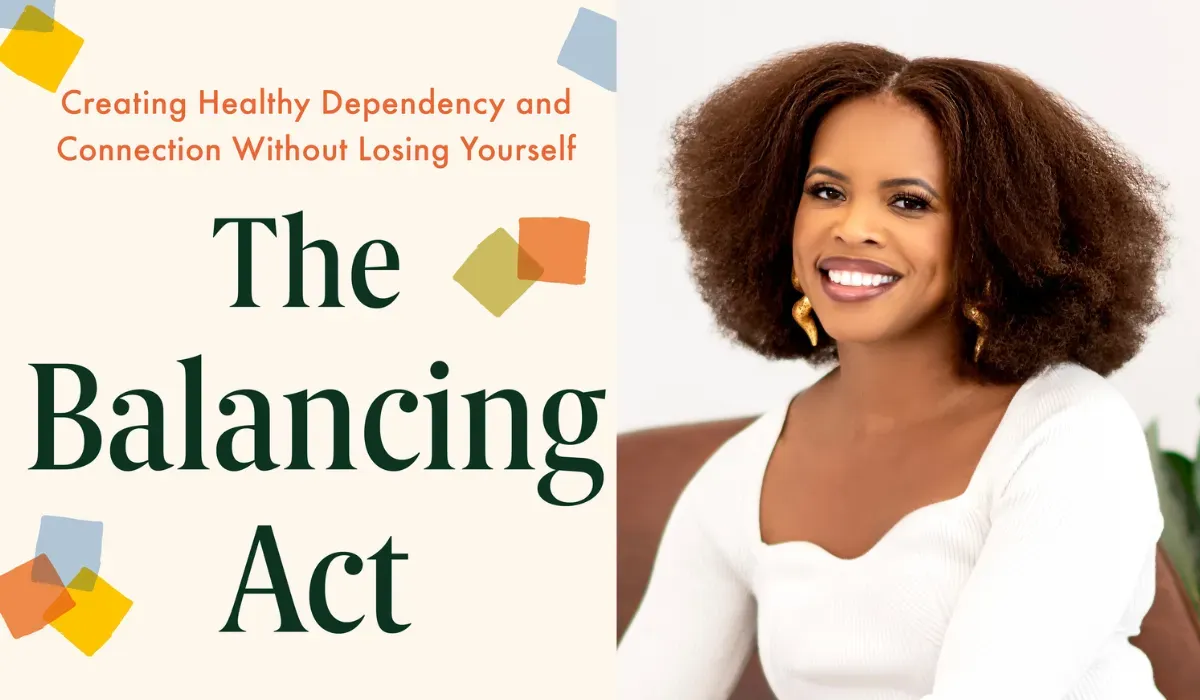
The Balancing Act: Creating Healthy Dependency and Connection Without Losing Yourself
By Nedra Glover Tawwab
Tarcher
Penguin Random House
Feb. 10, 2026
In 2021, givers of the world took a stand. Therapist and social media video creator Nedra Glover Tawwab had just published Set Boundaries, Find Peace: A Guide to Reclaiming Yourself. It rose to the top of bestseller lists as her readers learned how to do just that. They learned how to identify when they were stretched too thin, and how to say that fundamental word: No.
Two years later, Tawwab published Drama Free: A Guide to Managing Unhealthy Family Relationships, tightening her focus on the family.
Now Tawwab seems to be looking toward the other side of the path she’s made so much headway on. She’s refocusing on the value of relationships and interdependence. At the same time, she’s not saying “never mind” to all the boundary skills. She’s simply asking readers to strike a balance.
Her new book The Balancing Act: Creating Healthy Dependency and Connection Without Losing Yourself takes readers through the dangers of being too independent (even if that danger is as ordinary as living a harder life) and the psychological myths that might contribute to that state of mind. Tawwab tells harsh truths in her straightfoward, compassionate style and provides a multitude of examples for readers to ponder.
The first few words of the book’s subtitle, “Creating Healthy Dependency,” are a phrase that might have frightened readers, if not for Tawwab’s five-plus years establishing a standing as someone firmly committed to self-determination.
For those who just started establishing boundaries when Tawwab published Set Boundaries, Find Peace in 2021, the time may be ripe for a re-evaluation of what it means to depend on others. It’s actually all right to request help, it turns out. And it’s an art.
Is that person actually available?
Will you be all right if they say no, or have you waited so long your alternatives have grown thin?
Will they appreciate the chance to hold you in a vulnerable moment?
These are some of the thoughts Tawwab asks the reader to consider.
The Balancing Act hits all the likely themes in the therapeutic zeitgeist: attachment theory, codependency, even Internal Family Systems, or IFS (a therapy technique that came under controversy in October for allegations of inappropriate conduct at the IFS-based Castlewood Treatment Center, which prompted a response from the IFS Instituteemphasizing, among other details, that IFS founder Richard Schwartz and Castlewood director Mark Schwartz are not the same person).
Throughout it all, Tawwab keeps it relevant. Even people who’ve seen a thousand infographics on, say, enmeshment—a type of relationship with a high level of coordination and low tolerance for autonomy—might find something new in Tawwab’s take on these topics. She tells stories of how these patterns look in the world and offers concrete examples of how to address them.
I approached Tawwab’s chapter “The Hyper-Independent Person and Relationships” like a kid white-knuckling the big rollercoaster at the theme park. I knew it wouldn’t be the smoothest ride, but I was already buckled in for the ride.
Over the past several years, I slowly learned how to say no to others. I came to feel like a semi-pro, at least compared to before. Little did I know my comfort-with-No journey was only half complete. When I sidestep help from others and try to do everything in my own secret ways, part of that, I realize now, is because it’s hard to open myself up to a possible No.
Love yourself and know this, Tawwab writes at the end of the chapter. Then she breaks it down to three bullet points:
- Self-love is not a kind of armor for avoiding problematic situations with others.
- Compromise is necessary and is a valuable part of loving both yourself and others.
- You need love from others in addition to self-love.
Ouch.
Even while reading Tawwab’s words, I felt myself resisting. What about things that are just easier to do alone? What if there are things no one can properly hold you through? What if, with enough determination, you really can do it all?
Now, after some time has passed, I’m ready to admit the protests were a bit hasty. Acknowledge That You’ve Been Hurt and Try Again, Tawwab titles one of her sections. She writes that by calmly addressing situations of disappointment (rather than letting them pass), you can leave them in the past and not “carry that hurt into other dynamics.”
For people who aren’t used to asking for help, Tawwab offers a couple key pointers. First, she says, make sure your request is clear and direct, even if it feels obvious to you. Second, try to choose the “right person to do the right task.” Consider their skills, limitations, willingness, and previous actions.
I’m trying! In one month, after 11 years in New Haven, I’m moving to Gwangju, South Korea and will continue arts reporting there. At exactly the least convenient time, I’m producing a limited series zero-budget kids’ public access TV show here in New Haven that requires a multi-person crew to film. These days, I’m asking for things all the time.
Tawwab’s book has been helping me. I ask my friend who likes camera work to operate one of the camera angles. I ask another friend who works in audio to run sound. When someone on crew can’t make the shoot, that’s OK. I can ask someone else. And when someone offers a hand, even if I don’t know them well, I’m able to separate out what is the actual task they are proposing and how feasible that is. My comfort with No opens me up to the possibility of Yes.


