
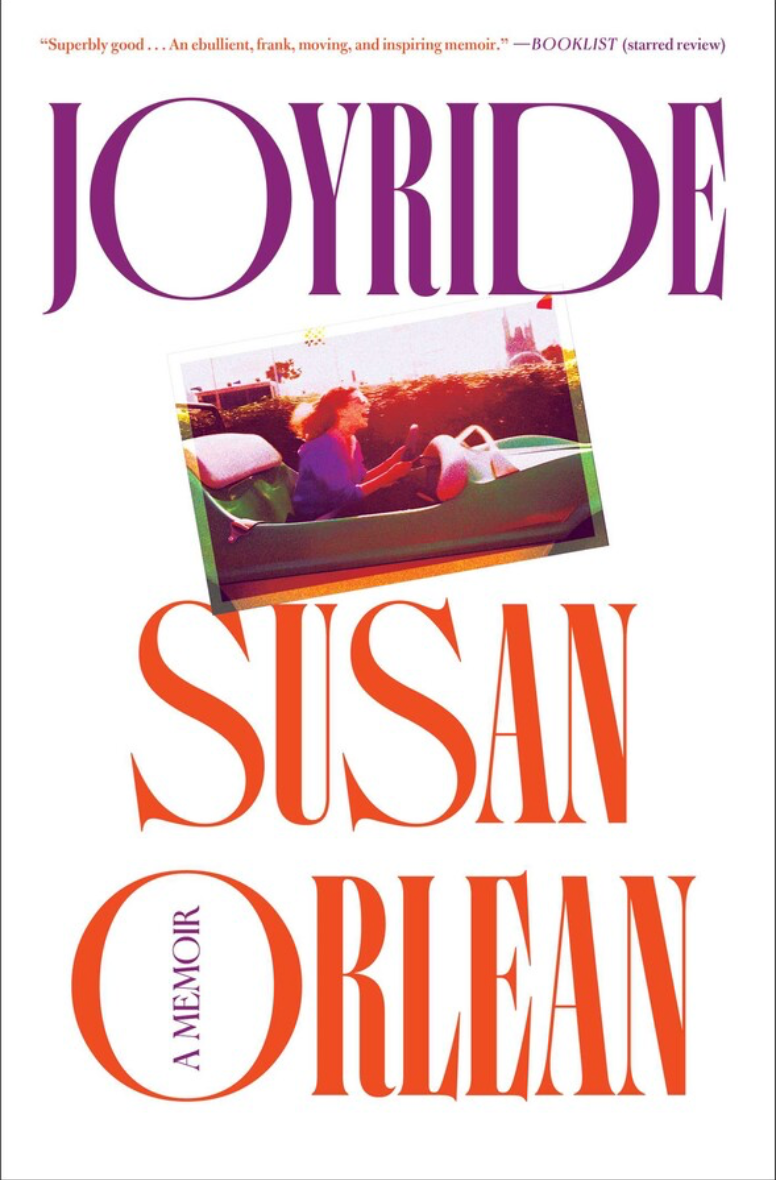
"Joyride"
by Susan Orlean
Avid Reader Press/Simon & Schuster
One question I’ve grown tired of writers being asked is, “What’s your daily routine?” Admittedly, the asker might be genuinely curious. But I get the sense, more often than not, that aspiring writers believe the answer to be part of the secret to “hitting it big.” Like, “Maybe if I assume the same writing habits, my work will flow and take off like never before!”
The further you get in this profession, though, the more jaundiced you become about its cultural romanticization. (Hint: there is no secret.) Still, I must admit that it is hard to beat hatching a story idea that’s so electrifying, it gives you goosebumps. Provided you can get an editor’s green light (a feat that grows more difficult each year), and thus get paid to do the research and interviews you’re suddenly itching to do, and piece the story together like an elegant puzzle – well, it’s pretty heady, addicting stuff, as Susan Orlean’s new memoir “Joyride” reminded me.
A longtime staff writer for The New Yorker, Orlean has published several acclaimed books (including “The Library Book,” “Rin Tin Tin,” and “The Orchid Thief”). But as she notes in her introduction, “Writing always feels new because you never build equity. Every sentence is a slippery invention, a bit of quicksilver I release to the world, and then it’s time to invent the next one. That’s why being a writer is never boring, but that’s also why it’s always a little terrifying, why every time I’ve sat down to write since 1978, I wonder if this is the time I simply won’t be able to do it and words will fail me.” (This was one of many moments I nodded while reading “Joyride” and thought, “Same, girl. Same.”)
You’d expect Orlean to start the book with an account of her childhood, She instead opts to begin in a pivotal moment of her career, when she’s begun writing for The New Yorker but doesn’t yet have a contract. In 1992, an editor at Esquire asks Orlean to profile Macauley Culkin as part of a series focused on milestone phases of men’s lives, but Orlean’s bored by the prospect and instead asks to profile a non-famous 10 year old boy. This is a risky move, but the editor agrees, and while the feature is difficult to research and execute – an adult woman shadowing a 10 year old boy as he attends school and plays with friends inevitably draws attention – Orlean writes, “This story was a defining moment for me. I had relied on my instincts, and it worked.”
From there, Orlean leads us back to her early life in Shaker Heights, Ohio, outside of Cleveland, where she falls in love with feature journalism via Life magazine. In one passage, she likens her urge to tell true stories about hidden or overlooked “regular” people to a Jewish tenet about each person being an entire world: “I always pictured it as … each of us contains an unimaginably rich world, a full universe of thoughts and knowledge and aspirations and reveries, of stories and memories and perceptions and emotions; that the sum of each person is an entire galaxy, unique and whole. If I had to point to one principle that has guided me, inspired me, and taught me how to be in the world as a writer, this would be it.”
Orlean attends the University of Michigan (woot!), then heads to Portland, Oregon, where she starts her writing career in earnest at a small, now-defunct magazine called Paper Rose, then an alternative paper called Willemette Week, where she primarily writes about music. She also pitches (and lands) a Village Voice feature about a dubious guru who’d recently set up camp in Oregon, and this led to more and greater opportunities for Orlean.
She’s also a young adult in this time, so the push and pull of an increasingly unhealthy first marriage – and questions of where to live next, and whether or not to have a child – have to be navigated with her partner as they both look to build their careers.
Orlean is candid about these struggles, and confesses to her own part in them. Plus, while her writing talent and curiosity and hustle went a long way in those early days, I appreciate that Orlean pointedly includes moments in “Joyride” when a story-in-progress seems destined to fall apart, or when an editor is less-than-fawning. For instance, in the ‘80s, when Orlean’s had bylines in Vogue and Rolling Stone, she reaches out to an editor at New York magazine: “Maybe I was getting cocky, but I simply assumed I would be welcomed there, too. Instead, I got a snippy note from him saying, ‘Dear Susan Orlean, I read through your clips, and though you handle the topics you write about well, I just don’t hear a distinctive voice yet.’ … I was outraged. … Who the hell did he think he was? I was smarting, furious, and, more privately, unnerved: Maybe he was right, and maybe I didn’t have a distinctive voice.” These moments of vulnerability, even as she’s growing more and more successful, ring absolutely true to the writing life.
Will non-writers be as drawn to and wholly satisfied by “Joyride” as I was? Hard to say – in part because Orleans’ life is so profoundly entwined with her writing career that it’s hard to imagine anyone other than her peers and admirers picking the book up. (“Joyride” chronicles the initial seed and the labor involved in each of her books; her second marriage and motherhood; the transformation of “The Orchid Thief” into a off-the-wall, fictional movie called “Adaptation”; and more.)
Plus, writers do their work in such isolation that books like “Joyride” feel like a balm; like someone sees you and articulates your experience with such exactitude that you feel both a sense of community and relief. As Orlean notes: “You need swagger to be a writer at all, to be convinced that readers should listen to you. You must believe passionately that you have something to say. … It’s a state of mind, a matter of willing yourself to trust yourself. I often picture this as walking along a narrow ledge and willing yourself to not look down: If you do, you’ll lose your nerve, and you’ll fall.”
Same, girl. Same.


