
Chamber Music Tulsa: Brooklyn Rider
WOMPA
January 30, 2026
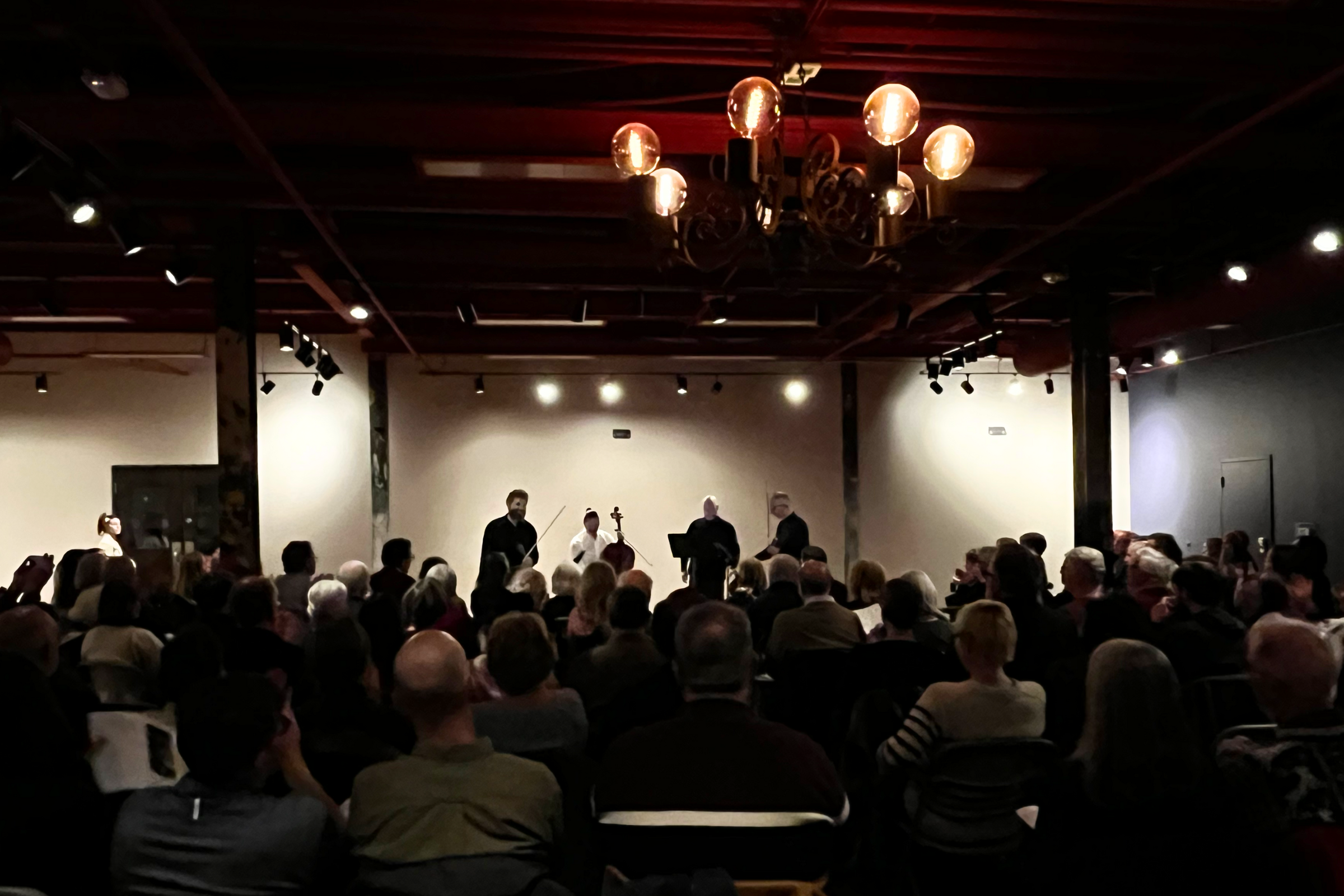
It would have been easy to experience Brooklyn Rider’s recent show at WOMPA and miss the magnitude of the event. Not only did the haunting repetitiveness of the music present a sharp contrast to what someone might expect to hear from a classical string quartet, but the intimately informal setting belied the fact that Brooklyn Rider had just flown in from playing Carnegie Hall the night before.
Brooklyn Rider kicked off a weekend of shows organized by Chamber Music Tulsa with four pieces by the minimalist composer Philip Glass. Over the last 20 years, the group has become a consistent collaborator with Glass and recorded his complete quartets over a decade ago, making them one of the preeminent interpreters of his music. Glass, in turn, is one of the most prominent contemporary composers and has written an incredible number of operas, symphonies, chamber works, solo works, and even film scores for The Truman Show and The Hours. His works often use repeated, overlapping patterns with a trance-like quality that has often been criticized as monotonous, even sleep-inducing, while just as often praised as subtly meditative.
Overcoming the intrinsic boredom of a pattern is one of the great challenges of playing, and listening to, Glass’s work. It’s also where the musicianship of Brooklyn Rider became spectacularly evident. Quartet No. 7, the first piece of the evening, was a prime example. It’s a single, meandering movement that leads to a delicate fade-out at the end. The group imbued the piece with dynamism by pushing the emotional capacity of each phrase while balancing the technical precision needed to maintain a steady rhythmic anchor. Throughout the 15-plus minutes of the piece, the musicians dipped, swayed, and locked eyes to ensure synchronization while engaging the audience in an embodied, hypnotic expression of the music they played.

This performative aspect of the music emerged from the intimacy of the chamber music format and WOMPA’s intimately industrial setting. With only four musicians, quartets can break free from the necessity of full symphony orchestras to remain still in order to minimize distractions for the audience. They can move and gesture with the music, as well as engage the audience with descriptions of the pieces. Violinist Johnny Gandelsman gave an anecdote during the performance about the closeness that chamber quartets can provide, recounting one of the first times the group played one of the works on the evening’s program. They’d performed it for a group of friends in a small Brooklyn apartment, and the listeners were so taken with the piece that a sudden turn in the music surprised one into an audible gasp. Though no one had a vocal reaction to the piece on this particular night, Brooklyn Rider’s ability to convincingly trap the audience in repetition made the subtle changes in Glass’s music feel more like seismic shifts during this performance.
WOMPA provided a surprisingly fitting backdrop, though in my experience the space typically doesn’t create a great canvas for this type of music. Other performances I’ve seen with string or wind instruments didn’t sound particularly good in the various areas at WOMPA, especially outdoors where the sound dissipates so that it’s difficult to hear a good balance of the players. However, this evening was done just right, using an indoor area that had just enough reverb and resonance to contain the music without overpowering it.
The aesthetic decision to use WOMPA, a converted manufacturing plant, as a stage for this particular performance helped usher in the feeling of closeness between audience and artists, while also underscoring the mainstream accessibility of Glass’s music. Though WOMPA does have the sleekness of a high-end coworking space, it still retains some of the grittiness of its past life as a construction site for large equipment rigs for the oil industry with exposed concrete walls, beams, and industrial fixtures. That industrial texture helped to tamp down the air of pretentiousness that can too often accompany any event that involves a violin, viola, or cello and cause a chasm between the event itself and the enjoyment of what the audience hears. Though Tulsa largely avoids the sort of pomp and circumstance that can accompany contemporary classical music, it is still refreshing to be able to listen to these works in a place that invites the audience in rather than holds them at a distance.
Brooklyn Rider’s show was a prime example of the impressive job Chamber Music Tulsa has done with their programming this year, bringing high profile artists who balance contemporary pieces with canonical works to Tulsa while shedding the snobbery that barricades music behind elitism.


