
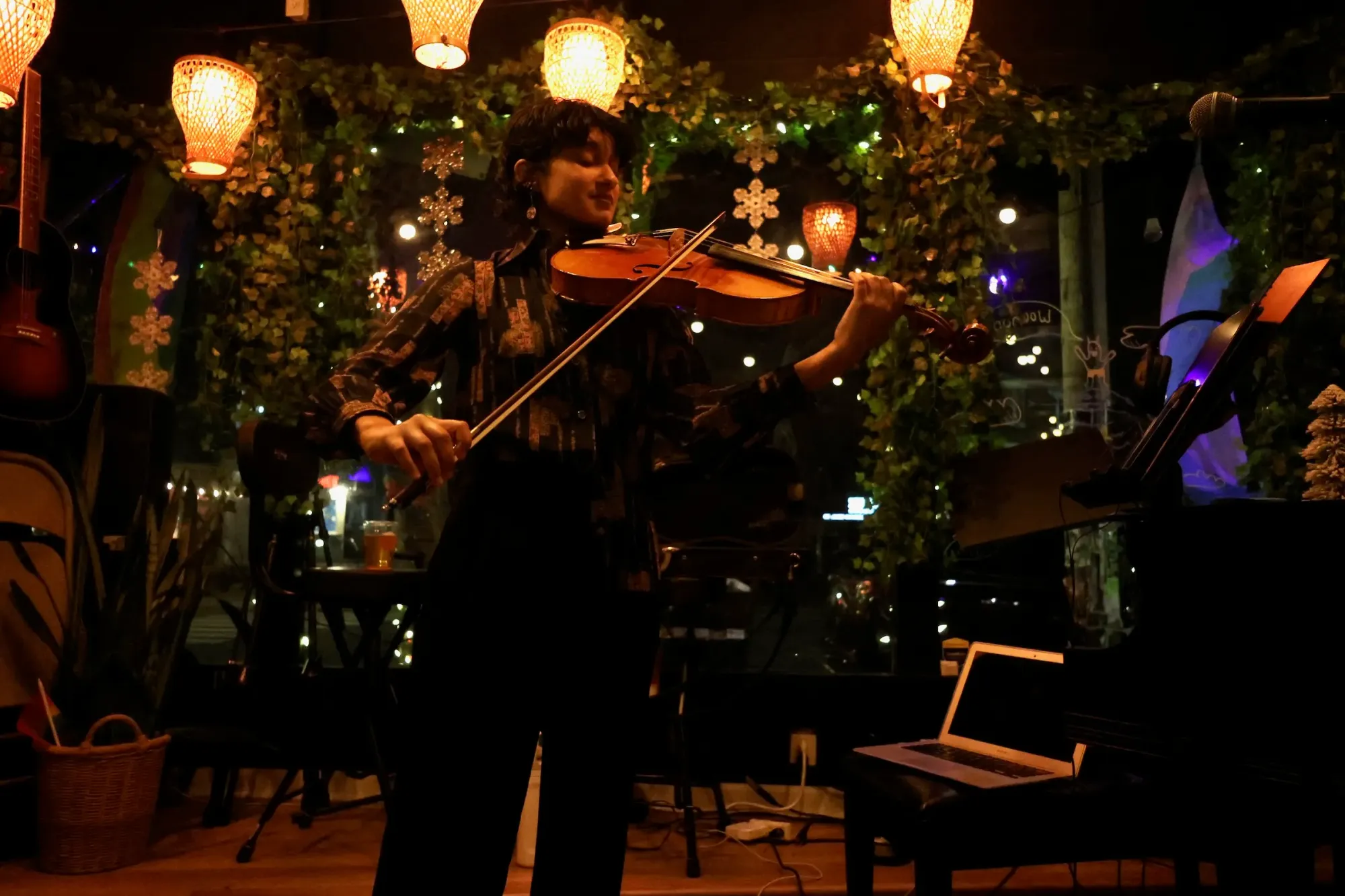
Aditi Prakash
Spruce Coffee
952 State St.
Dec. 8
The rapid plucking sound coming out of the speaker at Aditi Prakash’s feet, Prakash had said, was inspired by the sound of an instrument that composer Missy Mazzoli had heard in Uzbekistan. Now it was racing through the ears of the audience at Spruce Coffee on Monday night. Prakash was ready with her bow; she touched it to the strings of her viola, and a frantic, searching phrase spilled out, followed by another, and another.
It was a night of solo viola music at Spruce Coffee, now celebrating its first anniversary and boasting a full roster of musical events in its Upper State Street location that are relatively low in volume but high in diversity, from classical to folk to punk and a few stops in between. Prakash hailed from the classical end, with a distinct taste for the modern.
Prakash began studying music at the age of 4, and got her bachelor’s degree from Eastman School of Music in Rochester, N.Y. and her master’s from Juilliard. She is now enrolled in a post-masters program at Yale School of Music. She described New Haven as a “change” from New York, “but there have just been spaces — here and other coffee shops, honestly — that I love to go to, that make it so wonderful.”
Prakash’s love of coffee has gone hand in hand with her musical training. In Rochester, she said, “I would coffee shop hop all the time.” Now “I feel like no matter where I go, I always look for that.” When she arrived in New Haven in August, she walked into Spruce Coffee, saw the events calendar on the wall, and thought, “it would be really cool to play in this space.”
She noted that classical musicians have been moving classical music out of concert halls and into coffee shops and bars. “It’s more accessible, and there’s so much great music that fits in these spaces.” It makes sense; chamber music, after all, was always intended to be played in people’s houses. “A lot of people think Bach is something that is really uppity or sophisticated, but it kind of never was,” Prakash said. “Bringing it into this intimate space is more authentic.”
She added that concert halls are “so nice” to hear music in, “because those are built in a way that makes us sound great, but I like the energy here, too, and people can grab a drink and chat.”
Part of the fun for Prakash lay in putting together a program for solo viola, an instrument very often found only in ensembles.
“There’s a lot of solo viola” repertoire, Prakash said, but also “not a lot.” She knew she wanted to try some new pieces, and also show the range of what the viola can do, starting from the center of the baroque repertoire and moving to new pieces that deploy electronics or borrow sounds from folk traditions. “Each piece had something in it that drew me into it, either the emotion or the texture or the technique.”
All three were on display as Prakash began with Bach’s Suite no. 1 in G major, originally for cello. Interspersing the pieces with poetry, she explained how a teacher in Germany had likened the Bach piece to a forest grove, in which the trees all stand together, but then as you examine them individually, they become different, like the “eccentric phenomenon of the snowflake.” The first movement in the suite is famous; Prakash treated it with reverence, drawing out each phrase to be appreciated. As she moved into the lesser-known parts of the piece, her approach worked as an introduction, a handshake. When the pieces leaned into dance rhythms, she served them, keeping each note agile. One minuet, which she likened to “a soft hand, heavy with snow,” became very lyrical in her playing as she took time with each idea. In the gigue, she contrasted slippery passages with precise staccato to create moments of surprise.
Prakash then moved to Kenji Bunch’s “The Three Gs,” which required her to retune her instrument dramatically. She first heard it in 2018. “It’s a crazy piece,” she said, “and I never thought I would be able to play something like this.” She added that “you don’t have to stay quiet — it’s not that kind of piece.” It began with aggressive pizzicato that turned into strumming, and then into forceful bowing that borrowed from country music. Prakash’s tone changed completely, deploying the harsh end of the viola’s sound and letting it growl out drones, harmonies, and slides.
From there, she moved to a cadenza by Krzysztof Penderecki, which she explained she started working on when she was “going through a particularly difficult time.” That paired with the music. The piece has “a lot of darkness and pain, and the threat of losing hope — but I don’t think this piece loses hope, and I think that’s special.” She paired it with a capriccio by Henri Vieuxtemps, which she explained would be good “aftercare.”
The Penderecki did not disappoint in its intensity. Once again, Prakash changed her tone to suit, becoming piercing and austere as she worked a series of intensifying dissonances, culminating in an eerie passage of skillfully deployed harmonics. By contrast, the Vieuxtemps was lush and mournful, for while Prakash again dialed in a tone, this one like dark chocolate.
The final piece — “Tooth and Nail,” by Missy Mazzoli — deployed an electronic track that served as Prakash’s collaborator. The acoustic and electronic sounds blended together in dramatic fashion, bouncing off of and echoing one another. In passage after urgent passage, they sounded like they were racing toward a distant horizon together. But then the sound broke into a serenity like flying through cool air. The electronics became a distant call, hearkening back to the beginning of the piece. The viola flew elsewhere, away.
The gathered audience burst into applause, and Prakash beamed.
“I’m new to New Haven,” she said, and thanked Spruce for having her. “It’s a space that has brought a lot of comfort to me.”


