
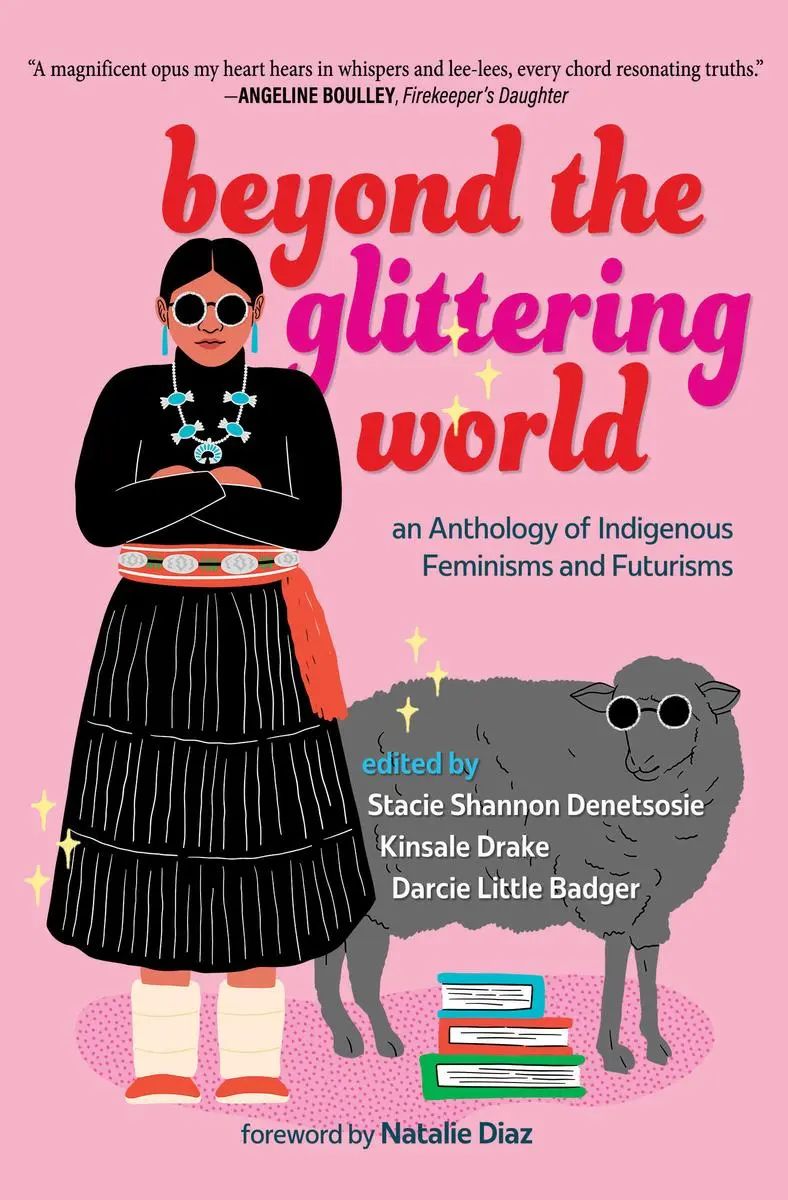
Beyond the Glittering World
Edited by Stacie Shannon Denetsosie, Kinsale Drake, and Darcie Little Badger
Torrey House Press
November 2025
In a note introducing her poem “Alfabetízate Otro Mundo: Reverse Abecedarian Broke Open,” Ayling Dominguez directs readers to Zapatista comunicados, messages transmitted by an indigenous-led army guarding their mountain communities against the encroachment of neoliberal globalization (e.g. NAFTA) in Chiapas, Mexico since the mid-’90s.
It is the 35th of 37 pieces from Beyond the Glittering World, a multi-genre collection of stories and poems by authors from indigenous cultures in North America and beyond, published in November.
The contributors are Diné, Cherokee, and Lakota, as well as Afro-Palestinian, Samoan, and Nahua. Together, they ignore discursive traps in order to advance collective feminist knowledge and indulge in moments of pure glee.
“Alfabetízate Otro Mundo” mostly fits a reverse alphabetical format, so Dominguez’s first word, naturally, is Zapatismo. They begin by borrowing the resistance army’s concept of “Un Mundo Donde Quepan Muchos Mundos,” a world where many worlds fit.
The book itself is an example of a world encompassing many worlds—all past the glittering one. The title refers to, as Natalie Diaz describes in the foreword, the Mojave concept of “a time when the world was still wet, after a flood or deluge, or after the original waters we came from had receded.” In the aftermath, while the soil is still soft, a multitude of realities are possible.
Speculative fiction shines in this anthology, a fitting genre for writers well-versed in the concept of the post-apocalypse. It’s grounding to see the artists speak calmly about what fits in their future and what never has, backed up by the writings before and after theirs.
When Moniquill Blackgoose reflects on “an infection called ‘capitalism’” in her futuristic short story “Sky Woman Rising: A Memoir,” she doesn’t need to elaborate.
And when a pair of beaded moccasins plots to escape from their caged existence in a museum in A.J. Eversole’s “Dilasulo Walks,” there are no exhausting disclaimers about the pros, cons, or necessary evils of museums. All we need to know, as the reader, is the exhilaration the moccasins feel as they anticipate finally being worn.
Dancing between the “N” and “M” in their backwards alphabet, Dominguez writes, “No model, no doctrine, no ideology, no blueprint, rather sacred intuition/ and mutuality, tools the master never had.”
Here, my mind goes not only to Audre Lorde’s 1979 speech “The Master’s Tools Will Never Dismantle the Master’s House” but also to the state of Georgia’s indictment of Stop Cop City protesters in 2023, which dedicates an entire section (each) to defining the concepts of mutual aid, collectivism, and solidarity—and warns that “these same ideas are frequently seen in the Defend the Atlanta Forest movement.”
Just when it seems difficult to find a model for the future that isn’t a replication of oppressive systems, Dominguez points out that even a concept as natural as mutuality is still a mystery for the powers that be.
So where do we go from there? To another planet, maybe. In “Sky Woman Rising,” Blackgoose crafts a universe with places that mirror the cultures of the anthology’s contributors, places with names like “New Sky World,” “Vittana Nagaraṁ,” “Jojolo,” “Taonga,” and “Hadiqat Fi Alsama.” Both in the story and in the book as a whole, the cultures are grouped not by geography but by relationship to the land (and, as it patterns, a history of colonization).
Unlike many space exploration stories, which have an air of conquest and involve a decision to give up on Earth, “Sky Woman Rising” underlines a deep commitment to this old rock, even after the creation of a new community elsewhere in space.
The story’s main character, Mama Moth, speaking to a group of children sometime in the 2100s, explains: “So many of the other projects, the ones that intended to leave Earth behind, didn’t hesitate for a moment to extract materials from Earth to build their ships. They didn’t ask, they didn’t thank, they didn’t return what they’d taken.” The planners of her world, in contrast, put thought into the harvest, always aiming to give back someday.
Dominguez’s call for sacred intuition and mutuality are also heeded in Dominique Daye Hunter’s poem “The Rhythm of Becoming.” In it, Hunter repeats simple phrases of the same numbers of syllables in each stanza, telling stories of daily routines: pulling on moccasins, braiding hair, fasting, praying, sewing, leading others. Her musicality builds a sense of trust, like practicing a routine over and over until it becomes second nature.
The phrases could be about various community members, or they could describe one little girl's journey through the stages of life. The two possibilities blend together, questioning just how separate they really are.
When Dominguez gets to “L,” they write, “Landowners begone. The land rejects ownership from those who poison it.”
This philosophy meets its literal counterpart in Trisha Moquino’s story “Our Native Languages Survive Us,” which is set in 2114 (maybe around the same time as “Sky Woman Rising”). In Moquino’s piece, flowers wilt at the sound of the colonizer’s tongue. A young Pueblo woman named Tallulah faces the daunting task of learning Tiwa just to safely speak in the presence of plants.
Within the desire to decolonize as fast as possible, there is still room to understand Tallulah's efforts to learn a language that was systematically denied to her. Her situation is met at first with impatience, then with grace. Tallulah's fellow travelers extend a smile and a comforting touch.
“Aquí manda el pueblo,” Dominguez’s poem ends. Here the people rule.


