
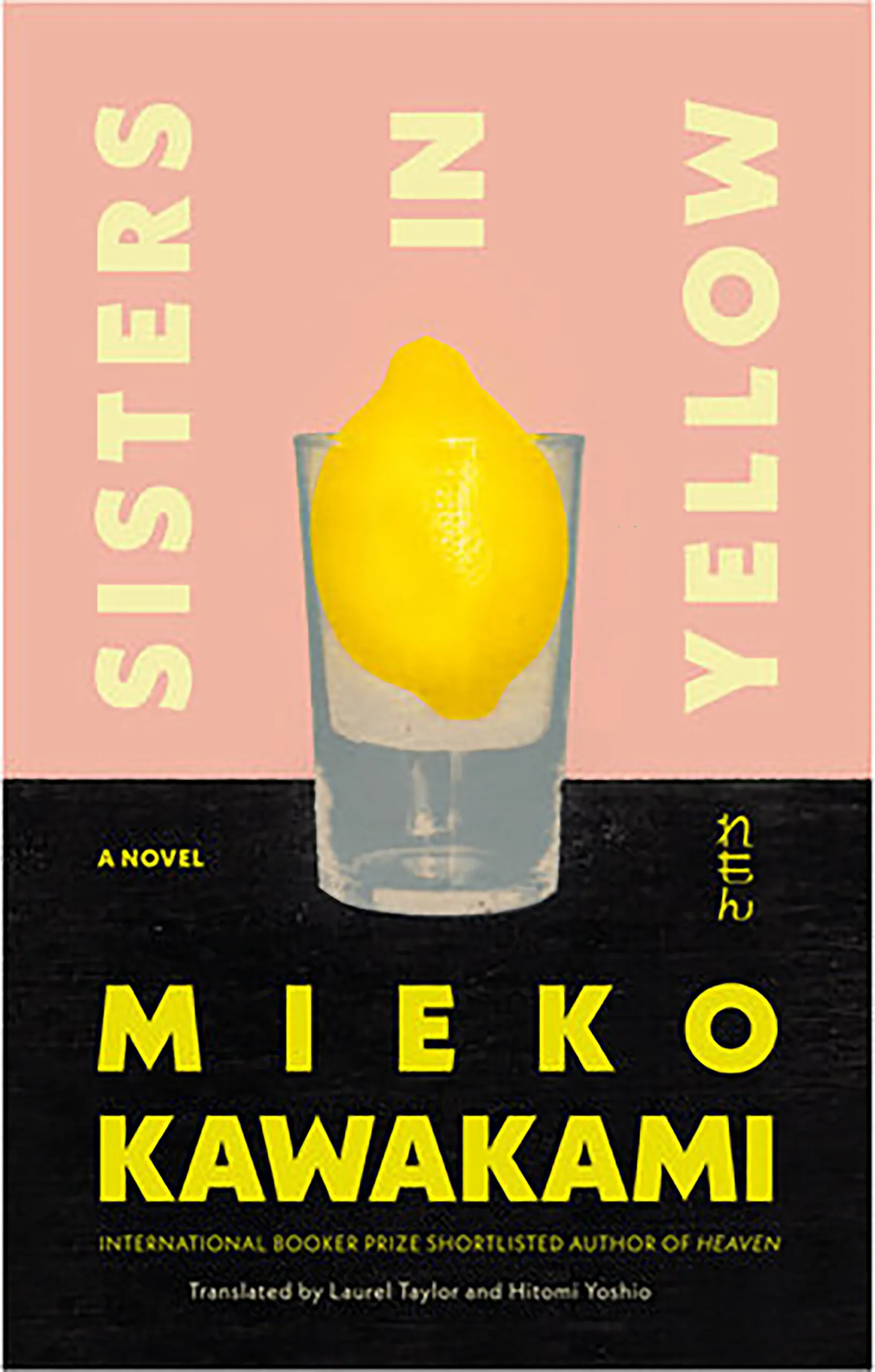
Sisters in Yellow
By Mieko Kawakami
Alfred A. Knopf
On sale March 17, 2026
When you think of the color yellow what do you imagine? Sunlight? Happiness? Warmth?
In Sisters in Yellow, the color works as a driving force that pushes a narrative of yearning and ravenous ambition. Yellow hums with hunger.
Yellow is our protagonist Hana Ito’s lucky color. She clings to feng shui’s promise that yellow represents stability, security and the attraction of wealth. Hana desperately needs those elements in her life, as she was raised in poverty in 1990s Japan by a flighty mother, Ai. Her mother doesn’t blink an eye when Hana decides to move out at age 15 to live with an acquaintance, Kimiko, whom Ai met while out drinking.
Kimiko provides and cares for Hana in a way that her mercurial mother does not – at least the semblance of care. She fills Hana’s fridge with food. They have lots of laughs and fun together. To Hana, it feels like fate that “yellow” is in Kimiko’s name. Together, they open a bar named Lemon, leaning fully into their yellow theme.
“I’m more afraid of being poor, of the future,” Hana confesses. Here author Mieko Kawakami reveals the psychic toll caused by deprivation. Poverty here is not merely economic – it is emotional and existential. It shapes Hana’s every calculation, every relationship, and every compromise.
As the novel unfolds, fellow wayward girls Ran and Momoko come to live with Hana and Kimiko. Their apartment expands into a fragile sisterhood shaped by their mutual desperation. Together, they drift into a moneymaking scam that is edged with danger – a venture that promises quick relief from financial anxiety but carries corrosive risks.
Hana, ever practical, becomes the group’s financial steward. She tracks earnings, tallies expenses, and absorbs all of the stress. Responsibility sits heavily on her young shoulders, despite the fact that she is living with Kimiko, who is at least a decade older. It’s telling that even in rebellion, Hana defaults to order. She seems to believe that careful accounting can ward off chaos.
But Kawakami complicates any easy reading of empowerment. The girls’ schemes are fraught, not glamorous. Their urgent hunger begins to erode the very solidarity that sustains them. Yellow, once a symbol of security, begins to flicker like a warning sign.
The brilliance of Sisters in Yellow lies in its refusal to flatten its characters into archetypes. Hana is neither saint nor villain. She is intelligent, cautious, and at times chillingly pragmatic. Her situation is troubling. Thus, Hana’s ambition and the choices she makes are somewhat understandable. Kawakami forces readers to sit with that discomfort.
Crucially, Kawakami renders Hana’s interior life with devastating clarity. In one scene, Kimiko responds to Hana unkindly, and Hana says she “glared at a point on the ceiling in the pitch dark and waited for my feelings to calm.” The image is simple yet startlingly familiar. Who cannot relate to being in an emotionally wrought position where one cannot do anything but stare at the ceiling? Throughout the novel, Kawakami conveys universality in Hana’s suspended, private moments.
The novel interrogates what it means to chase stability in a system that withholds it. How far would you go to avoid returning to nothing? At what point does survival tip into complicity? Kawakami offers no easy moral resolution. Instead, she presents Hana’s obsession with having more as both engine and trap.
There is also an undercurrent of illusion running throughout the novel – the illusion that color or belief can insulate one from structural precarity. Kawakami subtly critiques the seductive myth of self-invention; that with enough grit, enough aesthetic coherence, enough hustle, one can transcend class.
The world Hana inhabits is not so forgiving. The threat of scarcity hovers constantly, shaping intimacy into transaction and affection into calculation. Even love becomes entangled with utility. In this sense, yellow transforms yet again – from lucky charm to exposure. It reveals what the characters might prefer to keep hidden: their fears, their capitulations, their quiet betrayals.
By the novel’s end, yellow no longer evokes uncomplicated happiness. It becomes the color of desire stretched too thin – bright enough to dazzle, sharp enough to wound. In Hana’s world, yellow is not sunlight. It is illumination within true darkness.
In exposing the fragile architecture of ambition built atop poverty, Kawakami crafts a story that lingers.


