
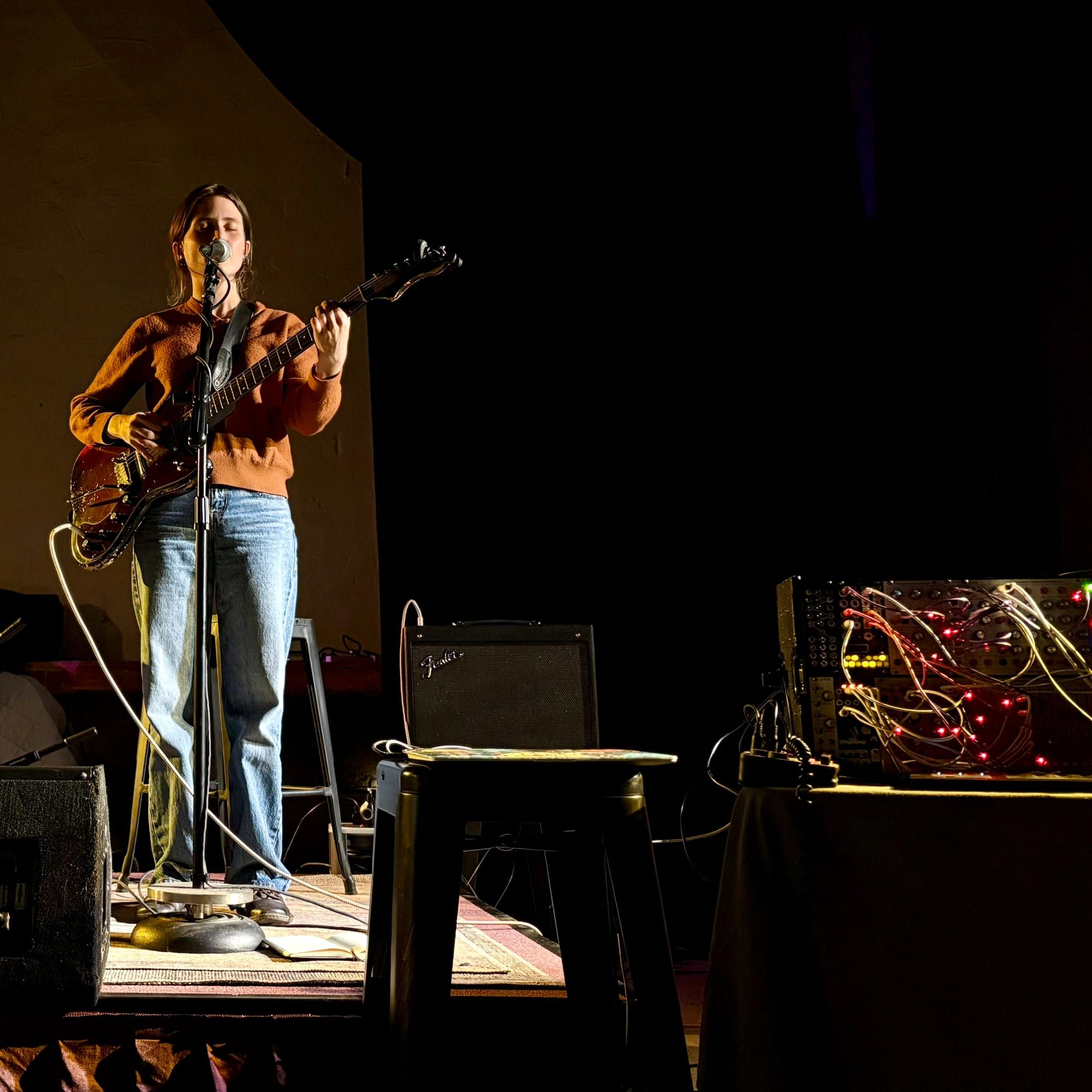
Hana Stretton, Jana Horn, Danielle Nia
The Perch
2008 E Arizona St.
Philadelphia
Oct. 6, 2026
I’m going to shows all the time, but some are more highly anticipated than others — those ones that feel rarer and more special in advance, for whatever reason: some one-time-only circumstances, or maybe the artist doesn’t tour often or hasn’t in years, or they just live very far away. I’ve been enamored with the Australia-based artist Hana Stretton’s music since first hearing her album Soon two years ago; it’s a one-of-one stunner, a piece of music that feels elemental and lived-in, as tactile as it is elusive, not fully graspable. (Yes, the great Jana Horn described Stretton’s music as “tactile” and “lived-in” from the stage last night, and I’m stealing those words because they’re spot on.) She released a new one this year, tiarn, that’s every bit as wonderful, gorgeous and mysterious. The room was packed with silent seated bodies; there was a church-like reverence for the music that was about to unfold.
Starting the night was the local musician Danielle Nia, performing on Buchla 258T and ROLI Seaboard Rise 2 keyboard; this was a lively improvisation, an unbroken piece of music lasting about thirty minutes. She began with low, oscillating, brassy sawtooth pulses, often drifting in pitch and rumbling like an oncoming train, with flute-y, tremolo’d higher notes coming and going, with a fast decay – tonal clusters eventually yielding to a loop in C major (mostly open, perfect, modal intervals) with melodic phrases from the ROLI, a touch-sensitive black digital keyboard whose notes are capable of getting wiggly. With a few knob turns on the Buchla, the looped pattern’s pitches drifted into a neighboring minor key, instantly more curious, and Nia gradually teased out trance-like square-wave arpeggios, locking into sequence with the loop – no discernible trace of a recurring metrical pattern, phrases long and intricate, but polyrhythmic and interactive music and all the more interesting for its playful near-randomness. The return of deep bass beneath all this rhythmic activity preceded pointy, water-droplet high synth notes popping in, and at the height of the music’s bouncy density, Nia began smearing everything, the envelopes opening wide. Around that time I noticed how much reverb was being applied to the sounds, reminding me of the experience of Sarah Davachi’s organ music in a great church, or choral music, voices sustaining and halo'd; the gridded music was gone, and a harmonically vague and unstable movement took hold, complete with quirkier, exploratory sounds, like throaty low synths and pitch-bent timbres similar to running a thumb across an inflated balloon. There was a final passage of sonic build-up – granular day grabbing bits of sound and randomly arpeggiating and reorganizing them on the fly – with great, messy, thick, dense brambles of sound finally clearing into a small, slow drip of high notes returning us to silence.
Brooklyn's Jana Horn was next with an as-ever captivating set of songs, mesmerizing especially, for me, because of the great quality of Horn’s singing. This was my third time seeing her play in the past year, but first time solo, and the stillness and stripped-down nature of these versions of the songs naturally highlighted Horn’s voice, phrasing, lyrics and spare, essential guitar playing. There is this melodic tendency in Horn’s music that I find present in Stretton’s too: leaps that don’t feel like athletic leaps – more like a new voice has appeared – and the subtle freedom of speech-like, natural phrasing, as if each word is being held and illuminated. This rendition of “It’s Alright,” with its 6/8 fingerpicked pattern as bedrock-in-motion, got at so much of what I love about Horn’s songwriting: deeply intuitive, full of slippery, small shifts that signal big feelings (the tumble of notes on “I miss you, I don’t”), and words that unfurl in ways that are revealing with much left concealed:
Blue skies again
See you as a friend
See you clearly
Don’t feel like a loss
To have been honestly wrong
It’s alright
Lights on the street
Are coming up green
It’s a feeling
That comes and goes
I miss you, I don’t
Finally, though, Stretton’s set was what I’d been most excited for, and it was well worth the cumulative wait since I first bought the ticket months ago. If you are familiar with her records, it’s worth mentioning that the live experience is far richer, far more immersive and enveloping, and ought to be considered unmissable. Stretton told me at the merch table after the show that she doesn’t want to tour anymore playing solo – it feels like doing karaoke, she said – but in spite of the inarguable fact of her solitary presence on stage, the way she utilizes pre-recorded sound and field recordings comes across as an invitation of other sources, voices and forces, and a communion with them, the sounds not arbitrarily pasted onto what she’s doing but totally connected. It’s not quite lonely music in a sad sense (fitting for an artist who named a song “The Thrill of Loneliness”); is it too much to say that the sound of it all was way more interactive, unexpected, alive and communal in execution than the average solo set, as though she was not only bearing parts of her spirit and voice in song but bringing old memories and lost places back to life, as vividly as if the stage had been decorated with photos and objects? This was revelatory, quiet and thoughtful music, songs as whole environments, pieces and slivers of life and time gathered and re-gifted. It feels too cliché or obvious to say it was gentle, although the sounds fell on the ear softly: there was pre-recorded noise, rain sounds and white noise and wind and other unidentifiable sources, then Stretton at the unamplified piano, or at her classical guitar with a foot tapped on a percussive box, another pumping air through a droning shruti box. Her piano playing reminded me of gospel after-hours, like someone had snuck into a church after it closed, after the light is gone, reverent and secretive; her open-tuned fingerpicked guitar playing was intuitive and inventive, coursing through false relations and hypnotic counterpoint, strings ringing out. Truly, I could listen to her play all day. (Stretton so dislikes playing alone that, chatting before the show, she suggested I play guitar with her, and as much of a thrill as that would have been, I was as pleased as I’ve been at any show I’ve seen this year just to sit and listen, to softly sing along, and to tap out a simple rhythm on my legs during one late-in-the-set song, the whole room eventually tapping along, too, to her clear heartfelt delight.)


