
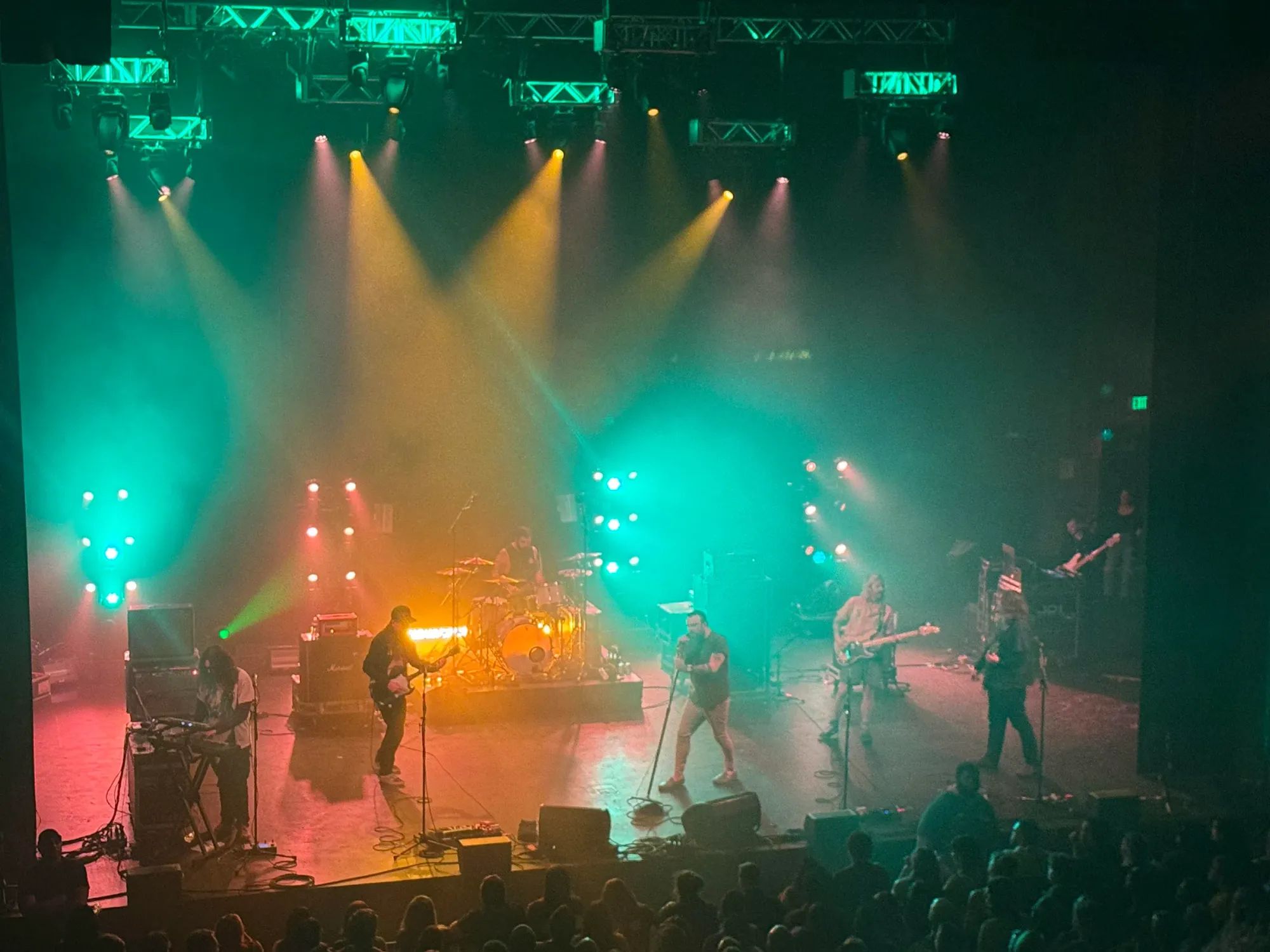
Say Anything
College Street Music Hall
New Haven
Feb. 3, 2026
“Donald Trump is dead inside,” declared Max Bemis, lead singer of Los Angeles-based rock band Say Anything, to a chorus of “yeahs!” and boos at College Street Music Hall.
Then the band launched into “Alive with the Glory of Love,” their radiantly tender pop punk anthem that represents everything the president is not.
As the crowd erupted, Bemis sang,
When I watch you, wanna do you
Right where you’re standing (Yeah)
Right on the foyer, on this dark day
Right in plain view (Oh, yeah)
Of the whole ghetto
From the start, the song is an erotic come-on, but it immediately veers into darker territory with the invocation of the “ghetto”. The shift was abrupt and unsettling at the Music Hall Tuesday night. Listeners were ushered into rough terrain before they had time to get their bearings.
The crowd scream-sang the chorus:
No
I won’t let them take you, won’t let them take you
Hell no, no, oh no
I won’t let them take you, won’t let them take you
Hell no, no
By then, the stakes were unmistakable and empathy had fully set in. Who were “them” and where were they forcibly taking the object of the song’s devotion?
The song sounded light and jubilant despite carrying heavy weight. Bemis wrote the deceptively upbeat song in honor of his grandparents, who are Holocaust survivors. He told Spin that he wrote it in three hours. “It came out all in go” as he cried. Bemis and the band wrote …is a Real Boy, the album from which “Alive with the Glory of Love” comes, during a period when he “was an unstable person who really wanted to do something positive for the world.”
On Tuesday night, Bemis’ earnest voice cut through bouncing power chords and a tempo that urged bodies into motion. Every syllable was uttered with force; every note carried inflection sharp enough to jolt. Underneath the song’s sing-along exterior is a story about moral clarity, devotion, and survival in the face of unimaginable horror. The song insists on love as an act of defiance – love as resistance.
And when our city, vast and shitty
Falls to the axis (Yeah)
They’ll search the buildings, collect gold fillings
Wallets and rings (Oh, yeah)
But Ms. Black Eyeliner
You’d look finer with each day in hiding (Oh, yeah)
Beneath the wormwood
Oooh, love me so good
They won’t hear us screw away the day
I’ll make you say
The song’s protagonist is relentless. He craves intimacy with Ms. Black Eyeliner even as ‘they’ loot their city that is falling to its axis. The image of a fallen city aroused a sense of foreboding as we imagined our own imperial ruin.
Under a wash of red and blue lights, Bemis stalked the stage with restless energy. He sang not at the audience but with them, inviting a collective reckoning rather than passive consumption. Voices rose from the crowd, all committed to singing the final verse defiantly, as Bemis yelled, “Come on!”
Should they catch us
And dispatch us
To those separate work camps
I’ll dream about you
I will not doubt you
With the passing of time (Oh, yeah)
Should they kill me
Your love will fill me
As warm as the bullets (Yeah)
I’ll know my purpose
This war was worth this
I won’t let you down
No, I won’t
No, I won’t
No, I won’t
(Alive! Alive!
Alive with love tonight)
In that moment, we were not singing of abstraction. “Alive with the Glory of Love’s” subject matter is still relevant, though the song was released in 2006. Its refrain, I won’t let them take you, lands differently when placed against today’s threats to bodily autonomy, historical truth, and basic human dignity. The “them” becomes elastic, shifting with the times while retaining its menace.
Musically, the song mirrors the lyrics’ tension between bliss and existential dread. The energetic pacing evokes euphoria but carries an undercurrent of urgency. There is no languid lingering; everything rushes forward, as if speed were a strategy for keeping the darkness at bay. The relentless – I won’t let them take you, won’t let them take you – contains an almost gleeful intransigence. The production amplified this: drums crashed, guitar layers built in waves, Bemis’s voice alternated between plaintive sincerity and raw shout. The dynamic layers replicated the oscillation between vulnerability and fortitude that the lyrics articulated.
The song is compelling because it asks listeners to hold two truths at once: that love can be effusive and ecstatic, and that love’s exhilaration does not erase the shadows within which it may be contained. The choice of the word “glory” itself is instructive: glory is an aesthetic category – luminous, elevated, almost excessive – yet in this context it is grounded by mortality and vulnerability.
What makes Say Anything endure, and so warmly welcomed by the enraptured New Haven crowd, is their refusal to dilute feeling in a time when evil trumps earnestness (no pun intended). Say Anything’s songs cover mental health, faith, addiction, marriage, and collapse. That openness creates trust between the band and audience. When Bemis sings about protecting love at all costs, it feels lived.
“Alive with the Glory of Love” chooses conviction. The song positions joy not as an escape from trauma but as a testament to survival. It insists that love – embodied, stubborn love – remains one of the most radical forces available.
As Bemis repeated the outro, alive with love, alive with love tonight, as the show came to an end, you could feel the missive embed itself in the room.
In a world that often feels dead, Say Anything made the case for staying painfully, defiantly alive.


