
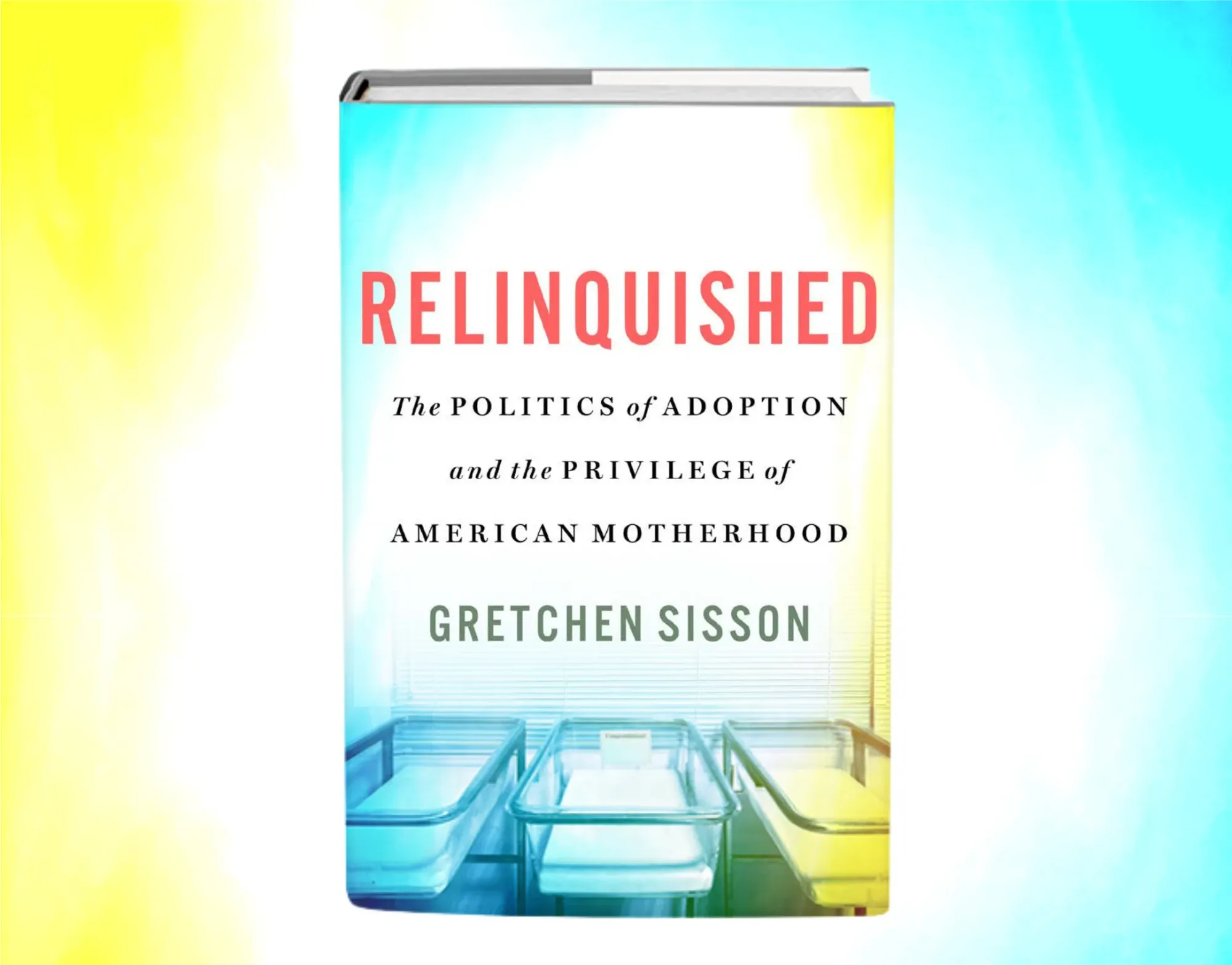
Relinquished
By Gretchen Sisson
St. Martin’s Press
Out in paperback March 17, 2026
Adoption. Let’s talk about it.
Specifically, domestic, private infant adoptions in the United States.
As author and research scholar Gretchen Sisson writes, Americans “see adoption as a way of ensuring better lives for children who might otherwise not have homes or parents at all.”
But, she goes on to say, “These beliefs are rarely rooted in reality.”
Like many others, I’ve come to understand society’s role in adoption as primarily one of celebrating chosen bonds. Sisson, in her book Relinquished: The Politics of Adoption and the Privilege of American Motherhood, pushes us to go further, to seriously consider all participants of the adoption process in movements for reproductive rights, and to take the time to hear from an often-deprioritized group: birth mothers.
In doing so, she recenters the focus not just on these mothers but on the wellbeing of adopted children, not necessarily adoptive families. It may seem that these are intertwined, and they are, shortly after birth.
Before that comes the relinquishment.
Relinquishing, Sisson describes in her book, is not just about letting your infant have access to more resources when you are struggling. It’s a legal process to give up parental rights to your child, and it’s permanent. Some mothers, like those in dire economic straits, are encouraged to relinquish to avoid being forced to give up their children to state systems.
Much of Sisson’s work in this book is in clarifying uncertainties about how infant adoption works. For example, are there more infants waiting to be adopted, or more families waiting to adopt?
The latter, Sisson says, overwhelmingly so.
So much that in the 2002 Supreme Court decision overturning Roe v. Wade, Justice Samuel Alito wrote that “the domestic supply of infants relinquished at birth or within the first month of life and available to be adopted has become virtually nonexistent.” This is from a ruling about abortion.
And does this rhetorical use of adoption for a pro-life agenda reflect the reality of how most adoption decisions are made?
No, Sisson says. Her research, which spans 77 interviews over 10 years, suggests that most birth mothers were not deciding between abortion and adoption, but between adoption and parenting.
Reading through story after story of young birth mothers and coercive adoption agencies, I realized that the seemingly tricky balance of infants needing families and families needing infants was not a balance at all.
An infant in need of a family is an absolute crisis. That is a human life, brought into a harsh world where their basic needs are very expensive.
A family in need of a child is a different story. I struggle to weigh this problem with anywhere near the same magnitude as its opposite. If there is a “virtually nonexistent” pool of infants in need of a home, as Justice Alito suggests, isn’t that a positive outcome?
Sisson’s tight focus on birth mothers’ personal narratives, some woven together over several years, brings out key phrases these birth mothers have come to use for their experiences. Like the “honeymoon period,” a time when birth mothers, Sisson writes, “feel optimism about their own life and their child’s; they feel a real connection to their child andto their child’s adoptive parents.” Or “coming out of the fog,” a hard transition many birth mothers go through after realizing they had made their relinquishment decisions under pressure and misleading information.
A quote Sisson shares from one adoption agency, a progressive one in Portland, Oregon, says, “Birthparents say they wouldn’t choose adoption under any other circumstances.”
Though the book is based on research and data, much of what I got from it was the knowledge that comes with emotions. In one woman’s account, she sits at an adoption agency and is given a worksheet with two columns: one for what she could provide the baby, the other for what an adoptive family could provide. Of course this made me cry.
Another woman’s story, echoing several others, spoke of the impossibility of getting over the trauma of the adoption, no matter how much time had passed. These people had been told they would not regret their decision, and that the pain would get easier over time. Story after story showed these predictions fail to bear out.
Part of this phenomenon seemed to be due to the utter transformation of giving birth. Multiple participants talked about how hard it was to go through the birth, see their baby, and then sign the papers. Many of them remembered telling themselves (or being told) to trust the decision they made when they were in a “sound” state of mind, less packed with hormones.
But since when were hormones, and the emotions that come with them, not real?
Sisson shines where she breaks free from the constraints of her discipline, letting the reader into her emotional reality as she collected the data. She takes care to respect the on-its-face truth of participants’ stories, presenting them even if they seem to conflict with later statements or what she observes on the whole.
It is so careful I found myself growing skeptical at times of Sisson’s conclusions. One mother seemed happy with what the adoption provided for her child, so was there really an imbalance of power involved?
Then Sisson spoke of her rage, and it snapped me back to the reality of the situation.
Throughout the book, Sisson keeps it professional, only making small comments on how she felt collecting the data. Still, these are enough for me to imagine what it must have been like talking to person after person recounting similar stories of coercion, disappointment, and lifelong trauma.
In many of the narratives, participants’ rush to establish their gratitude to the adoptive families and their love for their children exactly the way they are reveals the pressures they are under. They have no legal parental rights to see or talk to the children. “Open” adoptions are often not legally codified, and keeping them open can get dicey as the years go on.
The book felt like an essential read for someone seeking to understand the deep structures of sexism in our society. When Roe v. Wade was knocked down four years ago, I felt affected on a personal level even though pregnancy and abortion were not on the radar for me and I lived in a blue state. The legislative circus around reproductive issues provides a great deal of insight into how people across America perceive our bodies in general. And this is good to know.
Like many, I feel like an outsider thinking about adoption. Sisson shows what kind of political outcomes that internal hurdle creates: a reproductive justice movement, for example, that omits stories of adoption, assuming these stories might detract from the cause.
In reality, as Sisson describes, critical thought around adoption has mostly been led by adopted people themselves. They are not one and the same as their adoptive families, and they have valuable perspectives to share around the circumstances of their birth.
Relinquished provides a solid entrypoint into the infant adoption system and the people inside it. And in doing so, Sisson clears the fog of polite misunderstanding.


