
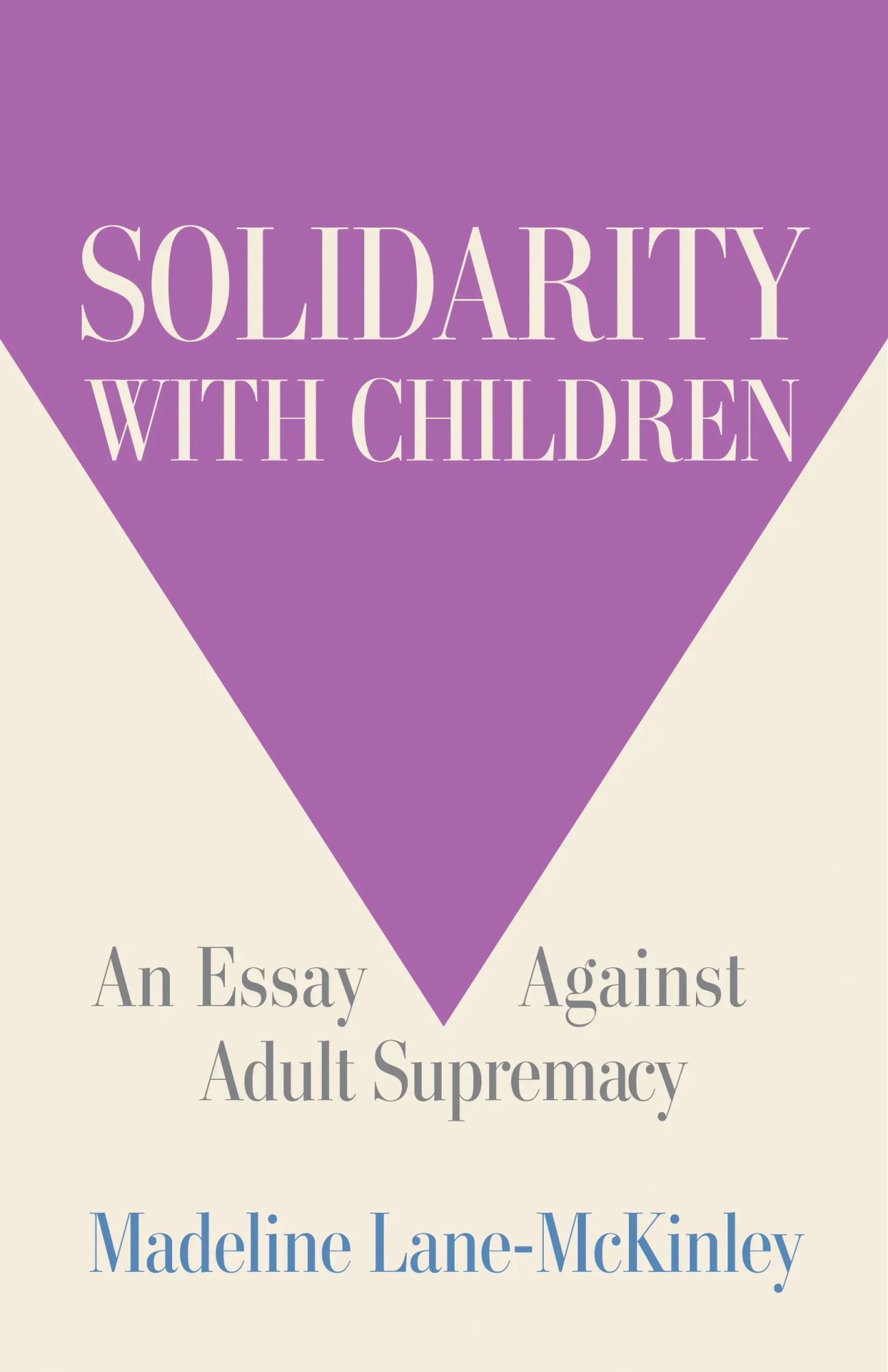
Solidarity with Children: An Essay Against Adult Supremacy
By Madeline Lane-McKinley
Haymarket Books
In her introductory chapter to Solidarity with Children: An Essay Against Adult Supremacy, writer Madeline Lane-McKinley urges us to listen harder to the perspectives of the next generation.
Readers can start, she says, by “meeting the challenge posed by youth climate activists: that we stop ‘pretending that empty words will make the emergency go away,’ and bring to an end the arrogance that enables this belief.”
“We cannot allow ourselves or each other,” she writes, “to surrender the future.”
It’s a galvanizing introduction, drawing from decades of radical movements to describe how factions on the knife’s edge are systematically undercut by accusations of childishness, whether or not the people involved are actually children. To be in solidarity with kids, Lane-McKinley argues, includes investigating the premise that adherence to conventional codes is evidence of wisdom.
I was so blown away by this chapter and its tight examples of adults warping kids’ messages—like student survivors of mass shootings “encouraged to focus on legislative demands” when they were still too young to vote—that the ensuing abstraction in following chapters on dreams, motherhood, school, and utopia left me grappling in the dust.
Much of the book’s analysis rests on expansions to a pro-kids lexicon. The etymology of “infant,” “adolescent,” and “utopia,” the suggested term “dis-alienating” in place of “humanizing,” and the utility of “commune” as both a noun and a verb all make appearances. As a fellow linguistics fan, I can see the appeal. As someone who just read Lane-McKinley’s quoting of young activists calling for the end of “empty words,” I’m skeptical.
In one chapter, Lane-McKinley offers the word “mothering” as a double-edged sword, stretching it to include a meaning I am able to grasp on a poetic level, but have never heard before. “One can be mothered,” she writes, “as in summoned into the labor of mothering.”
Later, she calls for “a dialectic of anti-anti-maternalism.” In the next chapter, she talks of homeschooling versus unschooling versus deschooling.
Presenting wordplay as a piece of intellectual capital, a contribution for future citation, strikes me as specific. Not morally good or bad, just specific to a certain academic culture that figures very little, if at all, in kids’ day-to-day lives.
Am I saying this book should be legible for kids? No. This is a book by an adult, for adults. Lane-McKinley speaks in adult language because that’s the language her audience speaks. But socially, the child-adult dynamic still exists among those who have long made the transition to sensible cereals, debt, and back pain.
Lane-McKinley includes several stellar cases of this in literature and real life. Tarzan, for example, is still a “feral child” in his adult life due to his refusal to conform to standardized milestones. Economic precarity and political left-ness are also barriers to adulthood in the public imagination.
So, the “child” in me—that is to say, the creature who hasn’t yet learned respect for societal systems—wonders: why is Lane-McKinley going so hard on the vocab? Why is she saying that to be “mothered” means both 1.) to be cared for, and 2.) to be turned into a caretaker, when only the first definition seems to be in common use?
Perhaps because the supposed double meaning lends itself to an elegant analysis. And because this nerdy delight in turning nouns to verbs (as Lane-McKinley admits when she writes that a gerund is “as I prefer, a verb breaking out of a noun”) is, for whatever reason, a healthy part of writer and academic culture.
I love wordplay. I love rap. I love poetry. I love whatever the kids are saying nowadays. I love “6, 7,” sue me. I even have love for the effortless way this generation’s queer kids have taken “mother” into their own hands: “she mothered too close to the sun, I fear,” or just “mother” as a compliment, no further elaboration.
But the way that essayists present their wordplay-based takes often implies that shaping language is part of their unique abilities of analysis. It polishes the value of the phrase itself. Lane-McKinley celebrates the ground paved by historian Jules Gilles-Peterson with the introduction of “un-children” and by philosopher Ivan Illich with “deschooling.”
What I see is that the people as a whole are the drivers of language change—most of all the kids and the ones in the margins. They do this naturally, collectively, and with razor-sharp intuition. Asking the reader to suspend disbelief for the sake of the essay’s argument means ignoring this inherent everyday power.
Call me impatient, but at a certain point I figured Solidarity with Children‘s word puzzles were not destined to come together for me. The focus on clever terminology felt industry-specific.
In the end, this is still a book that unearthed a multitude of incredible memories and realizations, mostly due to its daring subject matter. It features literary analysis, historical commentary, and real-life parenting stories. It made me think about the year I was born and the specific landscape I grew up into. Of course, it made me think of all my friends’ babies and the kids I worked with over the years.
And not for nothing, the book gave me an insider’s look at the minute differences in vocabulary in the current pro-kid discourse. I might not be a revolutionary feminist scholar, but I’m one step closer to knowing how to talk like one.


