
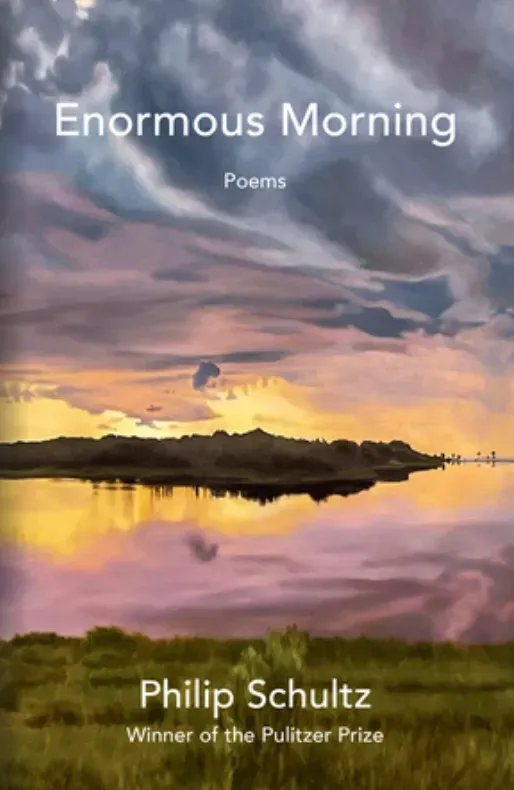
Enormous Morning
Poems by Philip Schultz
W.W. Norton & Co.
Review by Allan Appel
Step One: Accept the idea of 19th century art historian Walter Pater and poet Ezra Pound, who tell us that poetry, indeed all art, aspires to music. I’m not sure I know what that entirely means, but I’m persuaded.
Step Two: Turn on the TV or look around. These are times where misery can seem to have the upper hand – in Ukraine, in Gaza, in the lives of the chronically unhoused New Haveners and those displaced by fire. So a manual to make musical magic happen seems to be one we should pay some attention to.
That’s why I prescribe a cool margarita and a careful read of the affecting new collection of poems to be published next week by W.W. Norton & Company: Enormous Morning by Pulitzer Prizewinner Philip Schultz. He’s an octogenarian whose birthday happens to be Jan. 6, the day of the Capitol insurrection, so those are two reasons he knows what he’s talking and writing about.
There are more, and the formula for the magic will also soon be revealed; read on.
Schultz, who established the graduate creative program at New York University and a founded a highly respected private creative writing school called The Writers Studio, won the Pulitzer in 2007 for Failure. That collection was touted for a breakthrough confessional candor in writing about a struggling blue-collar childhood centered on the relationship of the writer and his dad, a luftmensch workaholic who emotionally ignored the family 24/7 to try to make a doomed vending machine business succeed.
Consider the first lines from the eponymous title poem of that collection:
To pay for my father’s funeral
I borrowed money from people
He already owed money to.
One called him a nobody.
No, I said, he was a failure.
You can’t remember
a nobody’s name, that’s why
they’re called nobodies.
Failures are unforgettable.
The verbal alchemy, that is, the magic that is poetry, emerges here in how Schultz, using the simplest means and the most straightforward language, has turned personal story, autobiography in which he could have slipped and slogged, into a grand, universal, and ironic statement. And one that is true.
For that’s Schultz’s deep aim in all he’s writing. In the spirit of John Keats, the truth about fascinating failures that Schultz has arrived at in these lines gives a kind of retrospective, perhaps even redemptive beauty to the suffering that adhered to the original experience.
Then check out the concluding lines, which – perhaps because my dad had more than a little in common with Schultz pere – took my breath away:
. . . He didn’t believe in:
savings insurance newspapers
vegetables good or evil human
frailty history or God.
Our family avoided us,
Fearing boils. I left town
But failed to get away.
Schultz’s new collection, Enormous Room, is touted on the book-jacket flaps as a female-centered sequel. There is indeed emotional candor here about Schultz’s mother, a long-suffering helpmate who counted coins from the father’s vending machines but had to earn extra as a file clerk to make ends meet. Even though she was artistic and brilliant she was denied opportunities by her Orthodox Jewish dad.
Oh, how those emotionally tone-deaf dads keep coming back!
The collection focuses on other women as well. The writer’s grandmother comes to life in a haze of Holocaust reflections. An especially haunting poem focuses on the poet’s sister, a stillborn, who, Schultz says, is, after all these 80 years, still within him. There are walks with his sculptor wife taking in the beauties of the seashore (he lives in East Hampton, across the Sound from us) and the lessons about life and love that dog ownership provides
However, I think the book flaps protest too much.
Schultz is not a “chronicler of compassion” for moms or dads or even his beloved canines. That would make him a social worker or an essayist.
He’s a poet.
And he’s interested in larger truths about this miserable/joyous experience of being human. Those truths can emerge from an intense retrospective observation of his own life — particularly that fraught and painful childhood. They can emerge from what’s around him now and new, a lifetime later.
In the poem “Santos,” for instance, he observes his dog chasing frisbees and the dog’s “entranced by the idea of passion being rewarded by pride.” You can’t tell me that Schultz is reflecting solely here on the lives of doggies.
One of Schultz’s signature skills is taking “miserable” subject matter – other poem titles include “Sacrifice” and “Suffering” — and personifying them so cleverly and even lovingly. They come to life as a memorable someone you might run into at your high school reunion or a difficult member of the family.
In one of my favorite poems, “My Mistakes,” Schultz begins with: “My mistakes like to argue about which is the most offensive.” They include regrets about his behavior during a radio interview, words or names he mispronounced at important times.
Then there’s this anthropomorphized mistake:
One waits until I’m asleep to ask why,
after all my father poems, in my one mother poem,
after all her sacrifices, I mentioned her bunions
and weak ankles, which hurt her deeply?
By the time you finish Schultz’s chronicle of those amusing and troubling mistakes, you already have felt – by the alchemy of concretizing the abstract – that these complaints are behaving like real raucous children shouting for the writer’s attention. Yet it’s not a happy ending: The children — that is, the lifetime of serious emotional errors — “know my passion for self-loathing is irresistible.”
The wonderful poem “Happy Endings” informs us that “happy endings are rarely reasonable, after all/ they must work hard to earn our belief.” Yet this one ends in hope, the enormous morning of the collection’s title, which turns out to be as modest as it is true:
happiness arrives when least expected
almost always uninvited. No matter how
unprepared we are the inexorable
eventually knocks. In fact, there it is now,
out on the lawn, lulling about, waiting
for an ending happy enough to be invited inside.
Some poets are sprinters, some middle-distance runners, others marathoners. Interestingly, 90 percent of the poem lengths in Enormous Morning are about a page or a page and a quarter.
That feels just enough for you to enter, dive into the recollection/memory/argument, participate in the subtle shift. You emerge aware of how the particular has been turned into the general, the past into the present, the once painful into a present ironic moment of truth.
It’s when Schultz is less certain of where the poem is going when he focuses on otherpeoples’ struggles or miseries. The short piece “Navalny,” his attempt to understand the source of the great Russian dissident’s courage, can’t achieve the elevation he’s striving for, for instance. In the wonderfully titled “Broken Hallelujah: After Eric Fischl,” his attempt to plunge into and behind the canvas of that painter, he’s less again. The writer is not nearly as close to the biographical furnace, the source that his soaring depends upon, so such poems remain more on the surface. They don’t quite take off into something larger than themselves.
I would have left out of this 80(!!!)-page collection a half dozen or so poems, including the ones to the writer’ kids on their special occasions, and the epithalamium “A Marriage Song,” for his friend the fine poet Edward Hirsch and Lauren Watel.
I’m nearing 80, as well. I too have published a few collections of poetry. But what do I know? I haven’t won the Pulitzer Prize.
But this I do know: At 80, when you write a collection of poems, the book and the poems you choose to include function as an accidental memoir. You want to get in there not only these fine, plangent, melancholy, bittersweet, memory-launched odes to being human. You also want to fit the people and places that account for your present joy, and for that your endless gratitude.


