
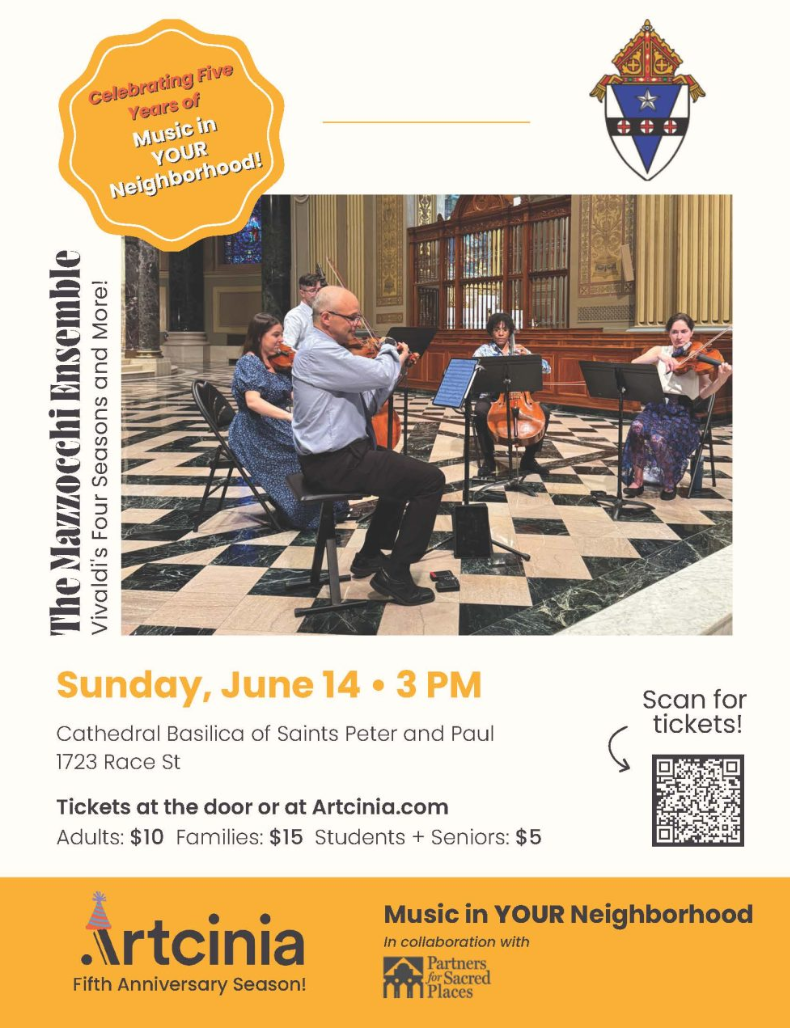
Vivaldi’s The Four Seasons
The Cathedral Basilica of Saints Peter & Paul
1723 Race St.
Philadelphia
June 14, 2026
On a warm and bright summer afternoon in Center City, about 50 music lovers filed into The Cathedral Basilica of Santa Peter & Paul. The modest crowd of casually dressed elders and young folks, and a few dudes in soccer jerseys were there for a performance of one of the most famous works of European classical music: Antonio Vivaldi’s The Four Seasons. Composed between 1718–1723, The Four Seasons is built on four violin concertos representing spring, summer, autumn and winter. It's considered to be one of the earliest examples of program music, an instrumental composition designed to evoke a narrative.
The performance was hosted by Artcinia, an organization launched during the height of the COVID pandemic with a mission to deliver affordable concerts to accessible spaces throughout Philadelphia. This performance of The Four Seasons marked Artcinia’s 200th performance and the concert’s modest $10 ticket was properly aligned with the organization’s ethos. The seven-piece ensemble was led by violinist Luigi Mazzocchi with Gared Crawford and Joseph Kauffman on violins, Ralph Allen on viola, the cellist Jie Jin, Brent Edmonson on bass and harpsichordist Cameron Khan. Upon first entering the cathedral, one is struck by sheer physical scope and grandeur of the interior. As I took my seat, the ensemble began the day’s program with two short but gorgeous pieces: “Sonata in B-flat Op.5 No.15” and "Concerto for Three Violins in F RV.551."
The ensemble's performance of The Four Seasons opened with Concerto No. 1, “spring." Perhaps the most recognizable movement of the entire piece, the lively, uplifting composition beautifully articulates the sound of nature teaming with new life. As the fertile, blooming spring transforms into summer, the first movement, Allegro ma non tanto takes over. The music here took on a richer, more melancholy atmosphere as Vivaldi intended the summer section of The Four Seasons to depict the heavy, relentless heat of the summer sun. A virtuoso of the violin, there were moments when the high notes in Mazzocchi’s solos were practically dancing off of the walls of the cathedral. “Autumn” opened with another immediately recognizable motif that practically vibrated with the same playfully, transitional energy of the fall season. By the Mazzocchi’s ensemble reached “Winter," the music took on a darker, more intense, but triumphant air. This section reminds us that even though the cold season will kill off the lush, green world that came before it, there is beauty and another cycle of rebirth just around the corner.


