
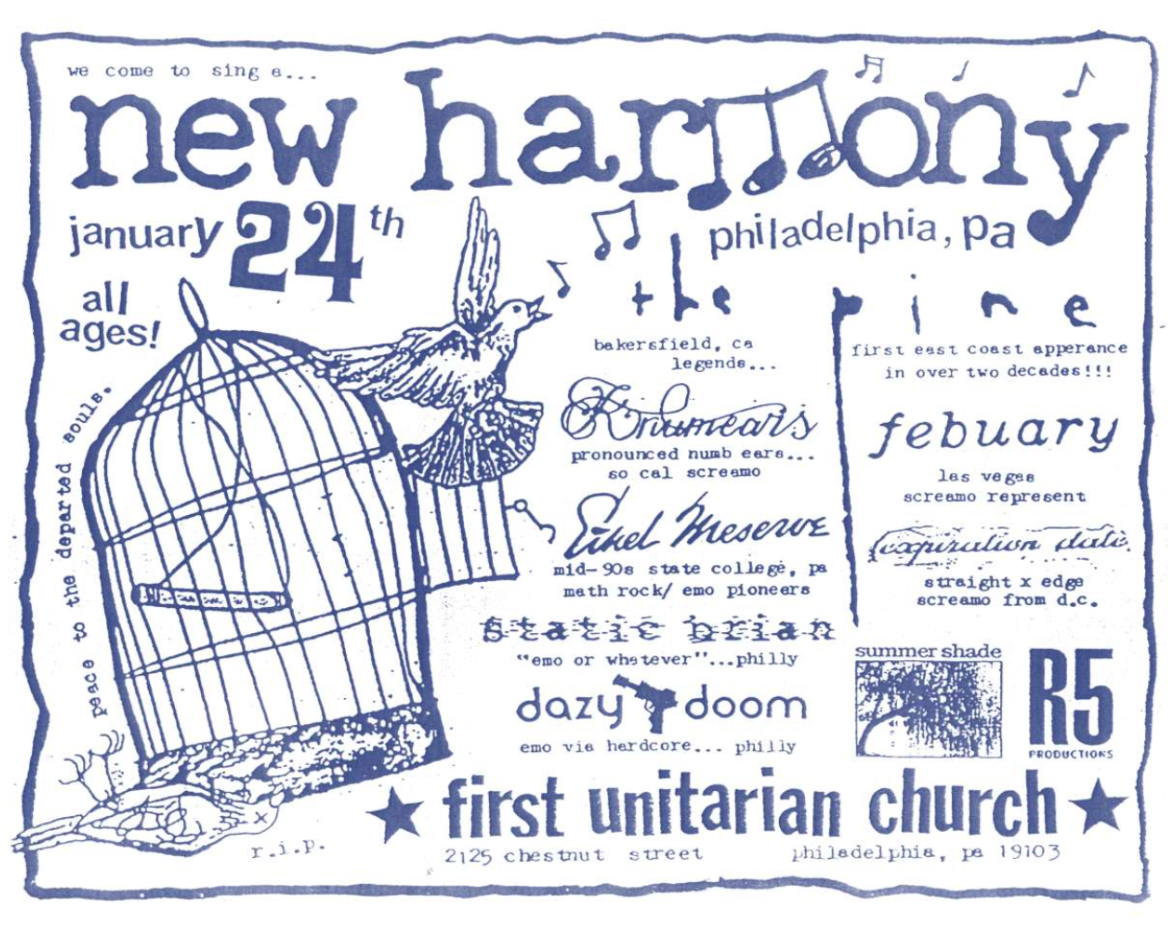
New Harmony
First Unitarian Church
2125 Chestnut St.
Philadelphia
Jan. 23, 2026
The Strauss-Howe Generational Theory basically asserts that historical events, specifically in the United States, recur in 20 year cycles. These cycles exist within a larger timeframe of (also cyclical) 80 year periods referred to as “saeculum.” That’s a free band name right there. This next sentence will hurt some to read, as it hurt me to write, but, 20 years ago, it was 2006. I was 13, and very interested in underground rock music, though I was a year from attending my first DIY show, and about 3 or 4 years from that one month that I listened to nothing but As The Roots Undo. That was how I got really, really, into screamo.
Strauss-Howe Generational Theory
In the two decades that have passed, I’ve watched screamo go from uncool, to painfully uncool, to “coming back.” I made a lot of my own music that was very deeply influenced by screamo. I saw the tiny t-shirts/baggy pants combo go out of style and return. I can’t act like this is some special shit. On “Excursions,” the opening track on Tribe Called Quest’s seminal album The Low End Theory, Q-Tip offers his own experience of Strauss-Howe Generational Theory:
Back in the days when I was a teenager
Before I had status and before I had a pager
You could find the Abstract listening to hip-hop
My pops used to say, it reminded him of be-bop
I said, well daddy don't you know that things go in cycles
The way that Bobby Brown is just ampin' like Michael
New Harmony, which I attended last weekend, is essentially a celebration of the youth participation that has breathed new life into screamo. It’s an effort the older punks at R5 (for whom I also work) make to give the new blood a larger and historic stage to showcase their talent while welcoming back veterans of the sound, like The Pine and Ethel Meserve, to harvest the fruits of their decades of labor. Young bands of the night includec Expiration Date, Knumears, Dazy Doom and Static Brian (who both come from Philly), and February (who had a stellar 2025.)
While witnessing and preparing first aid for the third injury of the night, I thought about what’s the same and what’s different about the changing screamo scene. I thought about how these shows are less dominated by all cis-male bands than they once were, and how each of these three injuries, in fact, happened during February’s set. I thought about how annoying I’ve always found spinkicking, and how the show injuries of others now make me feel exhausted half the time instead of proud all the time. I’m too old to pretend that getting hurt in a country that offers fewer health benefits each year can be that cool, but I’m also not old enough to really internalize that I shouldn’t stage dive anymore. I mean, David Yow is three decades my senior and he still does it.
I think again about the 20 year cycle. What does this all have to feel like for the people a generation ahead of me? Maybe it’s just one of many times they’ve experienced the Strauss-Howe Theory. When they were doing shit during that ‘97 - ‘02 period, did everyone feel like they were on some cutting edge shit, did it feel like it mirrored the cultural aimlessness of the post-disco era?
Screamo, emo, and post-hardcore were, arguably, in as weird a time when I was 13 as they are now. They’re also three very distinctly different genres with varying sounds and styles depending on region and time period, but often share an audience. Maybe they’ve never not been in a weird time? In ‘06, post-hardcore bands like Thursday were signed to Island Records and in rotation on Total Request Live. Simultaneously, many of the most notable 2006 screamo releases, like Suis La Lune’s Quiet! Pull the Strings!, Loma Prieta’s Our LP Is Your EP, June Paik’s Self-Titled, and the legendary Emo Apocalypse compilation, had a snowball’s chance in hell of getting that kind of coverage. There are bands now playing screamo at Coachella. Conversely, others eschew the idea of doing anything so antithetical to punk ethos, or at least feel like they would never have a chance of doing so.
By the way, Emo Apocalypse includes Philadelphia’s own D’amore, a trio including Peter Helmis and Craig Woods, the founders of the annual and sometimes multi-city Two Piece Fest. Incidentally, 2026 marks the 19th(!) year of Two Piece Fest. If you’re reading this and have or know someone with a band of only two members, the festival is still accepting applications.
I’m not the first asshole with a music column to talk about the ebb and flow of the popularity of emo and screamo. I’m also sure that I’m not going to be the first to comment on the specific intergenerational phenomenon screamo is in the midst of, either. But being caught in the middle ground between something I was once too young to have fully experienced, and am now too old to consider myself at the forefront of is… weird. Not good or bad, but similar to the same indescribable feeling as being part of the first generation to grow up with the internet.
In the past year, R5 has hosted shows for Ink & Dagger, Policy of 3, Frail, and Portraits of Past, all of which I was at. Whether or not you would call any or all of these bands screamo, I noticed the same thing at each of these shows. I noticed it over the course of the last decade I spent playing music, and I noticed it at New Harmony too. Gen Z and Gen X are the biggest consumers of the genre. They’re completely equal, mostly do not fraternize, and yet depend heavily on each other.
As someone in neither category, I wonder about the people around me. I talk about this with other millennials. We thought this whole dead genre we, at one point, were playing or casually interested in was just that: dead. All of the bands we loved and were influenced by, we thought we’d never see. After quarantine ended, it felt like one by one, each of these bands were taking chances on the music and one another again. Not only that, there was a whole generation younger than mine ready to watch, and maybe even open for, these bands once it was time to take the stage again.
It’s easy to find out about the post-Revolution Summer effect on punk and how that became emo, and later, screamo. It’s easy to connect with my elders about what it was like before me, and what it’s like for them now. It’s maybe the only way I can really contextualize these weird feelings about my current understanding of things. It’s one of the best aspects of culture in general and how our humanity manifests in the community of people who love this music. Punk never died, and screamo never did either. It’s just in a new cycle.


