
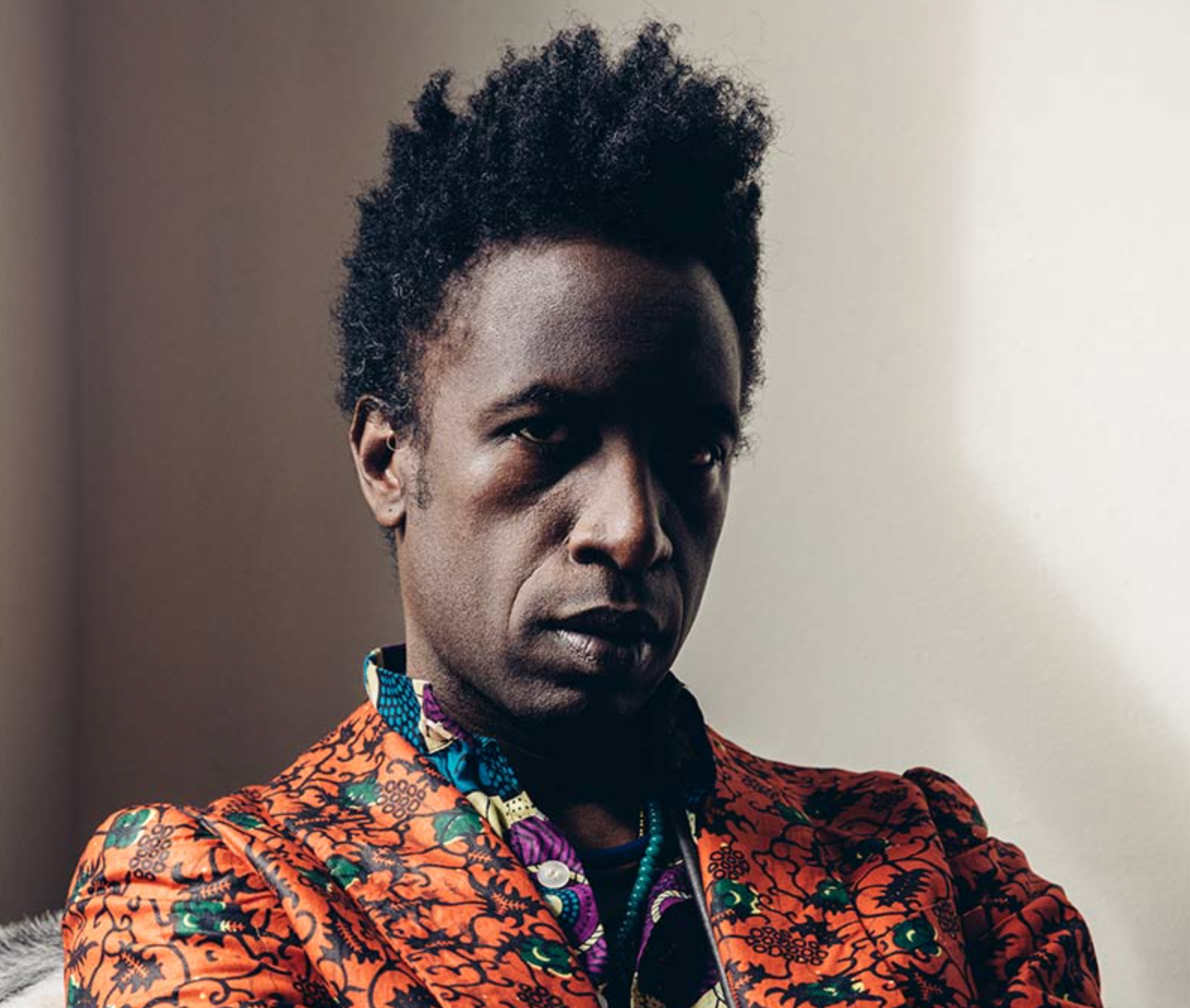
Saul Williams Meets Carlos Niño
Solar Myth
1131 S Broad St.
Philadelphia
April 1, 2026
On Wednesday, April 1st, poet/actor Saul Williams touched down for the first of a two-night stint at Solar Myth in South Philly. Williams is currently touring in support of his 2025 album Saul Williams meets Carlos Niño & Friends at TreePeople. Recorded in a single improvised session in California in the winter of 2024, the album pairs Williams with composer and multi-instrumentalist Carlos Niño and an all-star cast of musicians. Famously, Niño was one of the primary minds behind Andre 3000’s 2023 dalliance with ambient jazz, New Blue Sun. In stark contrast to the dreamy, chilled-out instrumentals of New Blue Sun, Saul Williams meets Carlos Niño & Friends at TreePeople is fiery and authoritative, touching on everything from the horrors of capitalism and government control to the pervasive nature of social media. This music is as righteously indignant as it is vulnerable, and at the Thursday night show, Williams, Niño, and crew hit the stage at Solar Myth with the power and fury of a ballistic missile.
Williams and company walked through the narrow walkway, dividing both halves of the seated audience with steely purpose. As Williams made his way to the stage, he played a shaker, slowly and intentionally. The casual crosstalk from the audience came to a halt as a hush and stillness fell over the room. Seated in the middle of the stage next to vocalist and archivist Dorothy Berry, the band swelled into a weighty cloud of percussion and Surya Botofasina’s freely flowing piano runs. For the first time, Williams addressed the crowd directly and broke the building tension and anticipation.
“We have begun to look at the Catholic Church as the first start-up…” The room burst into an uneasy laughter, and from there, the ensemble launched into a sprawling, improvised set of experimental jazz and spoken word. Thematically, the performance combined poetry and historical prose to weave an ambitious story of the West as an empire built upon the twin evils of colonialism and capitalism. By connecting past events like the expropriation of indigenous land in the Americas and the slave trade to contemporary horrors like the genocide in Gaza and the exploitation of Africa’s mineral resources for Western technology, Williams paints “the empire” of the West as a multi-headed hydra whose influence shapes every aspect of the modern world.
In his rich and commanding voice, Williams revealed that he is traumatized by these past and present horrors. “I find myself haunted by the children of the night. Their spirits haunt this space right now.” He referenced a poem he began writing three years ago, but could never get past the first line: “I have never seen so many dead children…” The line could have easily gone down like a lead balloon, but instead, a few murmurs of agreement rose up from the crowd. Since Oct. 7, 2023, and the Israeli government’s violent campaign in Gaza, we’d all been inundated with images of dead and wounded Palestinian children, broadcast directly to our phones and laptops via social media. Williams reminded us that although many of these atrocities have been occurring halfway around the world, they are still connected to us right there in this small bar/venue in South Philly.
“They'd have you believe that this small theater is somehow separate from their theater of war,” Williams remarked somberly.
Much of the night’s performance centered around Williams’ accounts of indigenous massacres, the buying and selling of human beings, and a vast, global network of exploitation. These stories and the images they evoked were complemented by the band’s deft improvisations. In the moments where Williams' and Berry’s voices expressed tenderness and insight, the band responded in kind with a soundbite that supported those dynamics. When the vocals turned to outrage and disgust with the state of the world we live in, the band would rage alongside Williams. At one point, when the subject of the U.S. and Israel’s war against Iran came up through Williams’ words, pianist Surya Botofasina played a haunting harmonic minor motif, evoking the sound of the Middle East. Before closing with a rousing rendition of Williams’ classic poem “Coded Language,” he spoke to the crowd and offered a call to action. Reiterating that revolutions not only require violence — they also require teachers and nurses and artists — Williams told the room, “We're not asking you to do something you're not good at. We're asking you to direct your talents to indigenous sovereignty and Black liberation. There is no other truth to be had on this land.”


