The Comet/Poppea
Yale Schwartzman Center
New Haven
March 23, 2026
I have been to only two operas in my life, so imagine my delight when I got the rare chance to double my opera intake in a single evening. The spectacle left me, in a word, stunned.
I was so mesmerized I forgot, for a moment, the intense work that lay ahead. How was I meant to comprehend the viewing of two operas at once, let alone convey the stories coherently? How to distill such vital messages from The Comet/Poppea that apply to our current evil times?
But forget the messages for now. I cannot get over what my eyes beheld.
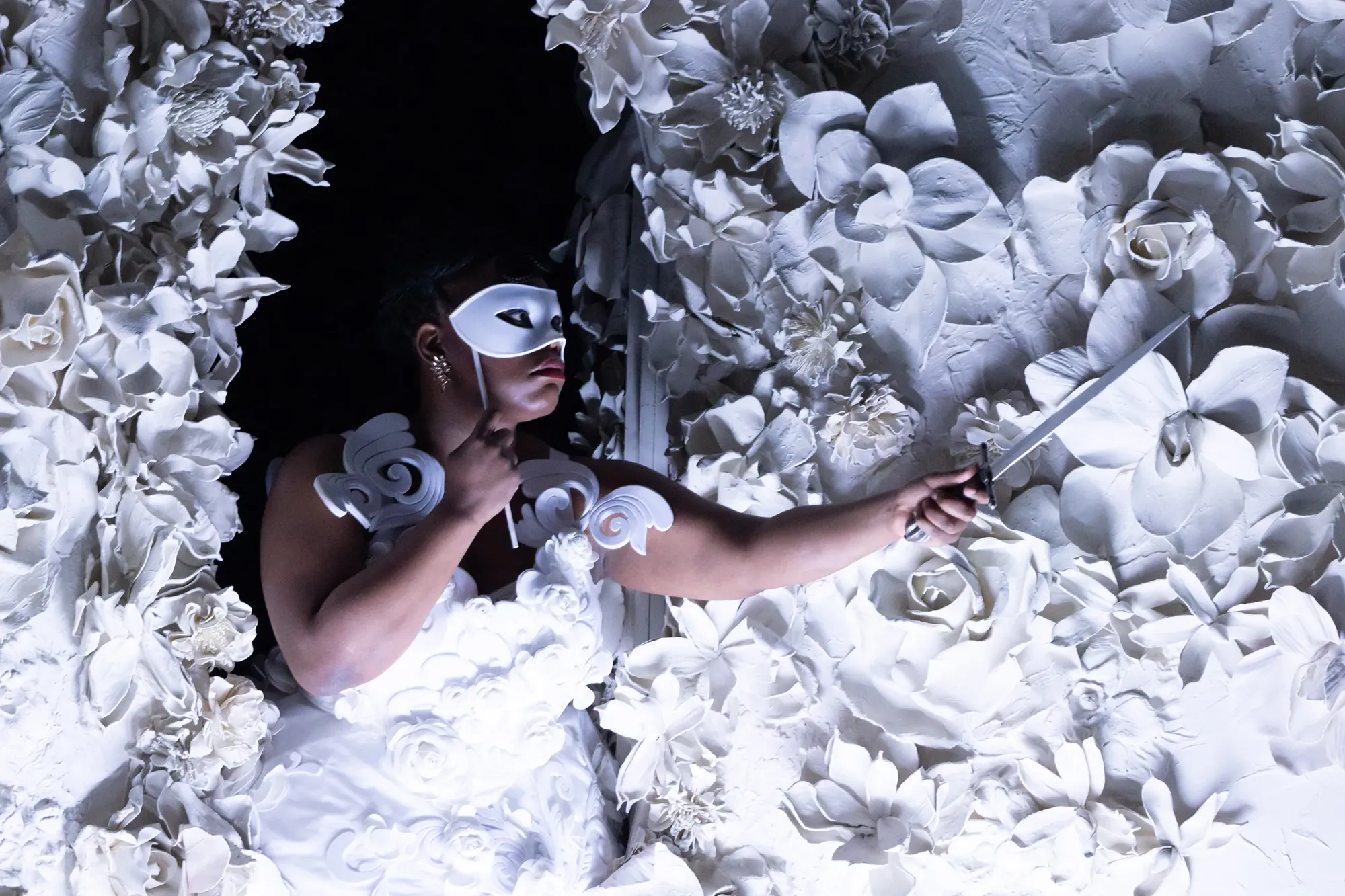
The Comet/Poppea gifted me a scene with the single most stunning image I’ve ever seen in my life. It lingered in my mind as I drifted off to sleep that evening, stubbornly resisting language.
In this scene, the goddess Love (Joelle Lamarre) emerged from an opening at the top of a wall made of lavish whorls of white flowers. She wore a white gown made of the same blooms, looking like a bride atop a wedding cake. She seamlessly blended into the wall, making for an arresting, larger than life visual. Love perched there, still and regal, as the stage spun round and round. The effect was that of a figurehead on a grand ship’s prow.
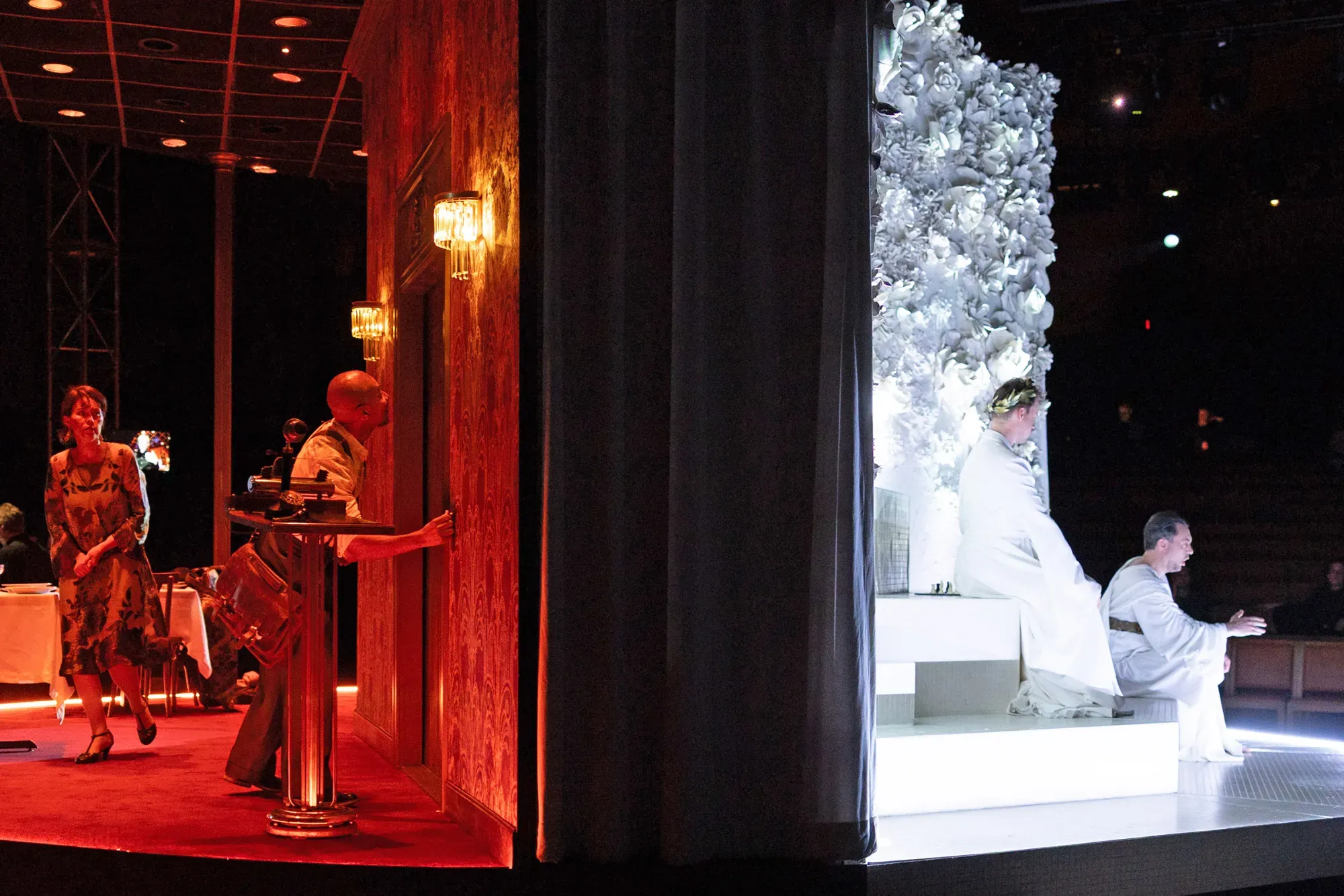
The Comet/Poppea presented two operas at once on a bisected rotating stage.
L’incoronazione di Poppea (The Coronation of Poppaea) is a classic, 17th century opera set in ancient Rome about the cunning Poppea, mistress of Emperor Nero, and the various players and deadly machinations that drive her to becoming empress of Rome. There are love triangles, murder plots and betrayal. No spoilers, but let’s just say the ending darkly reflects the present day in which it seems evil prevails.
The Comet is a contemporary Afrofuturist opera based on an experimental short story by W.E.B. Du Bois set in 1920s New York City. A comet hits the Earth, and a Black man and white woman are the sole survivors. The two uneasily navigate the vestiges of white supremacy as they fight for survival.
Though there are clear political messages in both works, they are not didactic. It is up to the audience to interpret for themselves. I left with the message that the world often runs on power and injustice but that it is vital for humanity to be vigilant and resistant.
Revival Director Alexander Gedeon articulated this theme: “The Comet/Poppea cuts through to something core about the experience of existing as a human through whatever complex power structures that we’re in, and the feeling of being in a moment of unprecedented, maniacal, democratic downslide, which is way more the status quo for how most humans have had to navigate experience. That’s why I think this piece is as timely now as it was when they came up with it, maybe even more.”
The Comet/Poppea was staged in an emptied Commons at the Yale Schwartzman Center, the same dining hall in which The Comet’s MacArthur Award-winning composer George Lewis ate his meals as an undergrad. (Such a grand way to come back to campus!) Ornate light fixtures drew the eyes upward and exquisite millwork framed the room in grandeur. The diverse audience was split up into two sides of the Commons, ensuring no two perspectives were the same of the spinning stage.
“I mean just being in Commons tonight, experiencing this opera with all different people from all walks of life and backgrounds – students, faculty, staff and community members – is so special,” said Rachel Fine, Yale Schwartzman Center’s executive director. “This is a community hub that helps build cohesion and continuity for the New Haven community. It’s such a critical bridge.”
Visually, the two operas occupied strikingly different worlds. Poppea unfolded against a marvel of white – a plaster wall of flowers and a triangular set of broad steps that led up to a bath at the top. The setting felt austere and cold. On the warmer end of the spectrum, the Comet side was a plush restaurant with a stately leather door, scarlet velvet walls, an elegant brass elevator and a charming old-school radio and “candlestick” phone.
At the start of the opera, Jim Davis (Cedric Berry) ran frantically around The Comet’s ruined world, surrounded by dead bodies, trying to figure out an escape. Opposite him, Poppea’s goddesses lounged, in conversation, arrayed in gowns of white and gold. I was struck by the sight of these Black opera singers beautifully displaying braided hairstyles and natural curls. One cast member even sported a trendy undercut.
Yesterday, they would not have served me, sang Jim in his rich baritone. The goddess Fortune’s (Whitney Morrison) luminous soprano rang out simultaneously on the other side, making for a mellifluous pairing. Nero’s (Cody Bowers) pure countertenor was divine alongside Poppea’s (Kearstin Piper Brown) honeyed soprano.
The experience of listening to the mélange of resonant voices from both operas while absorbing two stories was hypnotic and oddly soothing, rather than chaotic and distracting. Lewis’ composition proved to be spellbinding. The orchestras’ rich soundscapes, alternating between modern expansiveness and Baroque intricacy, perfectly accented the action.
As the operas’ plots thickened over the course of the evening, there were power plays and deadly schemes in Poppea and the simmering of age-old racial tension in Comet. The entire cast delivered performances of remarkable intensity. They really played to the audience, their faces emotive, gazes penetrating and gestures expansive. In a few uncanny moments, one side of the stage would go completely still, posed like subjects of an elaborate painting, while the other side was teeming with action.
The operas even bled into one another in a few surreal scenes. Early on, a Poppea goddess peers curiously into The Comet’s world. Later Jim and Julia from The Comet cross over to the Poppea side wearing extravagant silver headdresses that render them as a queen and a warrior, respectively.
At the opera’s close, Lewis, director Yuval Sharon, Gedeon and producers stood proudly on stage along with the cast; Lewis clutching a single white rose. It was stirring to see him get his “flowers.”
Reflecting on The Comet/Poppea’s impact, Lewis expressed that his goal is for people to leave both operas transformed. “I want them to think, ‘That was really different, wasn’t it?’ And then maybe they’ll think, ‘Well, maybe that’s not the only thing that could be different around here.’ That’s the subversive power of music and art, which is to make people think that things really could be different. I want people to really think about how we can forage new lives for ourselves in the midst of radical change.”