
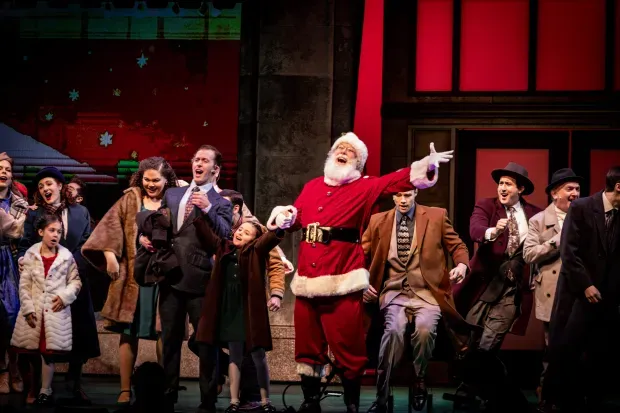
"Miracle on 34th Street the Musical"
Fox Theatre
Detroit, Mich.
Through Dec. 18, 2025
I was thrilled this summer when I learned of the existence of Meredith Willson’s “Miracle on 34th Street the Musical.” This little-known show was originally titled “Here’s Love” when it premiered on Broadway in 1963 and was making its first North American tour this holiday season, directed and choreographed by Antoinette DiPietropolo. Not only was this a musical version of one of my favorite Christmas movies, but the book and music were written by the composer of “The Music Man,” one of my top 10 musicals of all time. Surely this was a winning combination that would make my heart sing when the tour came to Detroit this week.
Alas, I was disappointed to learn the hard way there were solid reasons “Miracle on 34th Street the Musical” has not joined its film counterparts as a Christmas show staple.
The musical mostly follows the story of the original 1947 film starring Edmund Gwenn, Maureen O’Hara, John Payne and a young Natalie Wood. Jaded by love, single mother Doris Walker – who runs Macy’s Thanksgiving Day Parade – is raising her daughter Susan to believe that romance, fantasies and fairy tales don’t exist, including Santa Claus. When the parade’s hired Santa shows up drunk to work, the real Kris Kringle steps into the show and into their lives to make them believe in love and magic again, including facilitating a relationship between Walker and their next-door neighbor Fred Gailey. As Kringle continues his work with Macy’s, he doubles down on his belief that he is, in fact, the real Santa, resulting in a grand Christmas Eve trial to determine if Santa actually exists.
As the overture began, I was excited to hear Willson’s distinct, grand marching-band sound, reminiscent of “76 Trombones.” It made me optimistic for the music ahead. In my opinion, “The Music Man” score is made up almost entirely of bangers; surely at least some of that talent would spread to “Miracle.”
I was disappointed to discover that wasn’t the case. None of the musical’s more than a dozen songs was memorable, with the exception of “It’s Beginning to Look a Lot Like Christmas,” which Willson had written before the show in 1951 (and which wisely was sung multiple times).
The power of musical theater lies in the music’s ability to amplify emotions for the story’s most poignant plot points. Somehow Willson continually missed the mark. The vulnerable scene where Walker shares the pain of her romantic past with Gailey and why she no longer believes in love would have been a ripe moment for song. The finale in which the New York court rules that Santa Claus indeed does exist was another missed opportunity to capture the spirit of the triumph. Walker and Gailey’s similar Marian Paroo and Harold Hill love story could have solidified with a swoony “Till There Was You”-style ballad. Alas, no.
Instead Willson thought it more appropriate for Gailey to sing a bro-ey song with his friends betting on when Walker would be knocking on his door to ask him a favor. “She Hadda Go Back,” reminiscent of “Music Man’s” iconic “Ya Got Trouble,” was unfortunately the catchiest song of the show, wasted on a silly and unnecessary subject that matter that did virtually nothing to advance the plot.
The musical also made some changes story-wise, none of which was positive. In the film, Kringle gets frustrated and with his cane hits the therapist who provokes him. In the show, the therapist fakes the whole thing, which removes a layer of Kringle’s humanity as well as some justified basis for the trial. Gailey – the charming, patient, successful neighbor next door – is a juvenile, bachelor jerk with few redeeming qualities that would win over a woman scorned by love. Worse, his relationship with little girl Susan starts completely inappropriately, borderline predatory. They meet while watching the parade, with Gailey bombarding the little girl with questions about her name and where she lives, eventually convincing her to hop on his back to get a better look – before having even seen her mother, which is his motive for meeting her in the film.
Although the music was lacking, it was still upbeat enough to lend itself to some big dance numbers, which were sorely absent. The parade scene near the top of the show would have been an opportunity for a grand opening number. Instead, we get a parade of scale- down performers, including a baton twirler, a soft-shoeing drum major, a ballerina, Raggedy Ann and Andy and a duet of red sequined-dancers doing simple moves that had no reason to be unsynchronized. My friend – who hadn’t seen the film in years – asked me if the parade was supposed to be bad. Although the solo performers were individually talented, the few group dance numbers were short and unimpressive, with simple marching steps as their signature moves.
I had such high hopes for this show, and to say I was disappointed is an understatement. Willson fumbled a great chance to bring his uplifting, marching band-style sound to another parade-themed show, and one with a solid storyline – with its own built-in Christmas magic – that didn’t need to be altered. The cast did what they could with limited quality material, although a production with bigger dance numbers and effects would have helped to mask the show’s flaws. While I’m glad to have seen this show and add it to my repertoire of musical theater experiences, I can now understand why it had largely fallen into obscurity, and perhaps its for the best it returns to it.


