
The Rise of the House of Weary
Works by Mike Weary
Louisiana Art and Science Museum
Baton Rouge
Through April 12
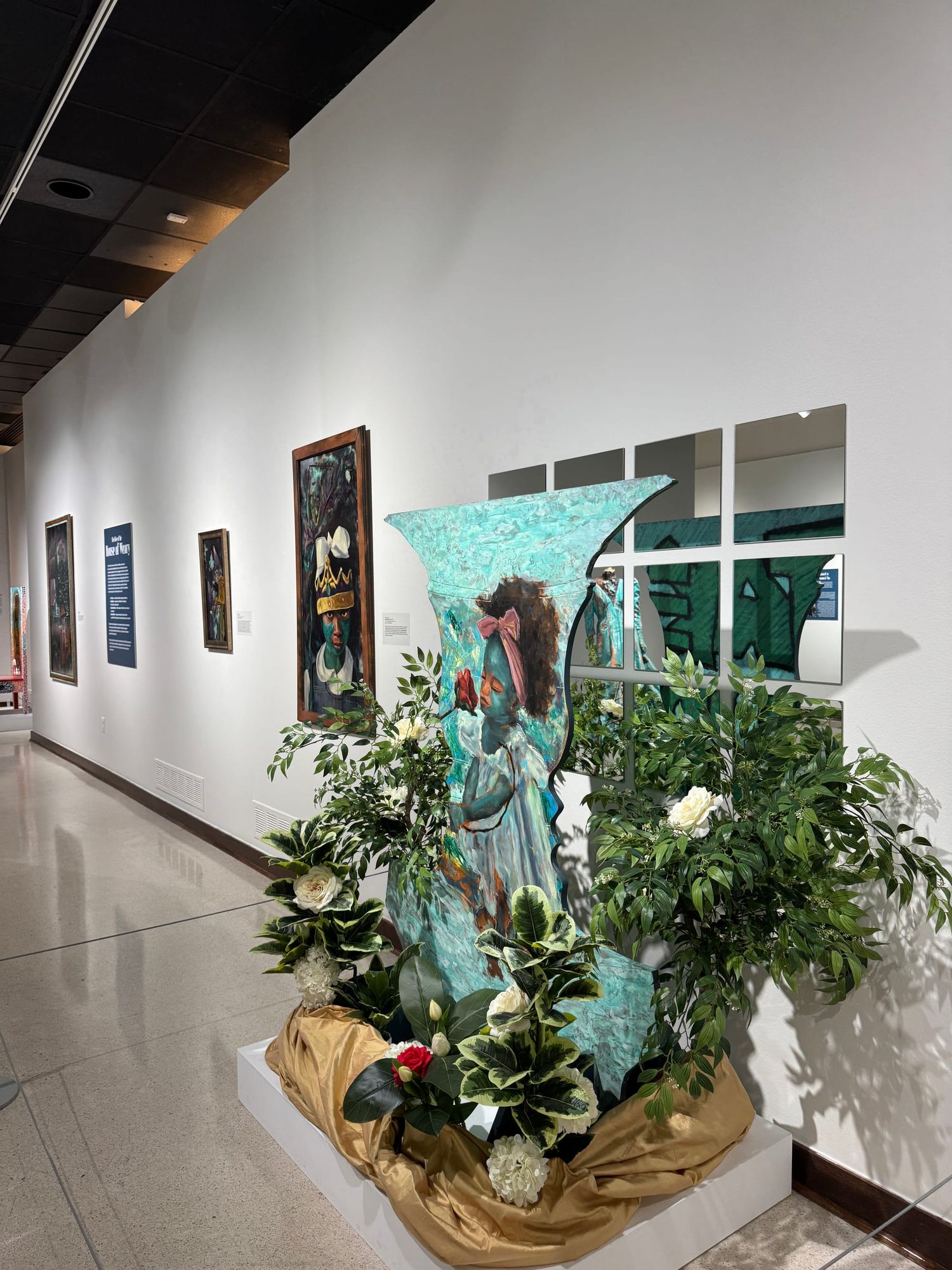
Walking around “The Rise of the House of Weary” is like taking a journey into someone else’s mind. The four walls enclosing the exhibit at the Louisiana Art and Science Museum follow Weary’s reckoning with memory, struggle and hope. On one side, a portrait inspired by his daughter pops off the wall in a vase shape and adorned with foliage. Down into the exhibit, a row of portraits stares back at you. One is an imagined self portrait of Weary, aged by a few decades, wearing a red dress. Across the room, a giant floor length robin blue dress is displayed on a mannequin and artistically draped across a podium.
Mike Weary is a resident artist at the Arts Council of Greater Baton Rouge; he recently curated the Arts Council’s exhibit The Great Reunion which revisits the legacy of the Great Migration. A stone’s throw away at the Louisiana Art and Science Museum, he has his own exhibit called “The Rise of the House of Weary.” The exhibit was inspired by Gothic Literature and showcases four distinct bodies of work: portraits, King Kake, Summer Dream and Electric Blue.
The exhibit is a multi-sensory experience. A QR code on the wall features a curated playlist that includes songs like “Inner City Blues” by Marvin Gaye and “Iko Iko” by the Dixie Cups. The most memorable part of the exhibit is the striking robin blue that feels like it carries from piece to piece. In “Kalika” (2025), Weary reimagines the Hindu goddess Kalika who stands at the threshold between life and death as a Black woman. Though her eyes, nose and mouth have a pop of her human colors, most of her body and face is robin blue. The same blue can be found in the floor length dress and the abstract painting.
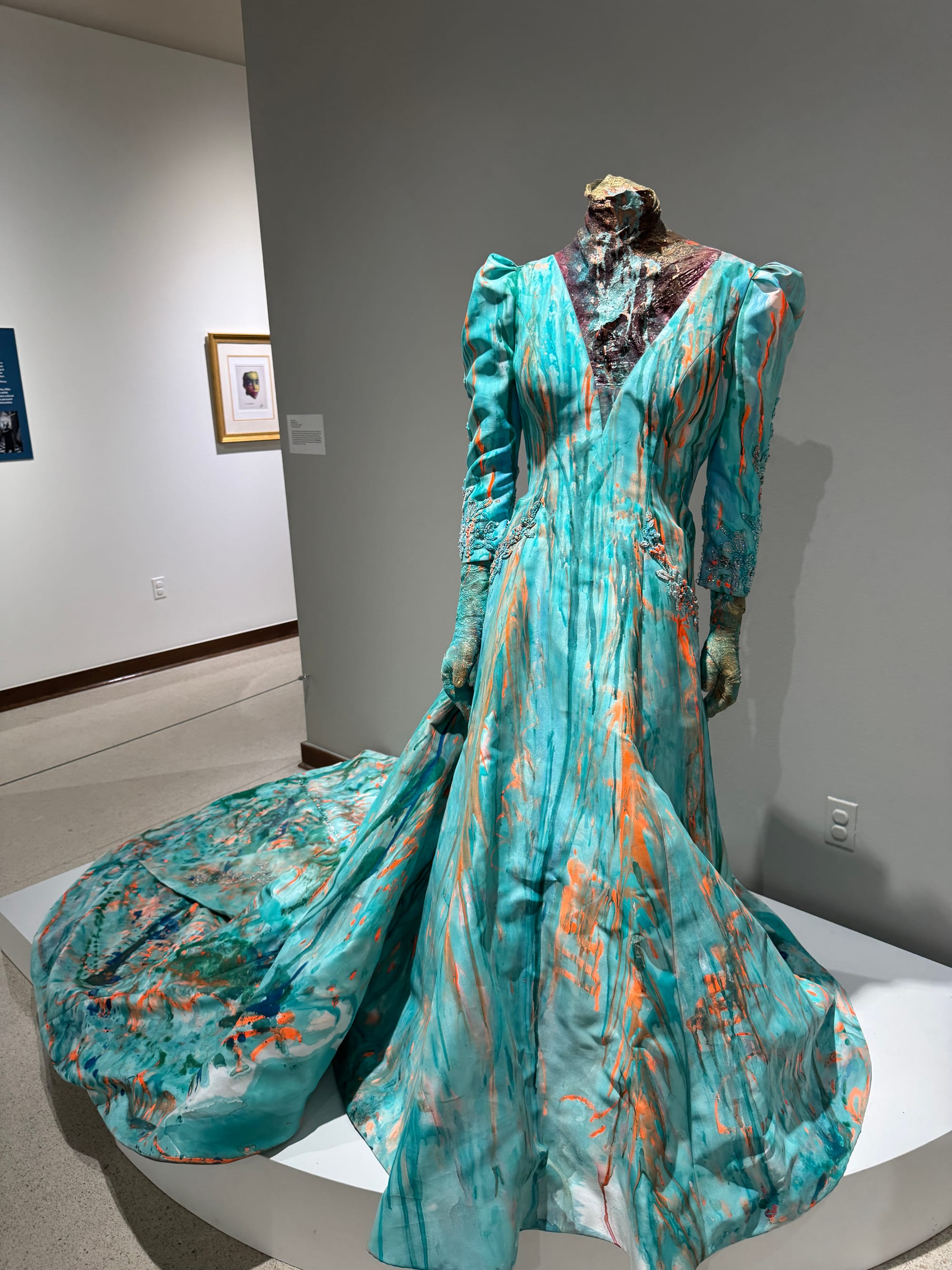
The blue feels in conversation with a whole body of Black art, music, and activism tying the blue to the Black American experience. As noted by Imani Perry in her treatise examining the Black experience through the color, blue has been intertwined with Blackness since before our contemporary construction of Black identity. From the blue of the sea on the Middle Passage to the musical melancholy of the blues to blue jays and jaybirds of Southern folktales, she argues that all this blue isn’t just a coincidence, it’s a way of life.
“This blue-black living and doing is a bittersweet virtue, mastery in heartbreak, and raw laughter from the underside. We people who created a sound for the world’s favorite color—the blues—offer a testimony,” she writes.
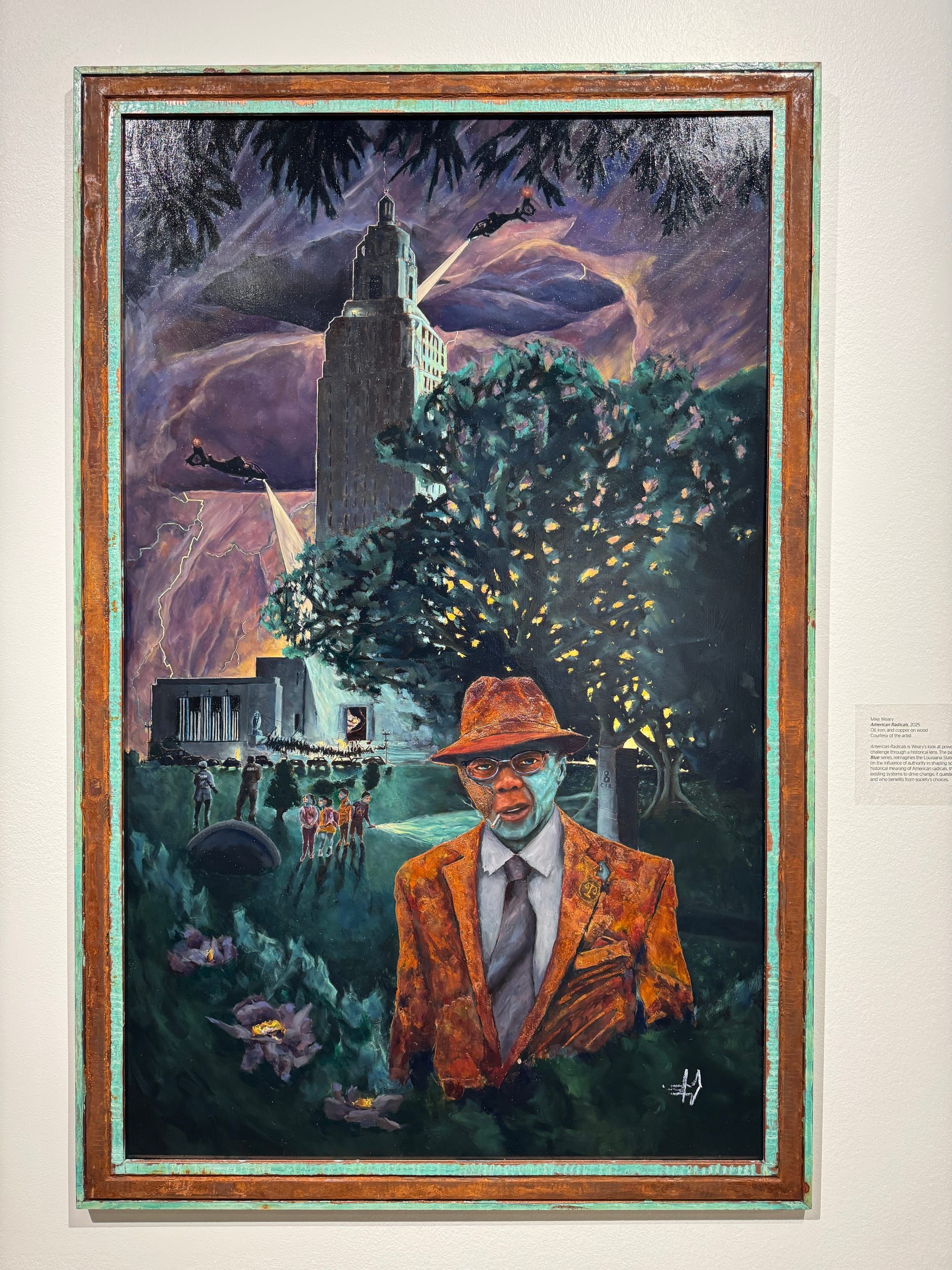
Weary’s art plays on this idea. His pieces in "Electric Blue” explore “the possibility of rising even as foundations seem to crumble.” One striking piece of that series is “American Radicals” (2025) which reimagines the Louisiana State Capitol building on a stormy evening with protestors in front of the building. A Black man smoking a cigarette stands in the foreground wearing a fedora. He has blue eyes and half his face is blue. He’s not looking at the chaos behind him. He’s looking at us, the viewer, as if we are the interesting thing happening here, not the lighting striking, not the helicopters with search lights descending on the building. Weary’s art is on display but it’s looking at us.


