
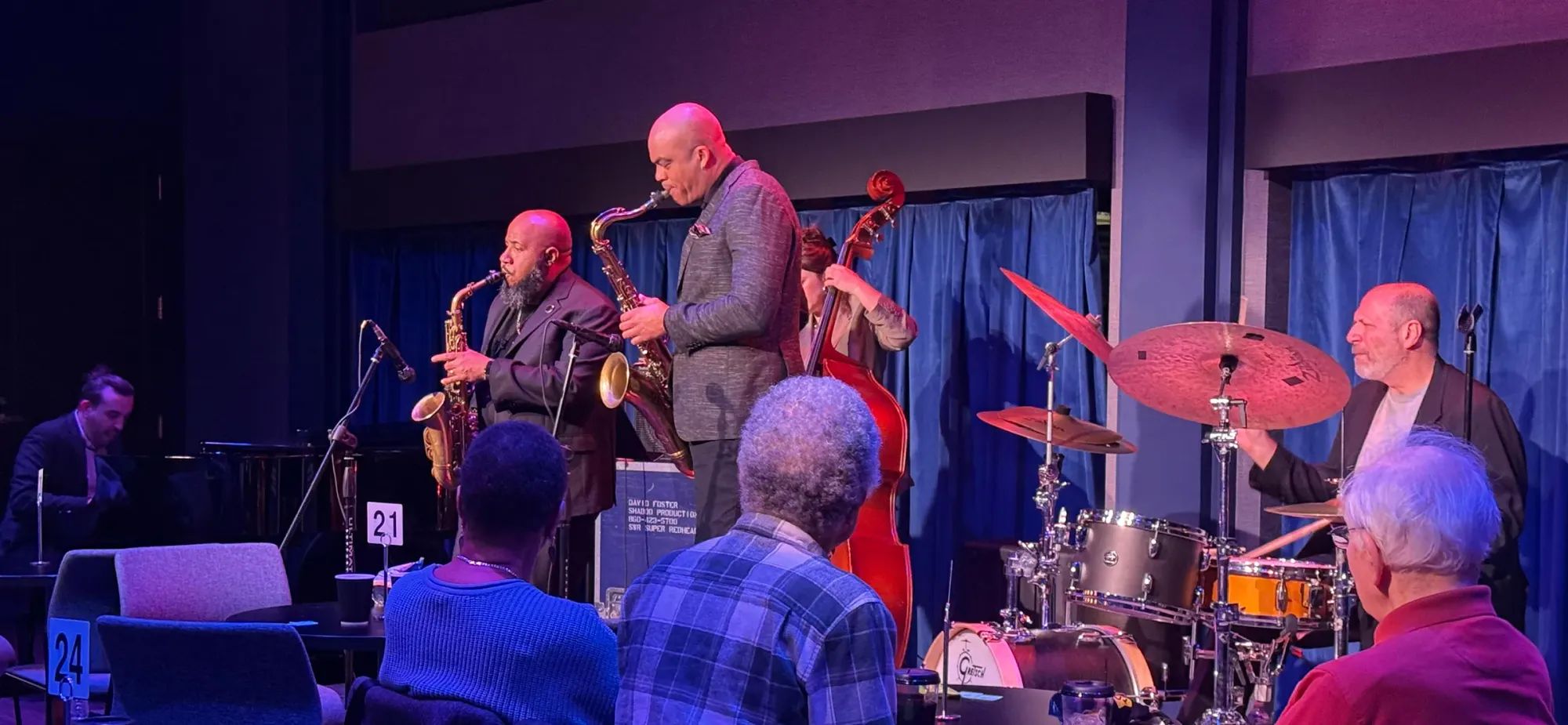
Metta Quintet
Shubert Theatre
New Haven
March 13, 2026
Two giants of jazz made Elm City’s Cabaret, the intimate music hall at the Shubert Theatre, their home Friday night.
Metta Quintet was the entertainment for the evening, performing a set devoted entirely to John Coltrane and Miles Davis music.
Metta Quintet is the resident ensemble of JazzReach, a New York City-based nonprofit that has been offering jazz educational programming to the public for over 30 years. On Friday JazzReach partnered with Shubert Theatre for a full day of jazz-related events that included jazz instruction for hundreds of students and a session with Betsy Ross Arts & Design Academy’s sixth to eighth-grade band. “All we can do is plant the seed,” said JazzReach founder Hans Schuman.
The party got started with “Dr. Jekyll,” which Davis and Coltrane recorded and Connecticut resident Jackie McLean, a jazz alto saxophonist, composed. A spirited conversation between the two saxophones – Christopher McBride on the alto saxophone and New Haven’s own Wayne Escoffery on the tenor sax – led the performance.
The band buoyed the saxophones. Schuman gently ticked on the drums, Adi Meyerson plucked at the bass unhurriedly and Roberto Acosta kept up the tune’s brisk pace on the piano. The mischievous song was a jolt of energy that livened up the space.
In contrast, the Quintet’s rendition of Coltrane’s “Central Park West” was a sweeping moment of earnestness. Beautiful notes bubbled from the alto saxophone as Schuman softly brushed the drums. Well-placed piano chords bloomed within the song as the bass and drums traded rhythmic gestures in quieter passages. As the piece came to a close, McBride drew out the last note for maximum emotional effect. There was a feeling of late-night stillness in the song’s atmosphere as if one were observing something sublime that shouldn’t be disturbed.
Throughout the evening, the two horns seemed to lean toward one another, trading phrases like old friends reminiscing about a shared past. At times, McBride and Escoffery seemed to circle the same melodic idea from different vantage points. Meanwhile, the rhythm section moved with understated assurance. Meyerson’s bass lines anchored the music with a steady pulse, while Schuman’s drumming alternated between gentle brushwork and crisp accents that nudged the music forward. Acosta’s piano added flashes of color – rippling runs here, luminous chords there – like quick brushstrokes illuminating the band’s sonic landscape.
Coltrane’s “All Or Nothing At All” featured a sharp, singing horn riding a steady, sparing rhythm from the bass and drums as Escoffery coaxed notes from his saxophone. When it was McBride’s turn to tease out the melody, Escoffery looked on approvingly. The piece felt as vulnerable as it felt meditative. It closed with searching phrases from the saxophone and dissolved into cascading notes from the rhythm section.
A flurry of piano notes underpinned “All Blues” by Miles Davis as the horns circled one another in a dance, echoing one another. The tune remained calm at its center, allowing the melody to breathe. Meyerson swayed with the groove while Escoffery’s tall frame curved along with the notes that poured out of his saxophone. The ending of the song became the beginning once more as we returned to the initial melodic theme, punctuated by a few flourishes – discordant piano chords and snappy drums.
Metta Quintet ultimately carried the crowd on a richly textured journey through the words of Coltrane and Davis. The performance captured the emotional breadth of their music – its wonder, introspection, and joy. For an evening, their legacies breathed again, living in the exchange between the musicians onstage and the community that gathered to hear them.


