
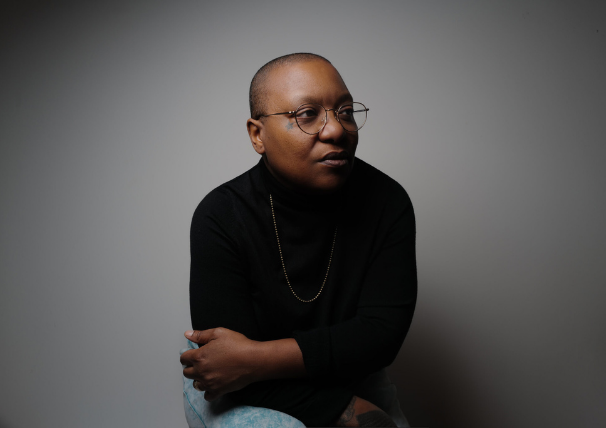
Meshell Ndegeocello
Morse Recital Hall
Feb. 6, 2026
New Haven
Halfway through Mehsell Ndegeocello's Friday performance of No More Water — her Grammy-winning 2024 album of songs inspired by and contending with the work of writer and civil rights luminary James Baldwin — at Morse Recital Hall, as part of the Yale School of Music's Ellington Jazz Series, the famed musician and bandleader explained how she became connected to The Fire Next Time. She had never read Baldwin's 1963 classic until she was commissioned by Harlem Stage to write a piece about it, for a performance slated for 2015.
"It was life-changing," she said. "I carried it around in my pocket for three and a half years." It wasn't just that The Fire Next Time is a searing look at race relations in the United States that echoes across the decades in startling ways into the present. In its pages, Ndegeocello found connection and understanding with her own parents, whose belief in the American Dream, Ndegeocello said, lay at the core of their difficulties when they realized they would never achieve it.
“We are controlled here by our confusion, far more than we know," Ndegeocello said, quoting Baldwin, "and the American dream has therefore become something much more closely resembling a nightmare, on the private, domestic, and international levels. Privately, we cannot stand our lives and dare not examine them; domestically, we take no responsibility for (and no pride in) what goes on in our country; and, internationally, for many millions of people, we are an unmitigated disaster."
In the intervening years since 2015, "I have returned to that work," Ndegeocello said. "It's the work that reminds me that history doesn't repeat itself, but it often rhymes." She finds herself having imaginary conversations with Baldwin when she wonders "what am I doing?" What was her proper place in the continued social struggle Baldwin illuminated years ago? She imagined Baldwin telling her to keep playing music.
"Girl, even if you don't want to, you got to keep going," she imagined him saying, because Baldwin had always known the importance of art to any social movement. As Baldwin himself said, "The poets (by which I mean all artists) are finally the only people who know the truth about us. Soldiers don’t. Statesmen don’t. Priests don’t. Union leaders don’t. Only poets."
Ndegeocello and her band — Justin Hicks on vocals, Christopher Bruce on guitar, Jake Sherman on organ, and Abraham Rounds on drums — amply demonstrated what Baldwin meant. As a singer, Hicks was a revelation, with an astonishing range of expression, from a low croon to a full-throated cry that easily filled the cavernous space of the recital hall and the hearts of those listening. Bruce, switching nimbly between acoustic and electric guitar throughout the evening, proved a master of texture and timbre, making intricate patterns sound effortless and offering just the right sound at the right time. Sherman's seamless organ work gave heft and body to the music, whether providing nimble countermelodies and rhythms or near-orchestral swells of sound. Rounds was a champion of restraint, whether augmenting the soundscape of the music with a variety of percussion or laying down a deeply felt groove. He always played just enough, and just right.
Yet in every second of the performance, Ndegeocello left no doubt as to who was leading the band. As a bassist and vocalist, she was an understated but indomitable force; each note she played was a statement and an instruction for her band to follow, even as she also gave each musician miles of space for their own expression. So the song "The Price of the Ticket" was a delicate heartbreaker: anchored by Bruce's pulsing guitar, Ndegeocello's voice mingled with Hicks's and Rounds's to deliver hard-hitting words about a police encounter ("put down your gun and take your hands off me") as a lilting lullaby. "Trouble" bobbed on a swaying groove between Ndegeocello and Rounds that contributions from Bruce and Sherman made sound subtly titanic, which made the sung chorus shine through: "What's another word for trouble? / 'Cause that's what we're in / Everyone's down for the struggle until it begins /Pain makes you humble, hurt is hard to sing / What's another word for trouble?"
Perhaps the evening's most excoriating song was "What Did I Do?" The entire song was built on a simple, searching bassline that Ndegeocello laid down with weight and intensity. Hicks entered with a plaintive whisper, stating a question that doubled back on itself a few times before it found an answer: "What did I do
To be so / What would you do / If we became you / I can lie too / And be so / Black and blue / Sad and new / Lapis hue." As the song progressed, Rounds, Bruce, and Sherman entered and escalated, unleashing the power latent in Ndegeocello's musical statement. This, in turn, gave Hicks the chance to let his own voice fly, leading the song to a stunning, emotional peak before it ebbed again, leaving Ndegecello still playing, still searching.
Recitations from Baldwin texts throughout showed just how much Ndegeocello had taken her composition cues from her inspiration. Her music matched Baldwin's own lithe and indelible language, the rhythms of his hypnotic oratory. Many Baldwin readers and commentators focus on the breadth of his arguments, the range of his language, the complexity of his thought. Ndegeocello acknowledged and reveled in all of that, but also reminded the audience that beneath all of that was a simple message about the need for love — for ourselves and for others — and the importance of art and community in helping us find it.
“I imagine one of the reasons people cling to their hates so stubbornly is because they sense, once hate is gone, they will be forced to deal with pain,” Ndegeocello quoted Baldwin again. But for Baldwin, that pain wasn't just personal and therapeutic. It was written broadly across society, with the same high stakes for danger — and promise of salvation.
"I do not know many Negroes who are eager to be 'accepted' by white people, still less to be loved by them," Ndegeocello read from Baldwin again. "they, the blacks, simply don’t wish to be beaten over the head by the whites every instant of our brief passage on this planet. White people in this country will have quite enough to do in learning how to accept and love themselves and each other, and when they have achieved this — which will not be tomorrow and may very well be never — the Negro problem will no longer exist, for it will no longer be needed."


