
English
Long Wharf Theatre
At Southern Connecticut State University
New Haven
Through Feb. 1
Goli, an English student, is struggling with show and tell as she tries to explain in English how to use an eyebrow pencil to her adult class.
"This pencil is for make not real hairs," she says. She tries to demonstrate. "This is not good I need mirror."
"You need a mirror," her teacher, Marjan, says.
Goli switches to Farsi, venting her frustrations with the pencil and with her language ability. Her teacher makes her switch back to English, and Goli's speech grinds to a halt. "I am," she says. "I sound ..."
"I for one think it's nice that you can't insult yourself in English," Marjan says.
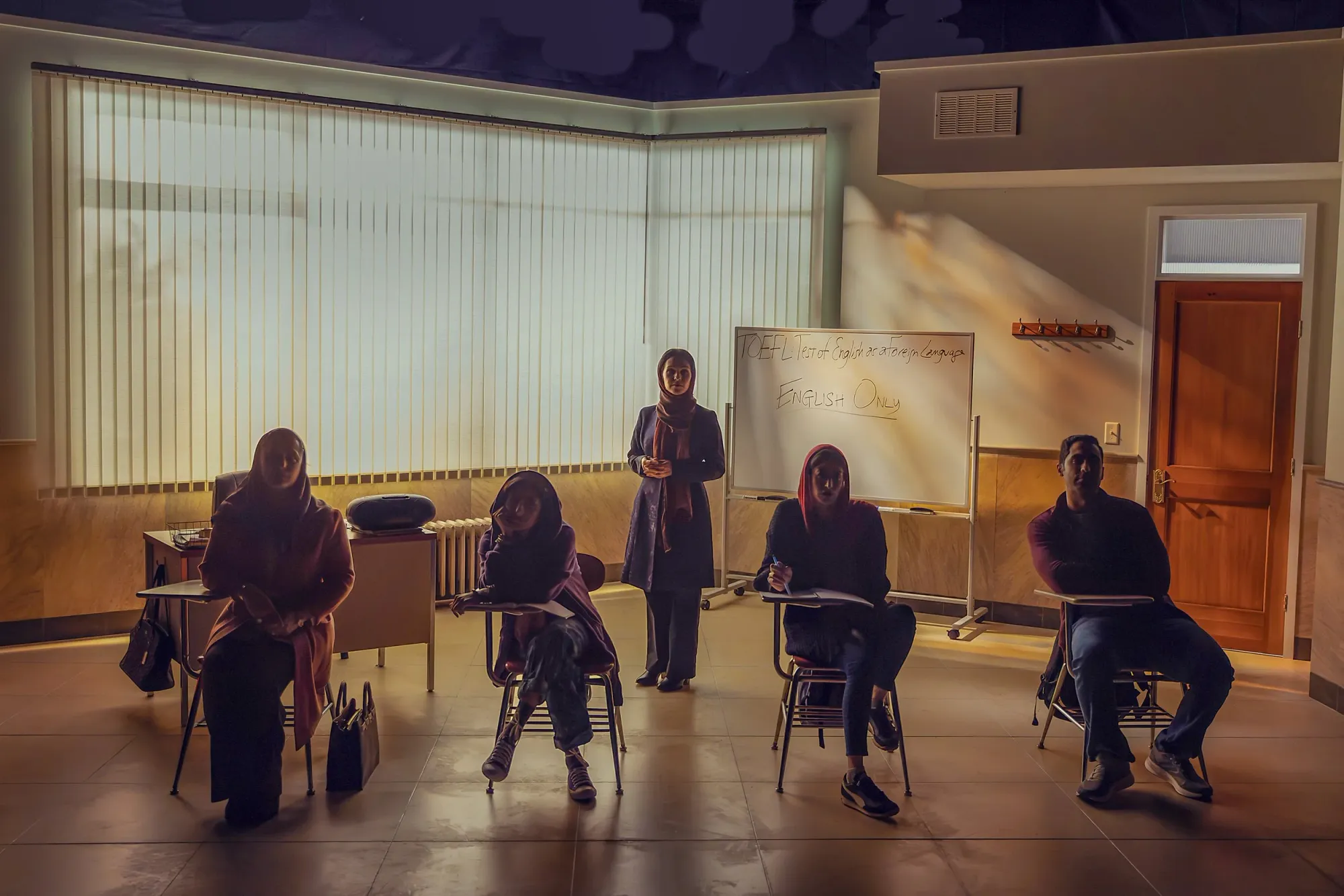
Sanaz Toossi's English — which won the Pulitzer Prize for drama in 2023 and is running now at Southern Connecticut State University in a Long Wharf Theatre production through Feb. 1 — follows four students and their teacher through a class in Karaj, Iran preparing the students to take a Test of English as a Foreign Language (TOEFL) exam. The teacher, Marjan (Neagheen Homaifar), guides the class with a mixture of spark and backbone that, as it turns out, hide a complex insecurity. Her four students, meanwhile, differ from one another in almost every way. Elham (Sahar Milani) is a fierce, competitive young woman with ambitions to go to medical school in Australia; she must not only take the exam, but excel at it. Roya (Nina Ameri) is a stately yet prickly older woman studying English so she can move to Canada to be with her son and his new family. Goli (Aryana Asefirad), an excitable teenager, is studying English to connect more thoroughly with the rest of the world. And Omid (Afsheen Misaghi) is a quiet young man whose English already seems too good to need to take a class for the TOEFL exam; his motivations for the class, at the start, are the murkiest of the lot.
With Arya Shahi's fleet directorial hand, English moves from class to class at a brisk clip; we watch the characters and their situations develop quickly, aided ably by an excellent cast (this production had a run at Hartford Theaterworks in the fall of 2025 before coming to Long Wharf's stage at Southern Connecticut State University). Elham is a gifted student for science and medicine but struggles with language, and Milani captures her sense of wounded pride and humiliation as well as her confidence: she's frustrated that the language won't come to her, but never questions her own intelligence. Goli is in some ways Elham's foil, and Asefirad excels in revealing by degrees that the teenager is actually a much better student than she initially lets on. Ameri is quietly heartbreaking in depicting Roya as a woman whose interest in English is so tied to her desire to reunite with her family that she falters as a student as she learns that her relationship with her son may not be as strong as she thinks it is. Misaghi reveals by layers that the amiable Omid is perhaps more manipulative that he appears. And as Marjan, Homaifar allows the other characters to chip away at her shell of an exterior, letting us first see how brittle it is, and then how deep the anxieties beneath it run.
In Toossi's hands, English's classic format — all the action of the play takes place on one set, the classroom, and we see almost nothing of the characters' lives that happen outside it — acts to constrain the plot and the stakes of the play. When different tensions develop between Marjan and two of her students, Elham and Roya, the consequences only go so far: the students, after all, are there voluntarily, and their final move, should they take it, is to leave the class. Likewise, when something of an attraction develops between Marjan and Omid, it feels muted; English is not the kind of play in which anyone is going to enact a torrid affair on a linoleum floor. The choice to keep the immediate stakes relatively low can seem a little curious, especially when many one-set plays, from Edward Albee's Who's Afraid of Virginia Woolf? to Ayad Aktar's Disgraced, do the opposite, turning the fixed four walls into a pressure cooker.
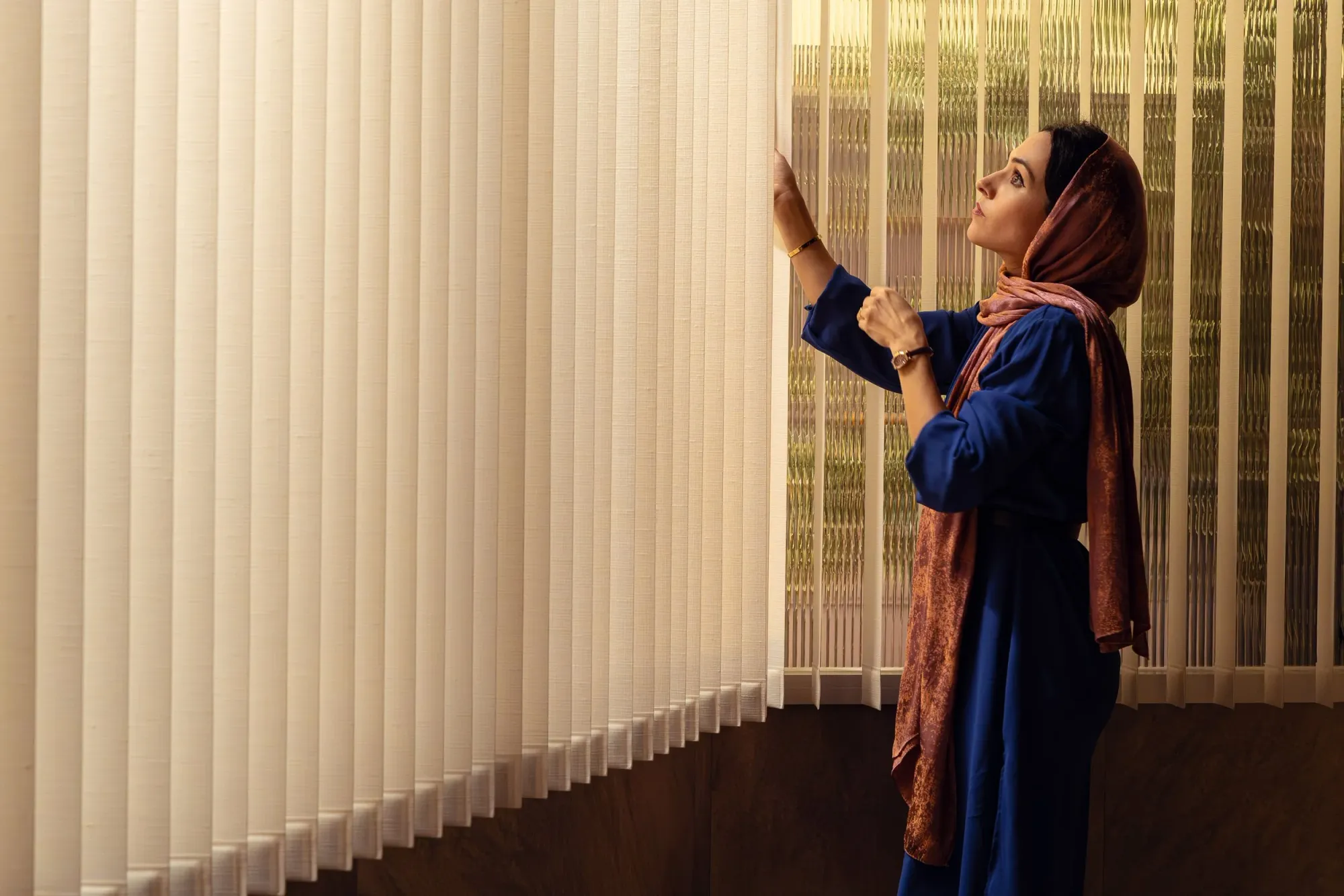
But the play's structure works deftly as a way to explore a series of fascinating questions about language and identity in both a personal and cultural sense. It observes, first, that our personalities are at least partly defined by how we appear to others, which means that, in a pretty fundamental way, when we switch languages, we become different people — and if we're not confident in our speech, we come across as not confident in anything. Elham is a smart, forceful woman brought to her knees by her lack of facility with English. In losing the ability to express herself, she is losing much of who she is.
English pushes this idea into the cultural realm, where it gains a richness that, in turn, fuels the play's momentum. What does it mean that Marjan forbids her students to speak any Farsi, their native language, in the classroom? What does it mean that she avoids it herself? For the students, what does it mean to sever the linguistic connection to their place of origin? How much of trying to leave Farsi behind is also about trying to leave Iran behind? And what of themselves do they risk losing in that process? The characters, and the audience, can't reach any easy conclusions. But there's power in watching them follow the trails of those questions, one sentence at a time.


