
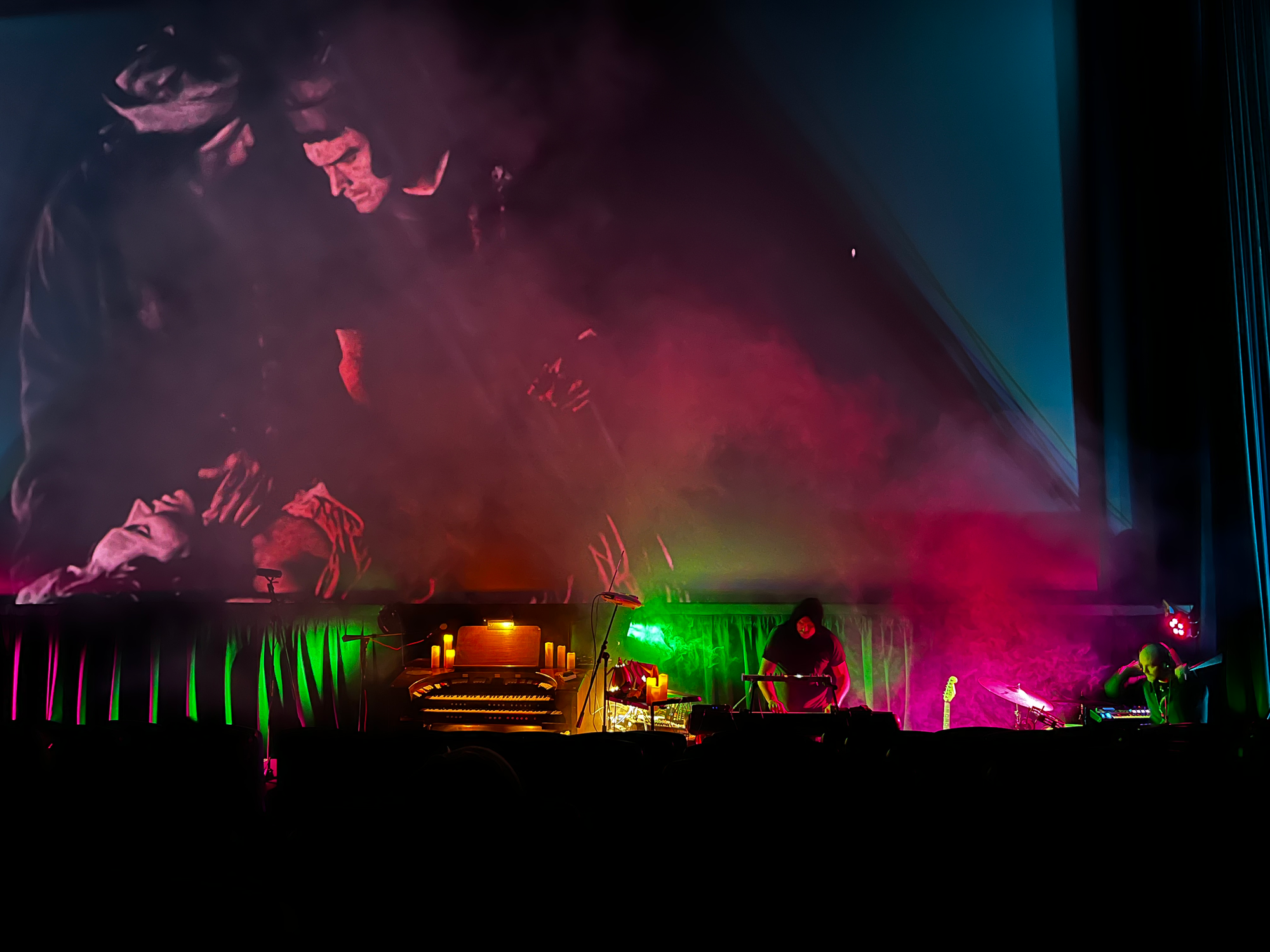
"Häxan: Witchcraft Through the Ages" with live score by Dustin Edward Howard
Circle Cinema
December 20, 2025
If you’ve never seen a guy in a black hooded cape play a theremin with laser gloves, surrounded by candles and smoke machines, while a live-action Satan flicks his tongue at you on a giant screen, you’re going to want to get yourself to Circle Cinema’s Häxan: Witchcraft Through the Ages on the next winter solstice. This was my second year celebrating the darkest night with Häxan, and it’ll be a tradition for me as long as Circle keeps it going.

You might think that Halloween is the proper time for a film about witchcraft, but Dustin Edward Howard’s annual one-night-only event—a screening of this Swedish docu-horror classic, originally released in 1922, for which he creates a live score on the spot—calls up the real spooks: the destructive forces of patriarchy. My year in cultural events started and ended with art about witches, from January's incendiary Allison Ward-curated group exhibit Waking the Witch at Living Arts to this film’s reflection on the fact that very little has changed in a hundred (a hundred thousand?) years. These events made pretty good bookends for a year that saw plenty of mass hysteria and misogynist bullshit thrown down under the cloak of law and order.
There’s some discourse in cinephile circles around the various versions of Häxan—like, that the 1922 silent original is the only version you should ever see, and that coals should be forever heaped onto the 1968 edit with narration by William Burroughs (the one shown at Circle). But I don’t really give a shit about discourse right now. It’s the end of a hellish year and I came out for synthesizers and subversive witchy business and a laconic monologue by the author of Naked Lunch, and that’s exactly what I got.
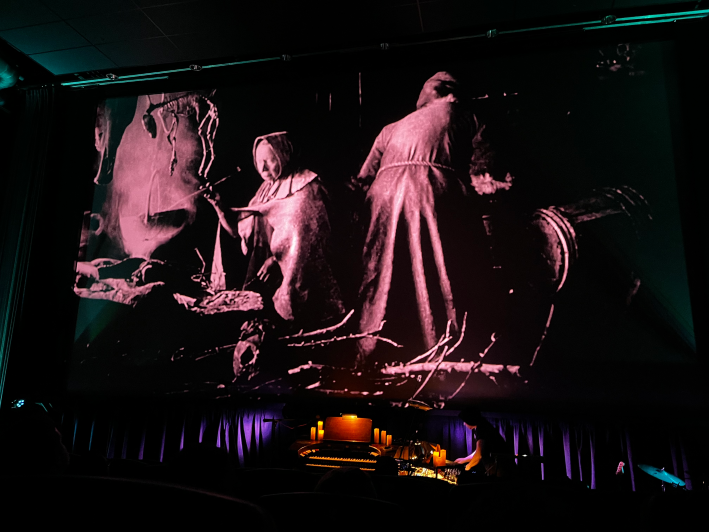
The film (a tight 77 minutes in this version, as opposed to the original’s nearly two hours) was and continues to be revolutionary. As Howard wrote in the lead-up to the show, Häxan is “an attempt to explain witch hunts using proto-psychiatry, not a celebration of witchcraft. [Director Benjamin Christensen] spent two years researching medieval manuscripts for accuracy. The film was meant to criticize persecution and superstition…. Think of it as a 1920s TED Talk with themes of how misunderstanding shaped history and insane visuals.”
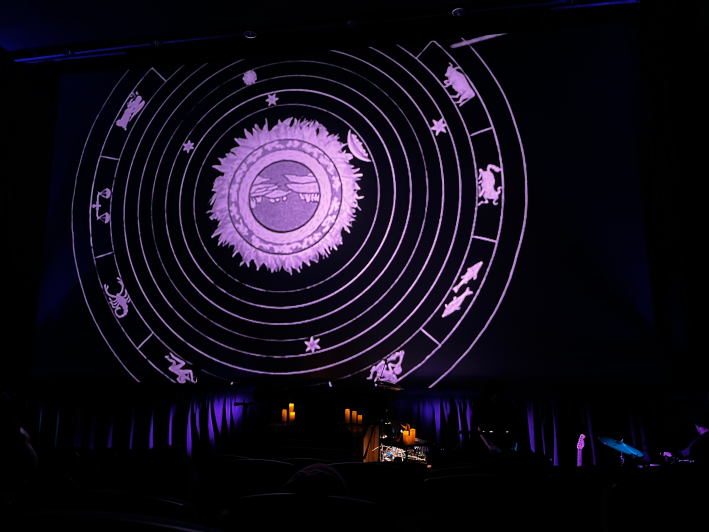
The opening scenes show Christensen’s labor of love: handcrafted models of the cosmos (hell included) in various religions, plus engravings that bring the demon-obsession of the middle ages into full and sometimes silly view. From there, Häxan moves into a look at historical witchcraft practices, and then into the tactics of those religious and civic authorities whose mission was to persecute these women—who (as Christensen persuasively suggests) were mainly trying to find ways to get out from under various other kinds of persecution.
video by Alicia Chesser
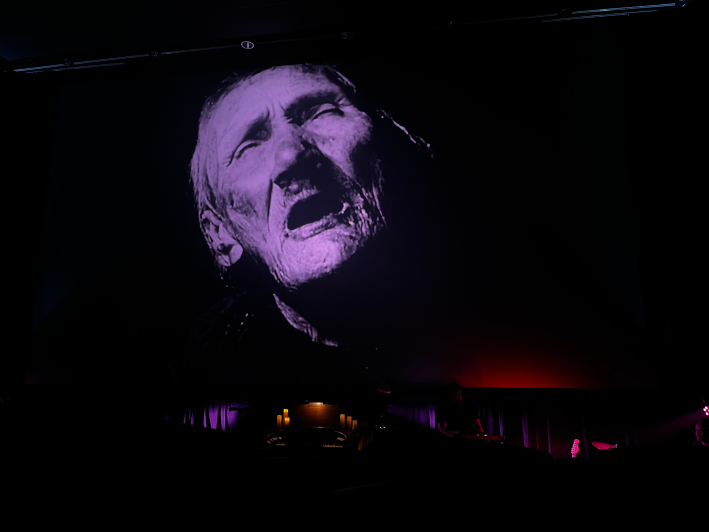
Scenes range from the absurd (a servant making a love potion to expose a gluttonous priest, then getting more than she bargained for as he relentlessly pursues her; women literally kissing the devil’s bare ass) to the devastating. A long sequence depicting the torture of an elderly woman reveals the whole process; in between showing her being bound and interrogated, the filmmaker cuts to her face, which fills the whole screen with woe, as Carl Theodor Dreyer would do seven years later in The Passion of Joan of Arc. As Häxan moves into the modern age, it draws a clear parallel with women institutionalized for what Burroughs calls “hysteria” (i.e., usually PTSD), with slick-haired psychiatrists standing in for the Church inquisitors of earlier times.
It’s funny, Burroughs says at one point, how in any place these judges showed up, there was suddenly an outbreak of witchcraft that needed to be tamped down. The half-sardonic, half-scholarly mix of tones in Häxan got a perfect mirror in Howard’s choice to score the film not with wheezy ancient music, but with a riotous blend of ‘70s horror soundtrack vibes, driving drumbeats, floaty synths, electric guitar, echoey voices (both live and looped), classical piano riffs, a theremin used at just the right moments, and even the theater's century-old two-story pipe organ.
video by Alicia Chesser
Musicians in Tulsa are always busy, but on Häxan night there’s none busier than Howard, who preps for weeks before this show so that every transition and instrument works seamlessly. If there were mishaps in Saturday’s performance, I missed them, and I was so enthralled by the film and Howard’s rapid-fire shifting between instruments that I wouldn’t have cared anyway.
Assisting Howard for this show was Nick Blackwell (both play with local psych rock band Groucho), who stepped in to replace someone who had to drop out and learned the intricate sequence well enough to improvise within it in less than a week. The score wasn’t a beat-by-beat interpretation of the onscreen action, but it did build and ease and build again as the film went on, bringing a layered complexity to the sonic experience that reflected the richness of Christiansen’s docu-drama style.
video by Alicia Chesser
Howard’s score added immensely to the atmosphere of hysteria and dread Häxan explores—and it added excitement too, heightening the impact of Christensen’s groundbreaking experiments (his stop-motion effects are insane) and his impassioned argument for the humanity of these women in the face of an extractive and predatory culture. I don’t often find myself on the edge of my seat while watching a 100-year-old film, but that’s where I was on Saturday night: coughing a little from the smoke machine (totally worth it though), biting my knuckles at this courageous director’s true-to-life depictions of torture and terror, riveted by the rise and fall of Howard’s score, and cackling as—century after century—these witches expose the real devils among us.


