
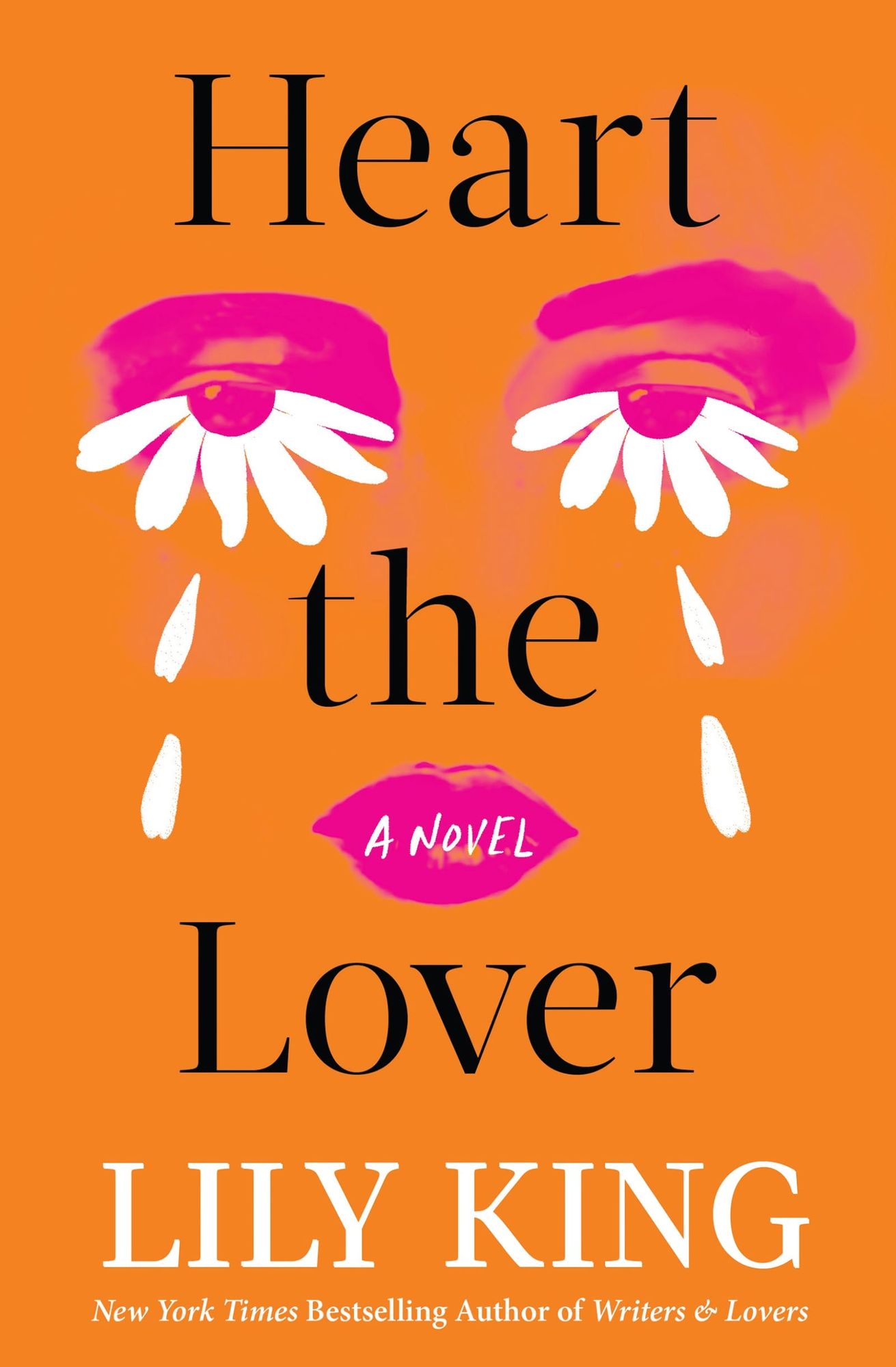
"Heart the Lover"
by Lily King
Grove
Confession: I kind of hated my twenties. I’d earned an impractical college degree at a respected school (where I regularly felt like an imposter); I made a series of terrible, often selfish decisions regarding my romantic life; I pulled further away from my family while working two dead-end, low-paying jobs; my mother got her first cancer diagnosis; and I felt, as a young adult, scared, excited, and paralyzed by the wide open possibilities of the world – certain that not only would I likely pick the wrong path, but that the right one wouldn’t even be open to me, because I wasn’t smart/pretty/charismatic enough.
With all that in mind, wow, did Lily King’s latest, “Heart of the Lover,” take me back to that chaotic era of life. (Though the novel features characters who appear in King’s 2020 book, “Writers and Lovers,” I can tell you, as a first-time King reader, that you needn’t have read one before the other. “Heart” stands on its own beautifully.)
The first section of “Heart” chronicles the love triangle that forms between two hyper-literate young men – the type who sit in the front row of a lecture hall and get mistaken for grad student teaching assistants – and a young woman they nickname Jordan, because, referencing “The Great Gatsby,” they decide “she’s not Daisy Buchanan, she’s Jordan Baker.”
Copper-haired Sam is her beau first, though Jordan quickly learns that Sam’s sexual passion regularly does battle with his religious faith. After an early, disappointing tryst, Jordan says, “I never liked sex in the morning, but sexual frustration in the morning is even worse. I try to distract myself by looking over his shoulder at the spines of the books on his bedside table. Confessions of St. Augustine. Paul the Apostle, Mere Christianity. Oh.”
Just as we follow Jordan’s thoughts – and put together, with her, the small puzzles of daily life – we do the same with King’s brisk prose style, wherein she provides key details that economically and vividly do a lot of work. For example, right at the novel’s start, a literature professor holds up what Jordan knows to be her essay, because it’s neon orange: “I’d waited till the last minute to write it. The only paper we had in the house was this thick stuff left over from our Halloween party. And it wasn’t easy, feeding that cardstock into my typewriter.”
Immediately, we know Jordan’s a procrastinator, but also bold and smart, since the professor is about to read her witty parody to the class. She’ll improvise and adapt when necessary. She lives with other college students in a house. And this is happening in the pre-internet, pre-PC age, since she wrote the paper on a typewriter. King thus accomplishes much, and points us in the right direction, from page one, as Sam and his best friend Yash watch the essay being passed back to Jordan.
Yash, like Jordan, comes from divorced parents, is a natural conversationalist and storyteller, and shares her playful, cerebral sense of humor. When Jordan’s relationship with Sam flames out, she and Yash slowly, tentatively make their way toward each other. And when they finally act on their feelings, their love feels organic and lasting and profound.
As I mentioned earlier, though, opportunities and choices abound in your twenties. Jordan unexpectedly gets a chance to work and write in Paris, so she takes it. Though she and Yash stay connected via letters and a long-awaited visit, when the critical moment to reunite comes – well, I won’t spoil it, but suffice it to say, things don’t quite work out.
The book’s second section features Yash and Jordan connecting years later. The third shoots even further into the future, when all three characters, now in their forties, are brought back together for the first time since college, as losses and medical crises loom. Even in hard moments, King affectingly highlights how the people who leave a significant mark on our past retain a nearly magical power over us: “Beside (Sam) now, I actually feel like Jordan again. I feel so young, like I’ve been shot through a secret portal straight back in time.”
“Heart” is an English major’s dream, because the characters constantly discuss books, making literature the filter and framework through which they figure out their lives. When Jordan gives a talk in Iceland, and a student challenges her argument about love being a form of hope, not weakness, Jordan replies, “Othello places his trust in Iago, not Desdemona. Anna Karenina’s society does not allow her to be with Vronsky. Love is not the weakness. People get in its way. People are weak and perilous, not love.”
This isn’t a narrative tangent. Though neither Sam nor Yash are present, we are getting a deeper glimpse at Jordan’s perspective now that she’s lived more life, and experienced both success and grief. As a writer, King offers, via “Heart,” a master class in the kind of light literary touch that is all the more powerful for its efficient subtlety.
Yes, the high (but still realistic) drama depicted in the book’s third section makes the narrative more akin to a literary soap opera. And the hype surrounding the book made me wonder how it could possibly live up to expectations.
But I’ve got to be honest. I loved every minute, every page of this funny, sweet, charming novel. I absolutely heart “Heart.”


