
Nine Inch Nails
BOK Center
February 27, 2026
There’s a thought-experiment game I like to play called “Favorite, Best, Greatest,” where pop culture entries are sorted along those lines. Favorite means the player’s personal favorite. Best means the best in a genre. Greatest carries the distinction of breaking down barriers and furthering a genre while also being really, really good. Think of The Sopranos as Greatest for TV, and The Wire as Best. No Tony? No Omar.
This game tends to piss some people off, as my television statement above probably did, and the next sentence definitely will: Nine Inch Nails might be the Greatest American rock band. Sure, Van Halen started the guitar arms race that defined ’80s metal, my favorite era of my favorite genre. Metallica pushed thrash into neoclassical, ultra-compositional territory and moved metal from clubs to suburban TV screens. And Nirvana launched a S.C.U.D. at the ivory towers of both. But Nine Inch Nails turned synthesizers, vulnerability, gender fluidity, and dance music into the true machines that kill fascists. As evidenced by their recent BOK show, they are also still really, really good.
This isn’t the place to detail NIN’s storied career, but it starts with a sad goth boy from Cleveland and involves heroin, David Lynch and David Bowie, sobriety, the most popular (and danceable) blasphemic paean to rough sex, the ingenious use of technology, and award-winning film scores, including for Disney/Pixar. When I had to download an app to pay for my 400% surge-priced parking space outside the BOK Center, I knew Woodstock ’94 Trent would hate the world that Year Zero Trent prophesied. That 2007 title was a concept album about a dystopian techno-theocracy that rallied the young into war with propaganda extolling a doomsday cult of sorts. Just let Secretary of War Pete Hegseth open his mouth for a few seconds and you’ll see where I’m going with that.
But where has NIN gone now that their satire is reality? They’ve come back to the synth.
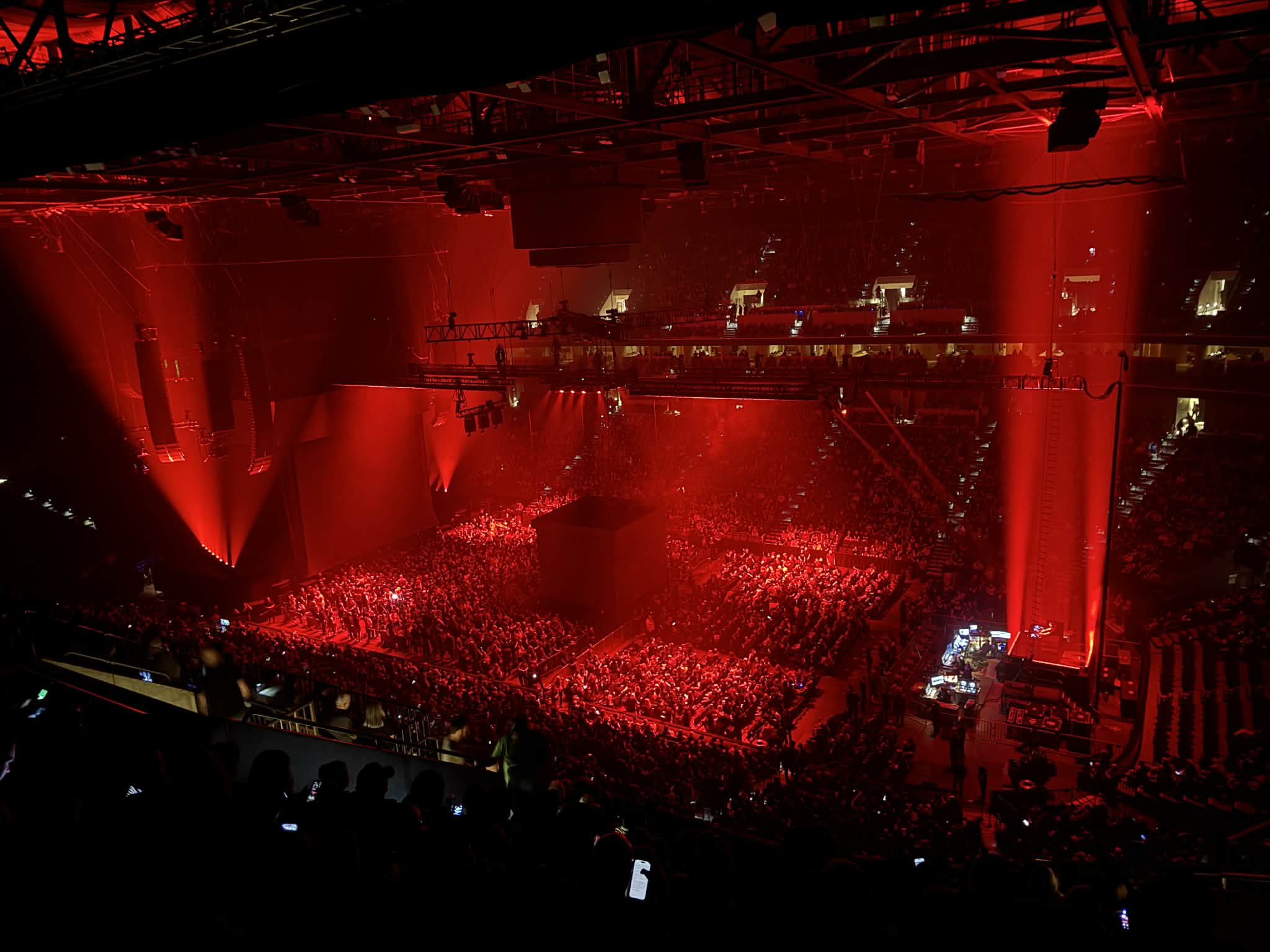
German-Iraqi DJ Boys Noize opened the show in one of the most iconic arena setups I can recall, with his booth behind the crowd, opposite the shrouded stage, and an ominous Kaaba formed of suspended black drapes hanging in the middle of the packed arena. Boys Noize sliced through a selection of original tracks and dark dance classics (like Depeche Mode’s “Enjoy The Silence,” which I’d classify as one of the Greatest goth anthems ever) before the cloth cube dropped to reveal Reznor and his bandmate and film score collaborator, Atticus Ross, standing at crowd center in a stripped-down synthesizer lab.
The name of this tour, “Peel It Back,” refers to this minimal setup designed to showcase the duo’s contemplative soundtrack work and NIN’s minimalist meditations. Functioning as double entendre, the moniker also references the soft piano section of NIN’s anarchic track “March of the Pigs,” which the full band soon ripped into on the main stage.
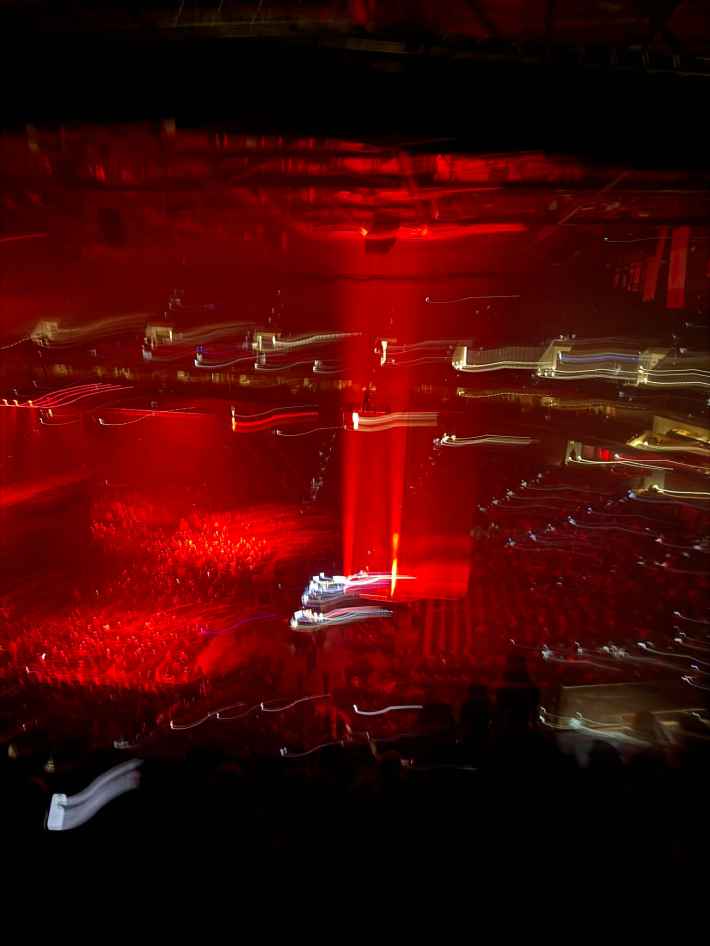
Shrouded on four sides by a titanic mesh scrim, Reznor and Ross toured through classics and deep cuts alike as manipulated live footage from handheld cameras was projected onto the monolithic hypercube. This “clean” lighting and presentation harkened back to Reznor’s “recently clean from heroin” With Teeth era, one that jarred my teenage sensibilities at the time, but which I’ve grown to cherish. Still, you could squint and see the mud-soaked and mesh-clad ghost of ‘90s Reznor haunting the pit over mosh breaks during the show’s Broken-era bangers like “Wish” and “Gave Up.” The blistering second act of the set saw the focus turn back to Boys Noize mid-arena, soon joined by Reznor on synth and vocoder to work through live remixes of NIN tracks, including “Closer,” with the duo tweaking the synthesizer knobs in real time.
Trent Reznor has long been outspoken on religion and fascism, both in concept work like Year Zero and in plainspoken interviews, so his tight-lipped banter at this show, in our current zeitgeist, may have surprised some. He did, however, share a beautiful anecdote about touring with Peter Murphy of Bauhaus in his earliest years and playing Cain's Ballroom. He remembers someone from the crowd screaming “Head Like a Hole” back at him during that Cain’s show, and that being the first time he felt he’d connected with someone so deeply through his lyrics.
That gorgeous anecdote may have been one of only a few non-lyrical appeals to the audience, but NIN’s cover of Bowie’s “I'm Afraid of Americans” said all that really needed to be said, anyway. And where words beyond lyrics ceased, there was the synthesizer: a tool to literally synthesize new sounds and, through hands like Reznor’s, forge new mirrors of our nightmare realm and visions of the world we would like to inhabit.
Brian Eno, an obvious Reznor influence and Bowie collaborator on “I’m Afraid of Americans,” prophesied the future of the synthesizer to The Guardian in 2010 this way: “What we like about acoustic guitars is players who have had long relationships with them and know how to do something beautiful with them. You don't have that with synthesisers yet,” he said. “They are constantly renewing … so you tend to hear more of the technology and less of the rapport. It can sound less human. However! That is changing.”
And that brings us back to the rock band that, according to my criteria, might be America’s Greatest. Nine Inch Nails have imprinted an indelible sonic mark on the genre with the constantly renewing sounds of the synthesizer, and with tones that the human ear immediately picks up as “NIN.” They’ve turned a tool once used solely to make people dance and swoon into a riotous clarion call of mosh destruction; a reflective soundboard for Johnny Cash to turn country gothic; and the soundtrack to your family’s favorite kids’ movie, whether it be about Ninja Turtles, a jazz musician navigating the afterlife, or a rogue security AI who leaves the world of binary code to become flesh in our own, which seems like another prophecy Reznor and Ross have set the score for. Wherever technology takes us as a species, this night reminded us that it’s still in our hands. For Reznor, that’s always meant pushing the limits of our ingenuity—with our humanity intact.


