
My Heart is Bloodied for You
Ball and Socket Arts
Cheshire
Through March 15
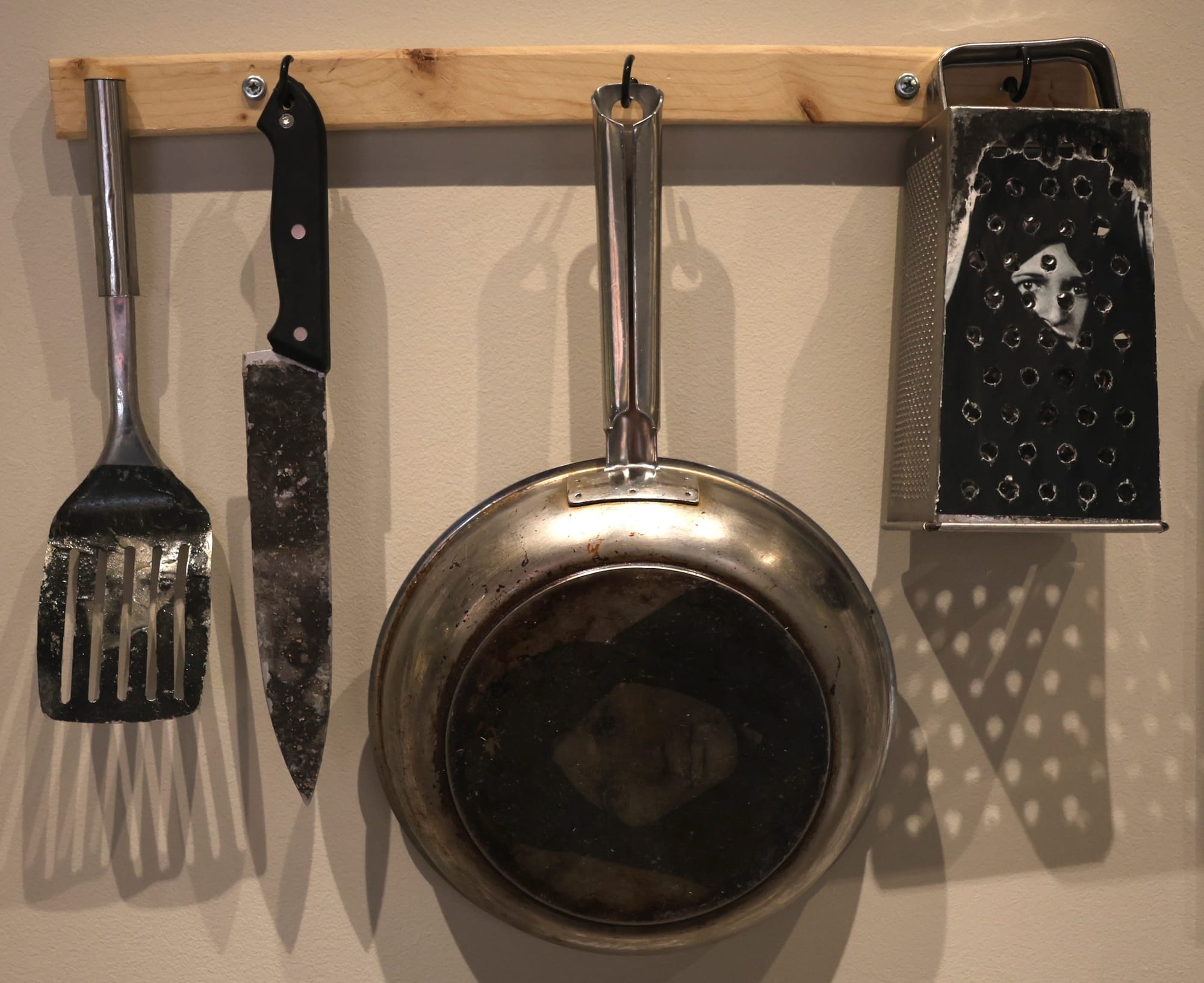
Mahsa Attaran's I Still Can See can seem at first like the latest piece in a long lineage of artists putting household objects on a gallery wall — pipes, bananas — and declaring them to be art. Attaran echoes that move, but adds a twist. Perhaps the grater first catches the eye, because the face on that one is the most visible, even if the face itself is half-covered. Then the other faces emerge on each of the other implements. The nod to the hiddenness of the work women do in the kitchen is on the surface. But it also matters where those faces are. On the grater, the face is where the most friction is. On the pan, the face is to the flames. There's violence there, too, oppression, difficulty.
I Still Can See, Attaran writes, is about transforming the objects "into potent symbols that expose the hidden struggles of women. By recontextualizing these familiar items, the work challenges the societal expectation that confines women to domestic roles, revealing how internalized oppression is woven into everyday life. It highlights the unsettling duality of the home: while it is traditionally seen as a sanctuary, for many women it can be a site of danger and threat, where the very spaces meant to nurture become arenas for control and violence. The work also addresses the harsh reality that many women are killed annually by male family members, often under the guise of preserving modesty or asserting ownership over women. This juxtaposition forces viewers to confront the complex interplay between domesticity and violence, urging a reexamination of the power dynamics that shape everyday life."
I Still Can See is part of My Heart is Bloodied for You, a sharp and absorbing exhibition of works by Attaran running now at Ball and Socket Arts in Cheshire through March 15. The show "explores the lived experiences of Iranian women, connecting contemporary struggles to a long historical lineage," the artist's accompanying note states. "By using archival photographs of Iranian families, I emphasize that patriarchal ideologies and systemic oppression have persisted across generations. While the forms of this oppression may have changed, the expectation for women to remain silent, hidden, or confined within socially prescribed roles has endured."
To some, the show may seem to have an eerie timeliness, as the U.S. assault on Iran blankets the headlines today, as Iran's ruthless crackdown on protestors did just a few weeks ago. But the Iranian-born Attaran's artwork points out that Iran's oppressive system has persisted now for more than a generation, ever since the Islamic Revolution in 1979. The government's attacks on its own people, followed by the U.S. attacks on the government and everyone else there, are crisis points. But life in Iran — especially for women — has been an endurance test for decades.
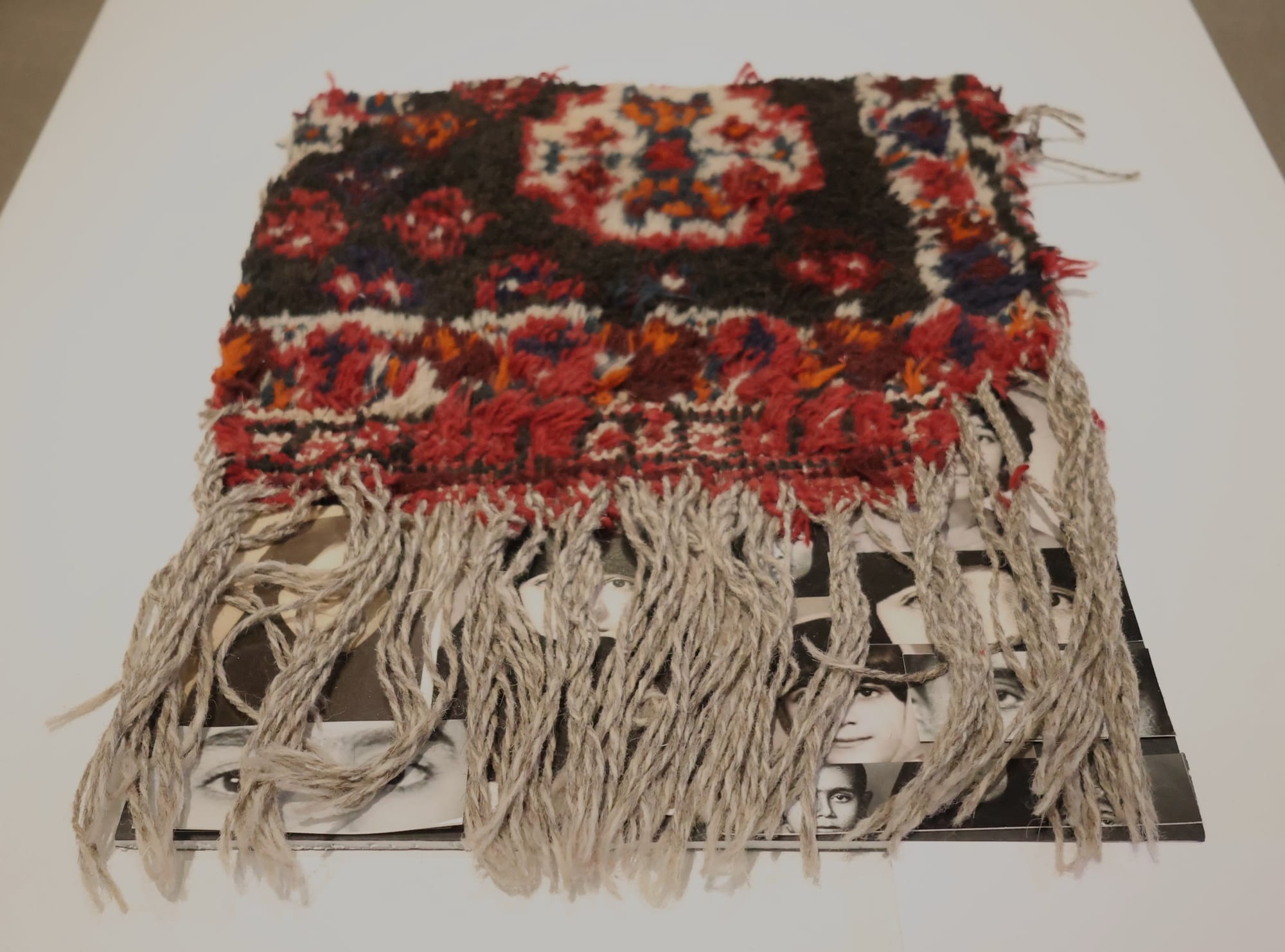
Persian rugs play a heavy role in the exhibition not only because women have traditionally made them. "Like the rugs, women have historically been stepped on, overlooked, or suppressed, no matter how precious their labor, presence, and contributions are. This concealment reflects how society has often sought to hide women 'for their own good,' masking control as care, while undervaluing their essential roles and strength," Attaran writes.
Attaran's accompanying notes make plain what her motivations are; in that sense, the exhibition perhaps hits hardest if you observe the piece, then read the caption, then observe the piece again. This is in part because so much of the work is visually inviting, with its bright colors and familiar objects, a style of art making that can lend itself to humor but here does not. That in itself has a point to make. Oppression and distance means that, often, the day-to-day lives of Iranians stay out of the international spotlight. This makes it easy for us Americans to not think about what has been going on there, for as long as many of us have been alive. We love Persian textiles and don't ask where they come from. Attaran's art points out how comfortable that can be, and then undermines it.
But "at the same time, the project celebrates collective empowerment" among women, Attaran writes, and "by juxtaposing concealment with collective strength, the work highlights both the historical pressures on Iranian women and their resilience. Ultimately, the project foregrounds women's endurance, asserting that while oppression has been pervasive, visibility, solidarity, and shared strength offer paths toward resistance and empowerment."
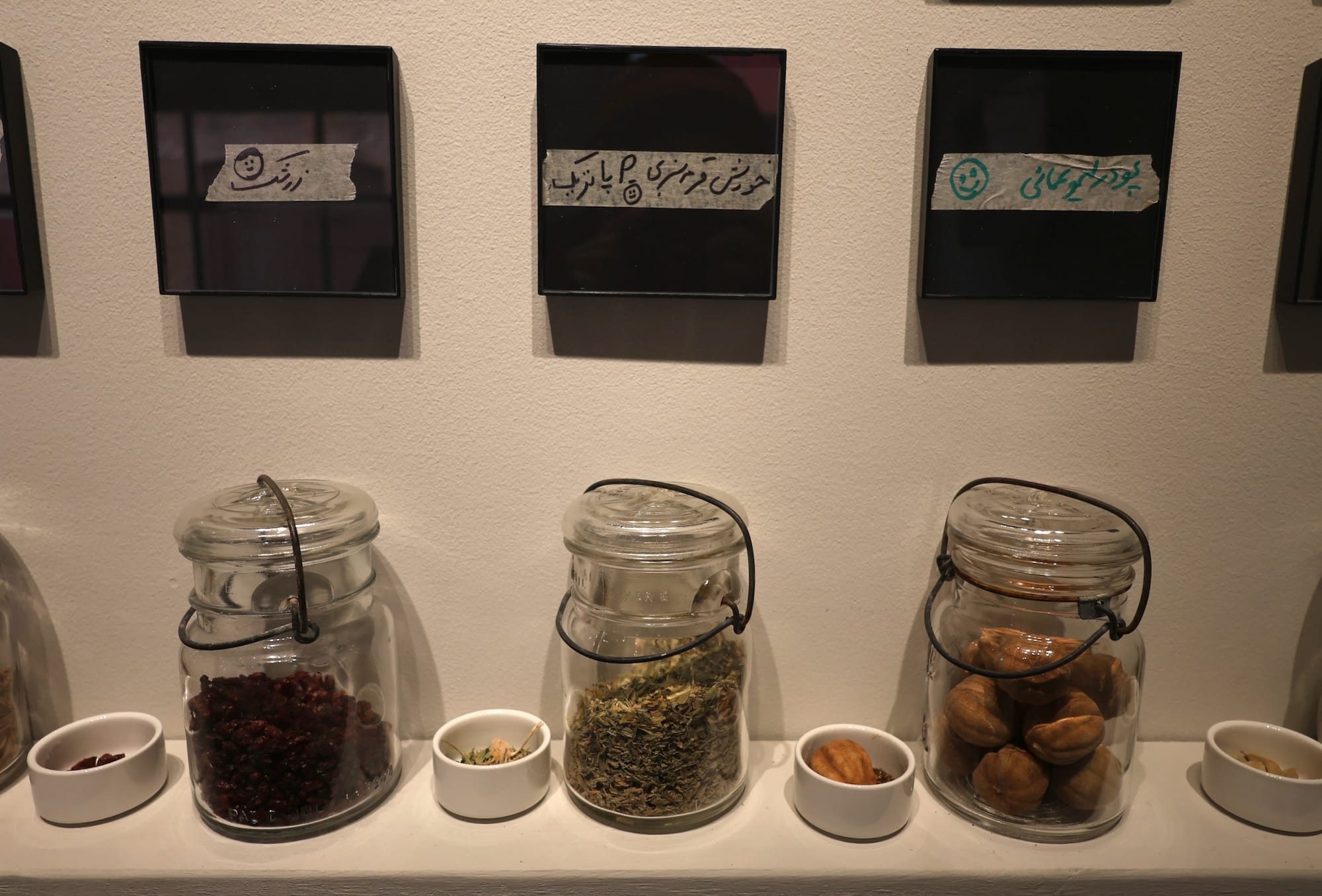
This celebration is perhaps most evidence in Ja Oftadan (Settle In), a wall installation of a large grid of framed pieces of tape, with jars of spices and samples on a shelf below. Here the description is integral to understanding. Ja Oftadan "began with a suitcase full of spices, the ones I brought with me when I left Iran for the U.S.," Attaran writes. "In the cold of North Dakota, they carried warmth. Each bag was labeled in my maman's handwriting, with tiny doodles and tender instructions, as if she were whispering, 'You're not alone.' I couldn't throw them away. They smelled like home. The first time we saw each other again, after more than three years, she came and made every dish vegan, just for me. The same recipes she'd taught me over the phone, her voice crackling across the ocean, guiding me through onions and turmeric."
Attaran's description makes the scribbles on the pieces of tape come to life. It's easy to imagine them on the bags Attaran mentions, to imagine Attaran discovering them one by one, and each moment of discovery bringing up the complex feelings of intimate connection, the love and the longing, the sense of support and disruption. And though the gallery isn't redolent of the scents of the spices, it's just as easy to imagine them floating in the air around us. Food is, first and foremost, nourishment. But as Attaran points out, it's also a link to family and tradition, an acknowledgement of history. Somewhere in there, it's also an act of resistance. Under an oppressive regime, food that delights the senses can remind people why they resist. Far from home, in a freer society, it can remind people what they want to preserve and cherish of the place they came from, even as they leave behind so much else.


