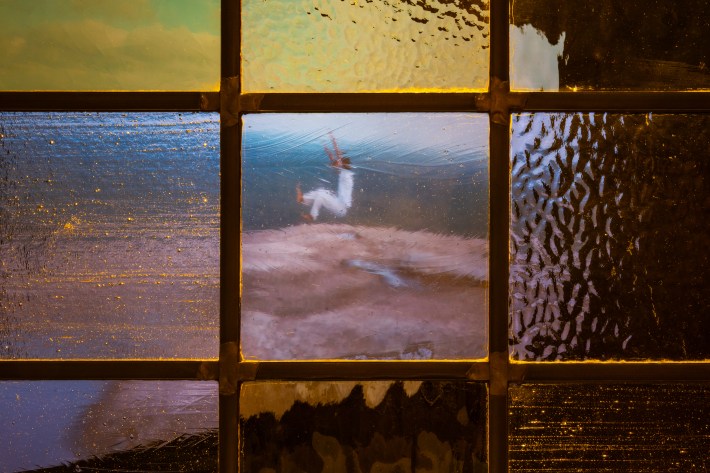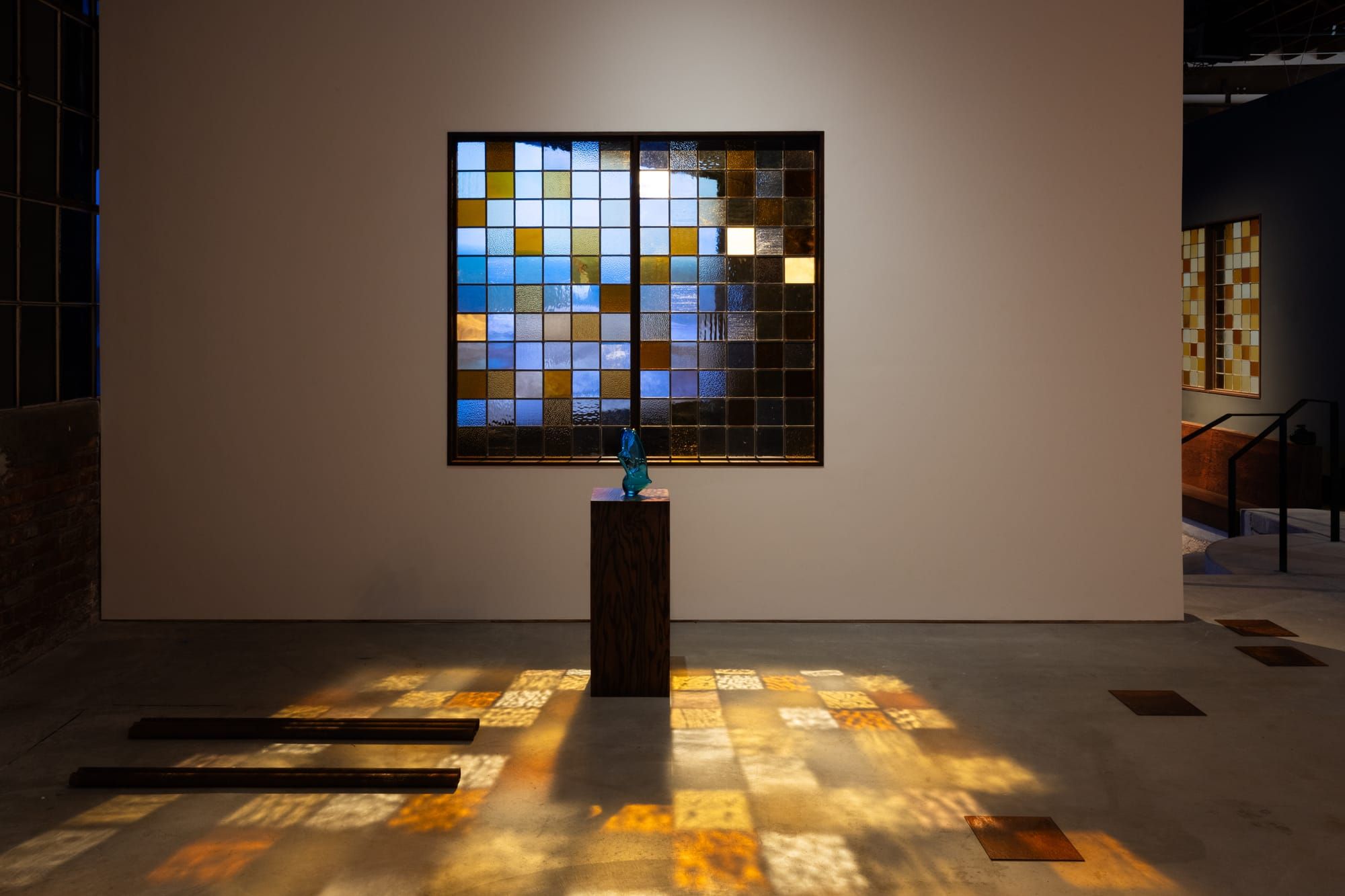
Do yourself a major favor and go see Le’Andra LeSeur’s exhibition Monument Eternal at Tulsa Artist Fellowship’s Flagship before it closes on January 10. Beauty has long been a dirty word in the art world, exiled during the rise of modernism; beauty, its detractors say, is superficial, subjective, even complicit in upholding power. I believe, on the contrary, that beauty holds unfathomed depths, and I’m here to say this show is beautiful—unapologetically, disarmingly beautiful.
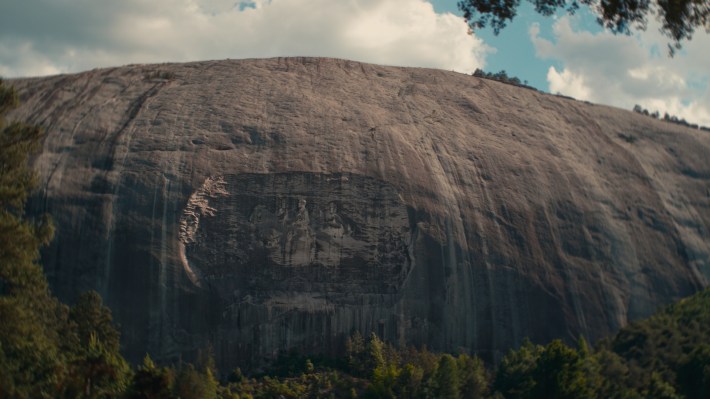
But how can an exhibition centered on Georgia’s Stone Mountain—the world’s largest piece of exposed granite, with three Confederate figures carved into its face in the world’s largest bas-relief, a mountain tied to the resurgence and mythology of the Ku Klux Klan—how can work grounded in that violence and in the erasure of Black bodies and histories be beautiful?
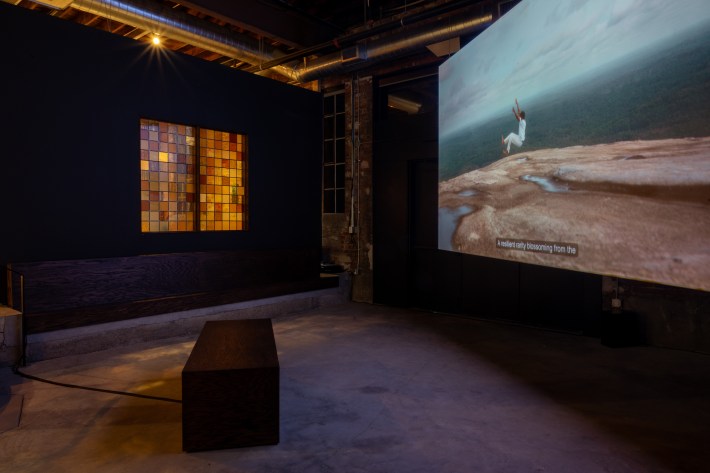
Maybe because LeSeur’s reckoning with the site is also a reclamation. She approaches the mountain not as a fixed monument but as a wound with its own hum, its own atmospheric vibrations. The video Monument Eternal, the conceptual and visual keystone of the exhibition, anchors this approach. The work is an extended meditation on ascent, trust, and endurance. We see LeSeur’s body in close-up, framed against a vast blue sky. Over seven minutes, her weightless form appears from the back, the side, at her feet; the camera tilts as she leans, angles, falls, trusting that the earth, and her own body, will be a “soft place to land.”
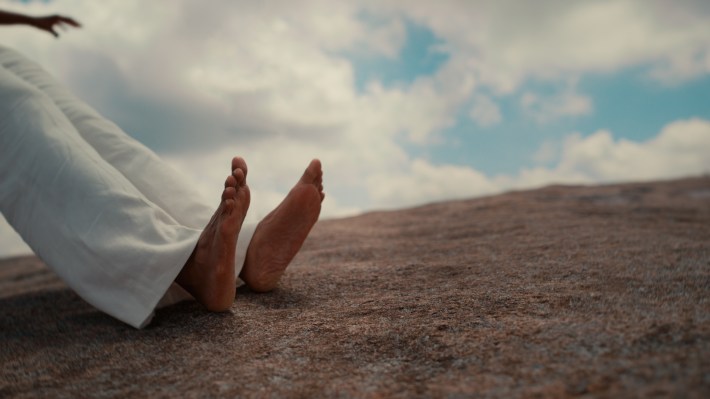
The video concludes with the haunting image of the Stone Mountain relief and the euphoric voices of Pastor T. L. Barrett and the Youth for Christ Choir singing “Nobody Knows The Trouble I’ve Seen.” Their harmonies do not offer absolution; instead, they bind the physicality of LeSeur’s gestures to a lineage of Black spiritual resilience, echoing upward and outward. Her presence, her breath, her careful attention transforms Stone Mountain into a site of her own becoming and transcendence. It’s a place where history’s weight is felt—with the site’s imposing size swallowing up almost the whole final frame of the video—but not allowed to dictate the terms of possibility.
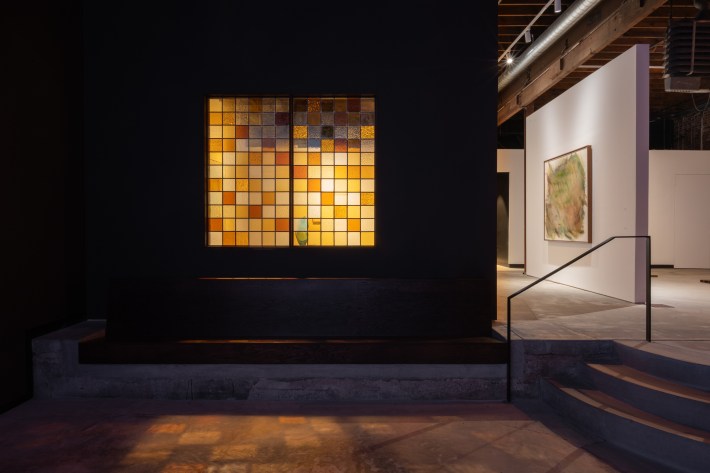
The sunken space where the video is projected is flanked by A soft place to land, a sculptural reference to a line LeSeur writes and speaks within Monument Eternal: the idea that her own body—held, worn, tested—is that soft place. These mouth-blown amber stained-glass windows contain the viewer in a warm atmospheric envelope. They cast clouded, umber light across the gallery floor opposite the video. The light is filtered and softened, unmistakably separate from the outside world; entering this space feels like crossing into an interior terrain where attention heightens and the air behaves differently.
LeSeur’s precision regarding how the viewer’s body moves, pauses, and redirects through the exhibition is as intentional as the gestures within her paintings A faint touch of bones remembering and Make a Landscape Look More Beautiful. Created during her residency at Pioneer Works in New York, these paintings are impressions of her embodied encounters with Stone Mountain. They conjure the chaotic creation of a world becoming: electric washes of green mingle with deep brown rubbings, all held within amber-nude tonal expanses of color that blot out and wash across elements of the whole. The gestures convey the body’s reaction to the site; the works register as deeply earthly and grounded, yet equally transcendent and otherworldly.
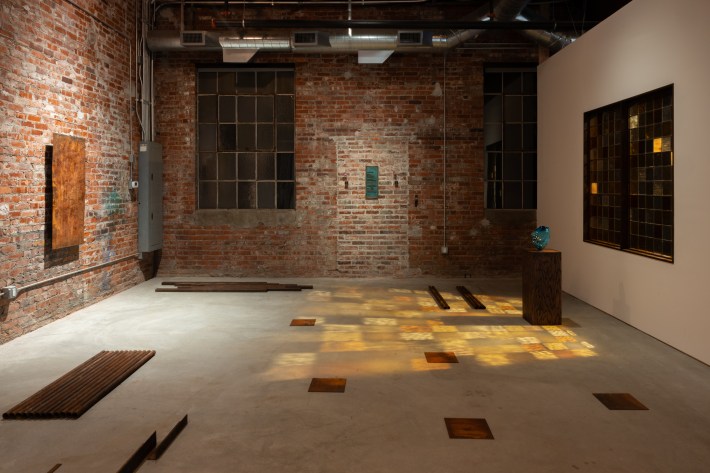
Works like No. 2897—oxidized steel plates installed on the gallery walls—reverberate back to the entrance to the gallery, where small square plates placed on the floor control one’s step, slow the pace, and guide the flow of movement. Their material weight suggests age, weathering, and the accumulation of time, qualities shared by monuments, mountains, and the bodies that traverse them.
I’m not afraid to say LeSeur’s work is beautiful. It is. It is also deeply moving, complicated, personal, opaque—in other words, not immediately transparent or readable. The pieces in this exhibition are layered with body and breath, meaning and history, place and personal salvation. As LeSeur suggests through her reference to Édouard Glissant in the video Monument Eternal, she refuses to reduce language or image to a singular meaning. The impulse toward transparency, comprehensibility, binary explanation, and fixed definition strips away complexity. Instead, LeSeur’s work insists on opacity, on welcoming complexity as a condition for enlivening beauty and transcendence without the burden of any single truth.