
Gaslight Theatre: Doctor Faustus
Turpin Theatre, Enid
January 31, 2026
Doctor Faustus is a play that I was only vaguely familiar with, despite my liberal arts degree and the work’s position in the classical canon. But I knew that it was important™. So when my friend told me about a community theatre in Enid that was staging Christopher Marlowe’s 16th-century play in a black box, I decided a three-hour roundtrip was in store for my weekend.
I went in without researching the play at all, but based on what little I knew, I assumed I was in for a serious, dark drama. On paper, I’d argue it’s exactly that. Doctor Faustus is a cautionary tale about a rather arrogant scholar who is bored with the knowledge of the world, so he sells his soul to the devil to practice magic and obtain knowledge of the divine, with the help of the demon Mephistophilis. Doctor Faustus indulges in each of the seven deadly sins, plays pranks on the pope, and at the end of the day, is unable to pray for his own salvation, which leads to his ultimate damnation.
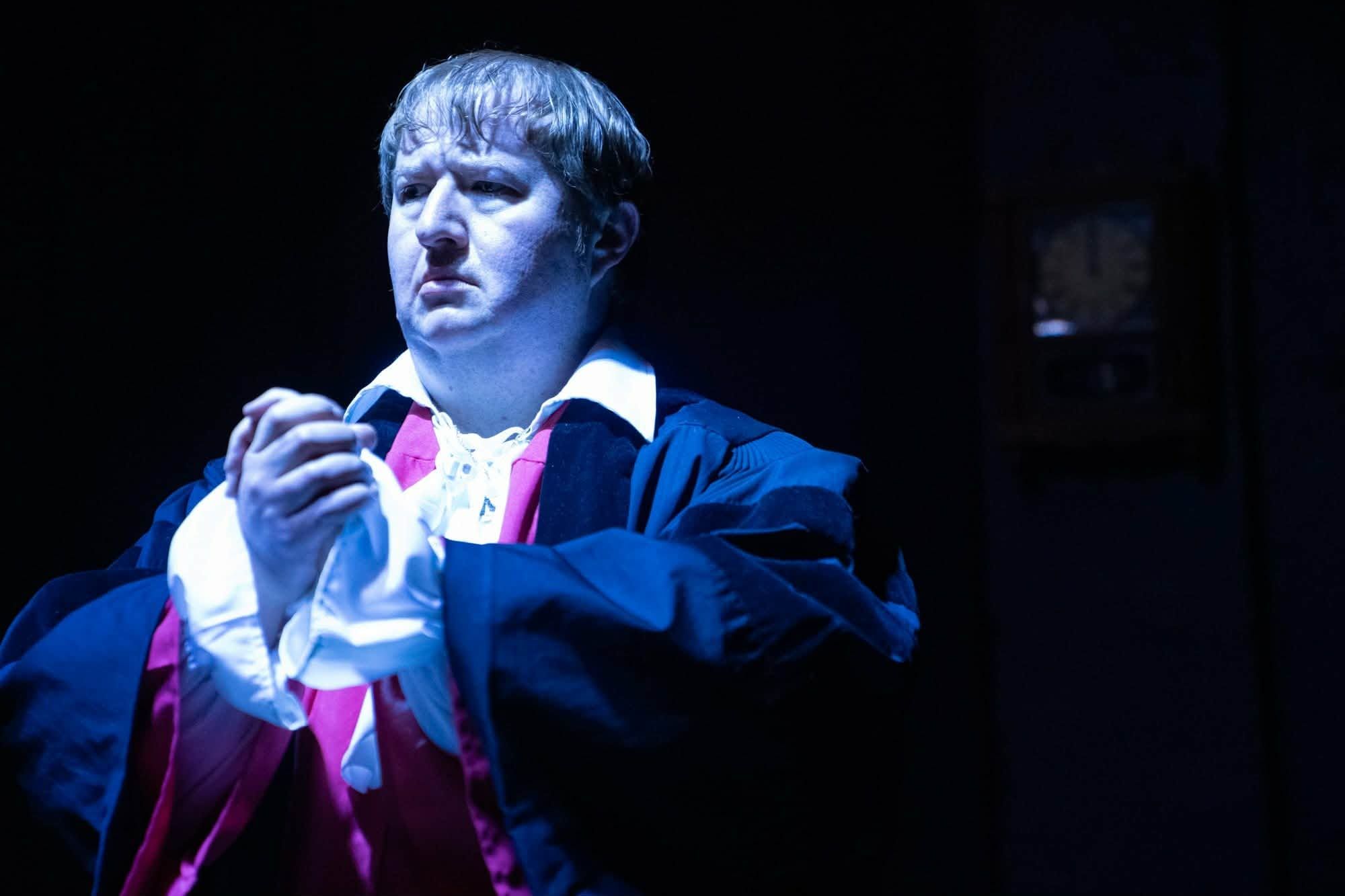
Reading that summary, you’re probably where I was Saturday at 7:29 p.m., expecting a heavy Elizabethan tragedy. But under the creative direction of Alex Johnson, the production was more like “magic show meets modern horror movie”—and my god, it worked.
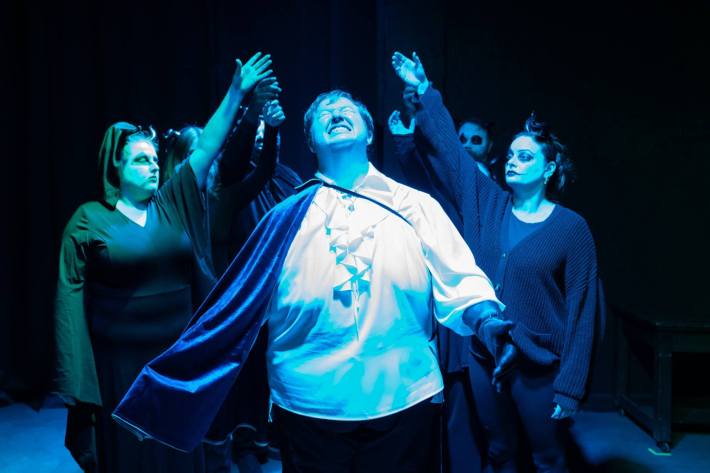
Several technical and artistic decisions factored into this success. In general, the furniture, prop, light, and sound changes happened seamlessly and had a showmanship flair, especially during Faustus’ conjuration of Mephistophilis in the first act and a trippy dream sequence in the second. I was particularly impressed with the overall sound production. Johnson added musical cues at key times in the script to indicate a tonal shift or a magical occurrence, which added pizzazz to each moment and helped me clock back into the show if I was feeling a bit adrift in the language. The sound was also layered in the scene expertly so it underlined the action while not overpowering the actors, almost how one would mix music into a movie.
Johnson also employed sleight-of-hand magic in the blocking, complementing the play’s themes and adding some energy. In the opening scene, two of Faustus’ students enter stage right and unfurl a banner with the title of the show on it. Then Warren, the student who serves as the play’s narrator, enters from stage left, guiding the audience’s attention his way. By the time he finishes his preamble, the two other scholars drop the banner and, behold! There sits Faustus behind his desk, having taken his place while no one was watching.
This simple trick of misdirection made for a bold character introduction and immediately got me excited for what was to come. While moments like these were peppered throughout the show—a clever paper switch trick, the use of bang snaps to emphasize the use of magic—I would’ve loved to see it incorporated more in the transitions and costume changes, especially in the second act, to help tighten the pacing.
One of the most surprising elements was Johnson’s incorporation of puppets and clowning with the actors who played the seven deadly sins. While that may seem like an odd artistic decision, I never felt like it distracted from the intended tone of Marlowe’s script; after all, clowns can come across as demonic as well as playful, partially thanks to modern horror tropes. This move also added humanity to a script that, similar to Shakespeare’s works nowadays, could feel a bit distant due to the language. Playwrights during the late-16th-century era often added a humorous b-plot to reengage the groundlings, and this choice reflected that approach.
Johnson also brought in elements of commedia dell’arte, an early form of comedic Italian theatre that used masks to invoke different stock characters. While I loved the thematic decision to use commedia to highlight the idea of the seven deadly sins wearing masks to hide their identity and further entice and entrap Faustus, I wanted the actors to embrace the attributes of the stock characters even more.
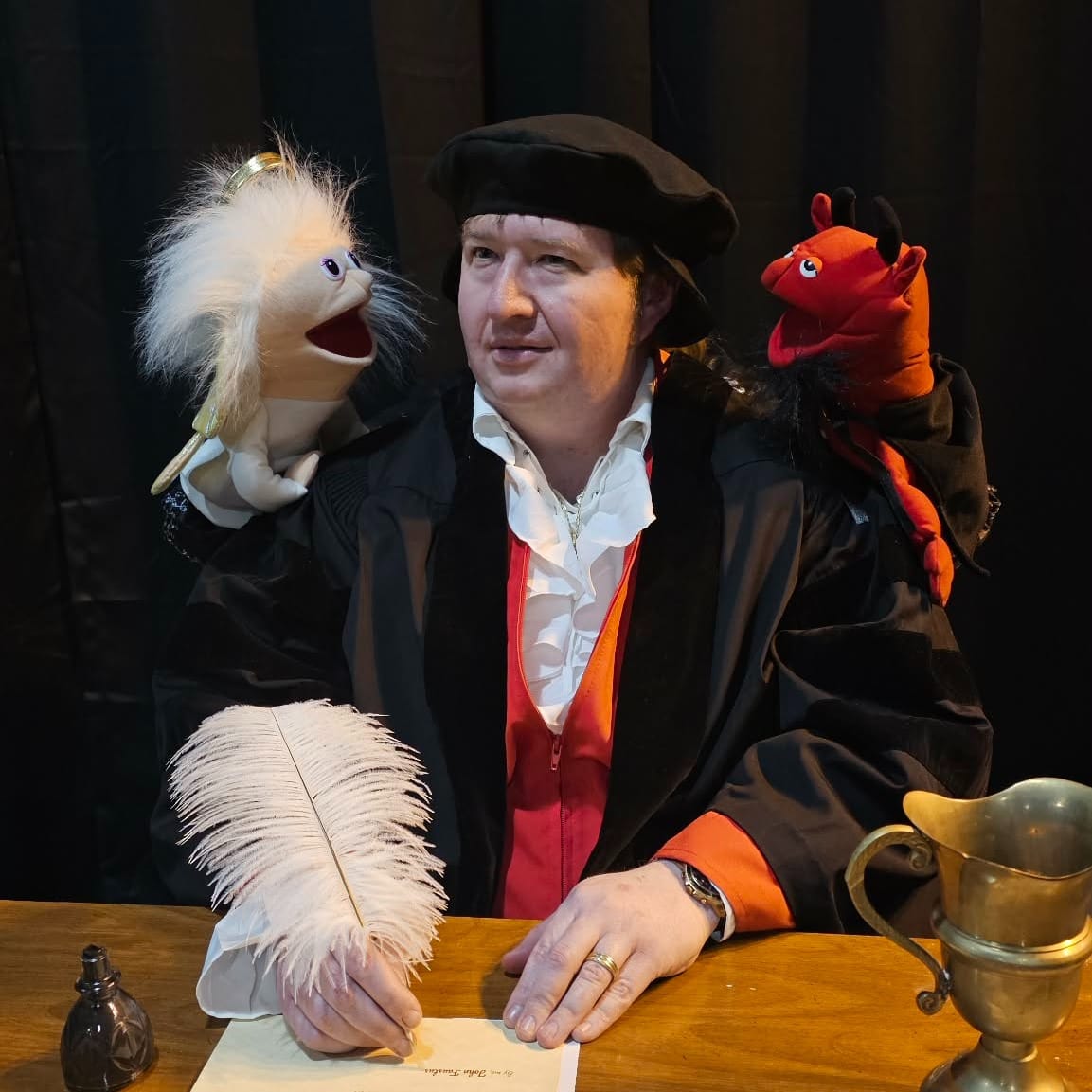
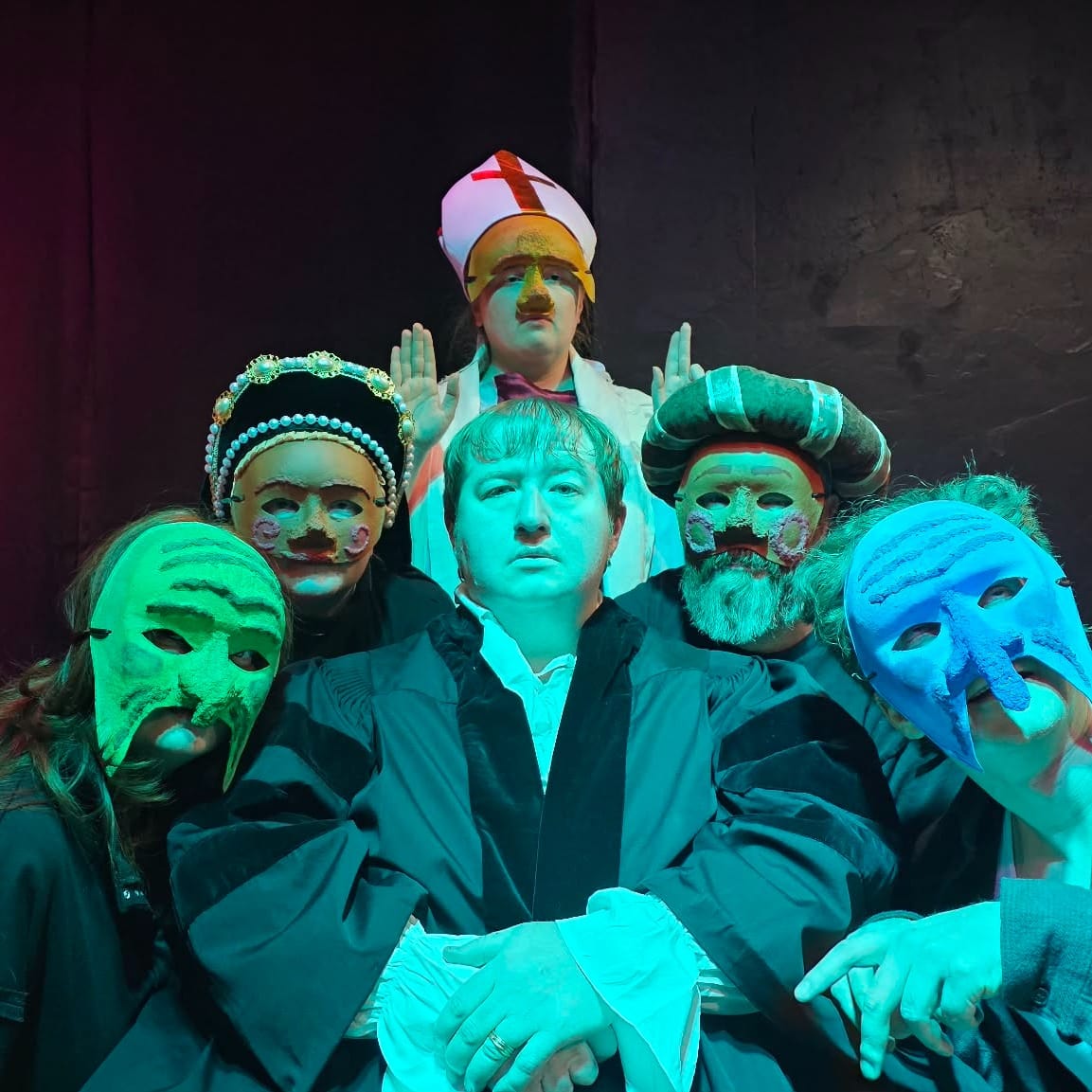
L: An angel and devil haunt Doctor Faustus. R: The commedia dell’arte masks, created by Charlet Ringwald | photos by Dawn Muncy
A handful of solid performances filled out the artistic vision. Jean Rene White, who took on four roles, stood out as Valdes, a creepy old magician, thanks to his astonishing physicality and commitment. Newcomer Michael Juliano embodied effortless swagger as Wagner. His puppetry work as Faustus’ angel and devil (a clever role combination on Johnson’s part) was particularly entertaining and a real crowd-pleaser.
In this production, Mephistophilis is presented as a demonic nun played by Bailey Wilson, whose uncanny ability to remain entirely still and emotionless for the duration of the show made for an unsettling performance. Her approach stood in effective contrast to the work of Chad Swanson (Faustus), who anchored the play with pompous, prideful gusto. While he ferried the audience through the character’s first-person monologuing with classical gesture work and conviction, Swanson’s true power lay in his strong, raw reactions, which helped set the tone and allow the audience to buy into what was happening on stage.
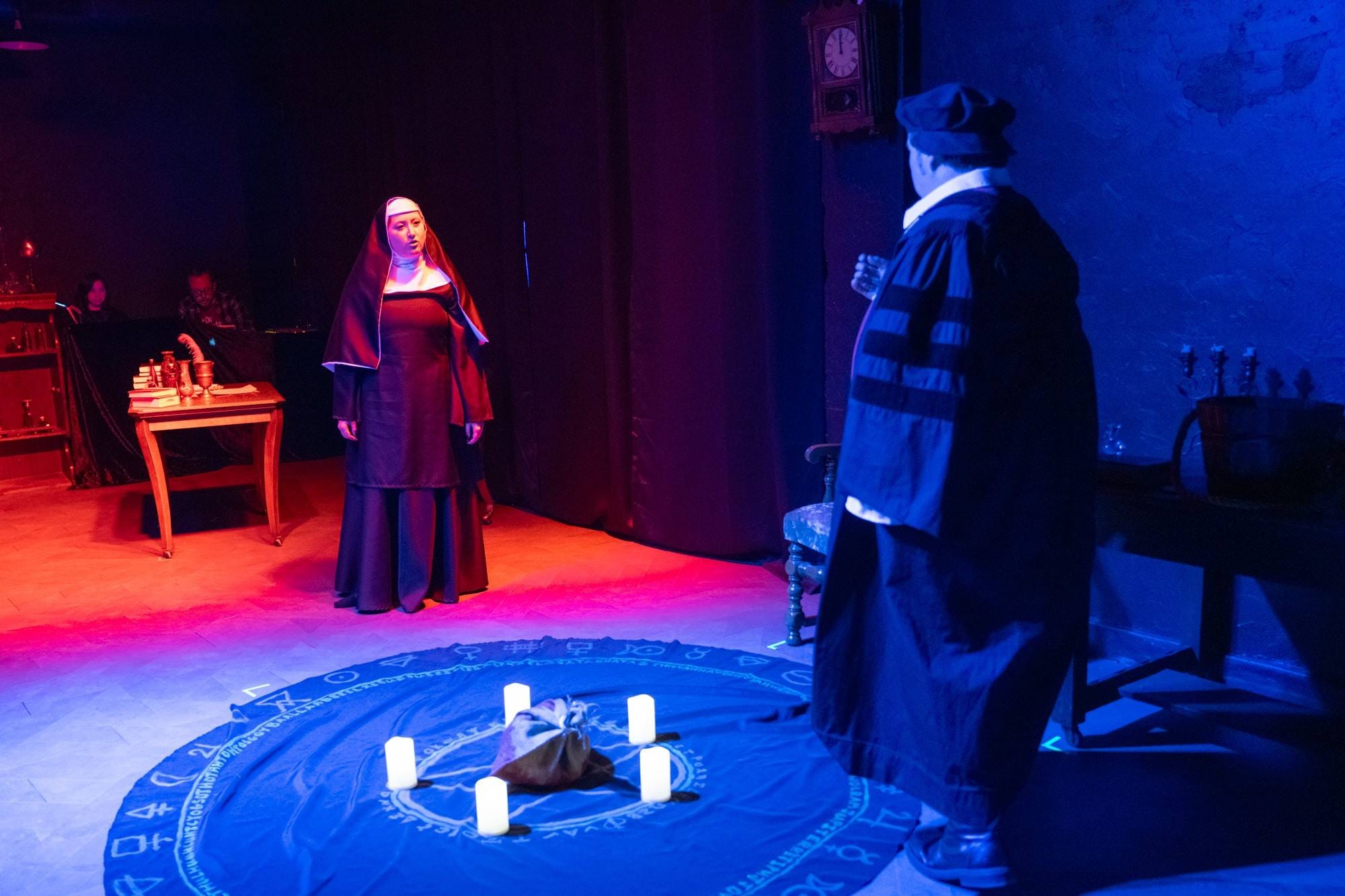

L: Doctor Faustus (Swanson) meets Mephistophilis (Wilson) for the first time. R: Wagner (Michael Juliano) | photos by Dawn Muncy
Underneath Doctor Faustus’ theatrical flair—the playful costumes, the glow-in-the-dark pentagrams, and, yes, the puppets—is a message about ambition. When Marlowe wrote the play, it was impossible to extract this message from its religious context, but I find a secular warning in this production that feels more universal: one about the dangers of selfish individualism. It’s not Faustus’ academic background that marks him as an antihero. It’s his conclusion that, because of his advanced knowledge, he is better than the world. When we lose our empathy, the play seems to argue, we lose our humanity.
Full of bold, original swings, Gaslight Theatre’s ambitious production made for a memorable evening. If this team’s involved in a show in the future, I’ll make the drive to Enid again. Meanwhile, if you’re up for a road trip yourself, Doctor Faustus is playing through February 7.


