
Showing Nationwide
June 12, 2026
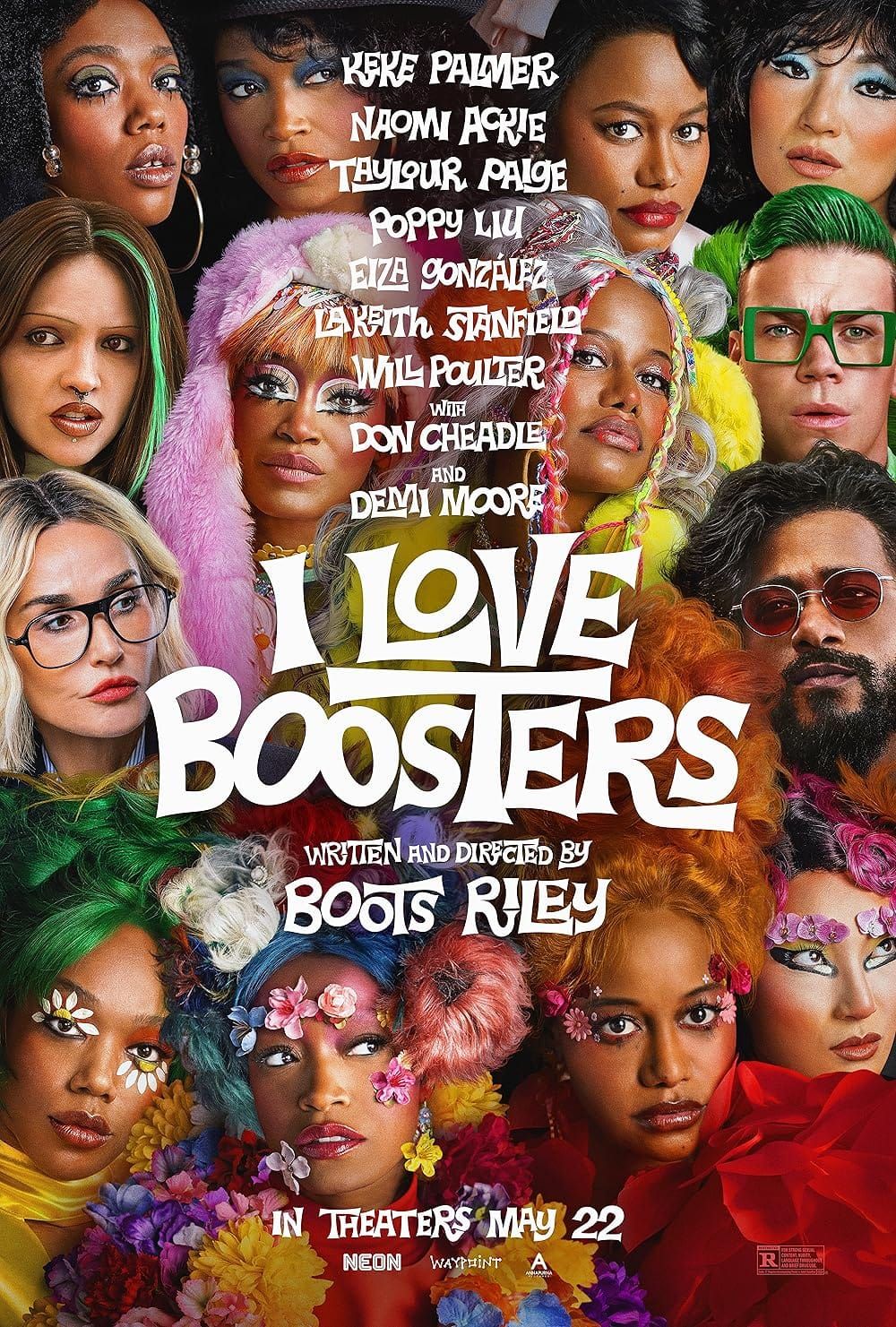
I Love Boosters is the kind of movie that people have been asking for. We don’t need layers of CGI or a reboot of a franchise, and the overwhelmingly positive initial response to Boots Riley’s second film is all the proof I need. The demand for original storytelling is higher than it’s ever been, and Boosters delivers many times over. Considering the recent works of directors like Riley, Ryan Coogler, Issa Rae, and, of course, Jordan Peele, this is a very awesome time for Black filmmaking, and the world craves more.
Boosters lives in the intersection of Riley’s interests in communism, absurdism, Black liberation as a part of a larger global struggle, and surrealism; these are also the themes explored in his directorial debut, Sorry To Bother You (2018). Riley seems to be treating his movies as a kind of manifestation, or perhaps sisterwork of concepts originally conceived and discussed in albums by his rap group, The Coup, something I truly don’t think I have ever seen before, but have absolutely dreamed of doing with my own work. Sorry To Bother You shares a title with The Coup’s 2012 album, while I Love Boosters comes from a song with the same name on their 2006 album Pick A Bigger Weapon. Riley’s pivot from musician to filmmaker mirrors the flexibility that many Black creators possess; it’s an almost compulsive need to overachieve and expand for the sake of representation, as well as a desire to contribute as much as possible to a future whose very existence seems constantly up for debate.
The Coup - Sorry To Bother You
The Coup - I Love Boosters!
“I look for ideas that I’ve always wanted to make,” Riley says in an interview with Filmmaker Magazine. “It’s like when you have a notebook full of ideas, and you go back looking through them to decide what could be good. It’s always chock full of angles.”
“I Love Boosters,” the song only details the premise and characters of I Love Boosters the movie. But the movie and its misdirections of plot, insane humor, use of models and miniatures and practical effects, all tell a much deeper story about how four women living in abject poverty find their places in the fight against economic inequality. I Love Boosters loves to turn left when you think it’s going right. In the scene where Taylour Paige’s character Mariah becomes Robin Thede as “Light-skinned Mariah,” I bypassed laughing entirely, instead grabbing the empty theater seat next to me and my friend's forearm for emotional support. In its discussion of high fashion, overconsumption, and workers' rights, I realized that I Love Boosters is essentially the Jodie Landon to The Devil Wears Prada’s Daria Morgendorffer. The film's editing and use of animation remind me of the work of Michel Gondry (who has his own ties to the music industry) while the humor and surrealism remind me of the early 2000s work of comedic kung fu genius Stephen Chow.
The movie discusses men’s presence in the struggle for equality as a distraction at best in LaKeith Stanfield’s character, and as actively oppressive at worst in Will Poulter’s character. Oftentimes, these two roles are one in the same, and I’d elaborate on that point more, but I don’t want to spoil the movie. I was initially thrown off by Tune-Yards as the composers of the film’s music, but the more I watched, the more it worked. “Hi-Ho!” adds to the whimsy and absurdity of the movie in a way I never would have foreseen. Given that they also scored Sorry To Bother You, it’s clear that Riley considers Tune-Yards to be trusted collaborators. Aside from worker organizing, I feel as though I Love Boosters is a movie that is meant to highlight the power of a coalition between the workers of all countries, but especially comments on the anti-Chinese rhetoric that our current leaders have spent years trying to drum up support for. Riley knows the potential power of Blasia and it is about time that someone stood up and said it. If we can get past our cultural differences, and do things like explain that “raw ass bitch” is a compliment, we can perhaps achieve incredible things.


