
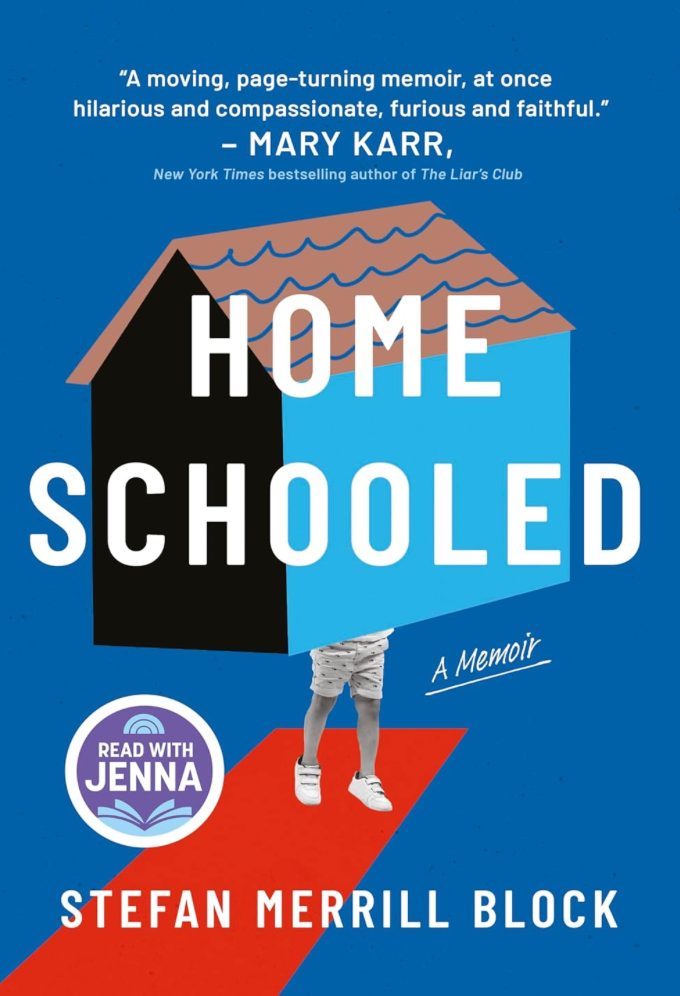
Homeschooled
By Stefan Merrill Block
Hanover Square Press
As the pandemic dragged on in 2020, one recurring point of panic for me was the specter of “home schooling.” My daughters were 12 and 9 when the world shut down. I had nightmares about cramming Khan Academy videos late into the night to refresh my memory about topics like slope and the Byzantine Empire (while also worrying about the girls’ mental health and my own career). Was this unexpected global crisis going to push me into a parenting role I didn’t feel at all prepared or competent to play? What did I know about what my kids needed to learn? And how would I approach all of that without support?
Many parents, of course, choose this path for their family willingly. Stefan Merrill Block’s fascinating, often claustrophobic new memoir “Homeschooled, chronicles one boy's experience in the early '90s, when the homeschool option had just become legal in Texas but was still rare.
Block’s family moves to Plano from Indianapolis. Within the first year, Block adapts well enough to his standardized test-focused school, where there are lots of worksheets to fill out, and where he secretly reads "The Cricket in Times Square” while seated at the back of the classroom.
But at home, young Stefan has learned that being sad and sulky – a counter to older brother Aaron’s dramatic flair – earns him attention and love from his mom, who’s become a much less happy version of herself: “The only monster actually waiting here to meet us in Texas was Mom’s anger. Since the move, she often seems distracted by adult worries until some irritation snaps her back into the present. And then she’s looming over us, jabbing a furious finger, speaking in a voice so patronizing it can make your nauseous, each word a sentence in its own right. ‘I. Am. Looking. With. My. Eyes. And. I. Don’t. See. How. You. Have. Helped. Me. At. All.’”
Block’s mother also traffics in odd theories (like white people experiencing photosynthesis, ear shape determining life success, modern medicine doing more harm than good, etc.). This mindset, paired with her profound loneliness in a new place and a cut-out newspaper article about homeschooling, soon lands her in Stef’s principal’s office to declare her fourth grader’s withdrawal from the year’s second semester.
Block writes, “Principal Sterne and I are looking right at each other, but Mom’s presence is a hot, close thing, a fire burning just beside us. What do I really want? For that fire to go out. To be with Mom in the way I was before our move to Texas, before her anger came and scorched the ground beneath us. Next to that want, it seems like a very small thing to agree to this plan now.”
So Block, believing he’ll just finish out fourth grade at home and be back at school the following year, tells Sterne that home schooling is what he wants.
But it quickly becomes clear that Block’s mother mostly wants her son’s constant companionship. (She’d also like him to stay a young child, which results in some wildly unhealthy behaviors.) The two often play in the backyard pool, or they go shopping and get ice cream. Stef copies the answers out of the teacher’s edition of the math book his mother has purchased; watches TV; re-reads his favorite books; and does occasional poster “projects.” Meanwhile, Block’s mother keeps trying to dye his hair back to the bright blond of his toddler-hood, repeatedly burning his scalp with harsh chemicals.
Wholly convinced of her son’s genius, though, she mostly leaves him alone to forge his own curriculum. As that one semester stretches not only through fifth grade, but all of middle school, Block can’t bring himself to hurt his damaged mother by telling her he wants to go back to school. His friendships grow awkward and strained; he has a horrific experience at a week-long summer Boy Scout camp; his mother makes both sons crawl around the house for a time, having read that this kind of regression might improve their messy penmanship. Because Stef has no contact with girls his age, he starts seeking them out in online chat rooms. When he goes to trade pictures with one he’s messaged regularly, “the blinking progress bar tells me it will take two or three minutes to download the whole picture, but I never do. By the time it’s a little more than half downloaded, I’ve seen enough.” Predictably (for us), the photo features a 30-something man masturbating into an old sneaker. Because … internet.
Yet when Block is scheduled to start ninth grade, he endures his mother’s hurt and anger long enough to finally re-enter the public school system – where he finds himself woefully behind, and oblivious to effective study habits, test-taking, and social skills. He gradually works to figure things out, and withstands even more than the usual amount of teen torture and ridicule along the way.
He finds success in science fair competitions. But he’s burns himself out with school work and activities, trying to make up for lost time. One day, he gets into a car crash. Though both he and the teenage girl in the other car aren’t seriously injured, his mother doesn’t speak to him for days, and tells him that he’s never once apologized.
“‘That was the first thing I said that day,’ I say, but the long silence that follows does not seem to be about the crash, the car I’d totaled, or even what I’ve said or not said. It’s about the choice I made when I was fourteen and have continued to make every day since. The choice to leave the small world Mom made for me, where I would always have been perfect and perfectly safe. ‘No,’ she says. ‘You never really apologized to me. Not like I deserve.’”
Readers do learn of the traumatic moments that shaped Block’s mom – she shares her hardest stories with Stef eventually – and this fills in a number of gaps, both for us and for Block. But it’s also the reason so much sadness haunts “Homeschooled.”
For parents, in most of the ways that matter, are always our first educators, whether they homeschool or not.


