
Glory
Curated by Juanita Sunday and Tara Fay Coleman
On View Mar. 7 — Aug. 30, 2026
NXTHVN
New Haven
Opening reception March 7, 2026
In Joi Williams’ grandmother’s house, a woman sits at the edge of her bed, tired, bracing herself for the workday to come. One strap of her nightgown slips from her shoulder. She comes to life in shades of blue, in a 1985 painting titled Blue Monday by Chicago artist Annie Lee. It’s a piece many in the Black America diaspora recognize from their homes of their own loved ones.
On Saturday, at the opening for exhibit Glory at Dixwell gallery and art fellowship center NXTHVN, Williams looked toward Akea Brionne‘s textile piece Where the Body Lands, depicting a woman at rest in the home. The woman leans across the long wall, glittering, eyes closed. Williams thought of the painting from her grandmother’s house, calling Brionne’s piece “the 21st-century rendition, in my eyes.”
What spoke to Williams as she walked through the exhibit was, she said, “all the women who are seemingly tired.” To her, the pieces told stories of work. This was by design. The show’s description explains, “Glory honors the aesthetics of everyday survival and the ways working class Black America families have built beauty, community, and meaning inside the walls that held them.”
“It’s necessary,” Williams said. “Work is necessary.”
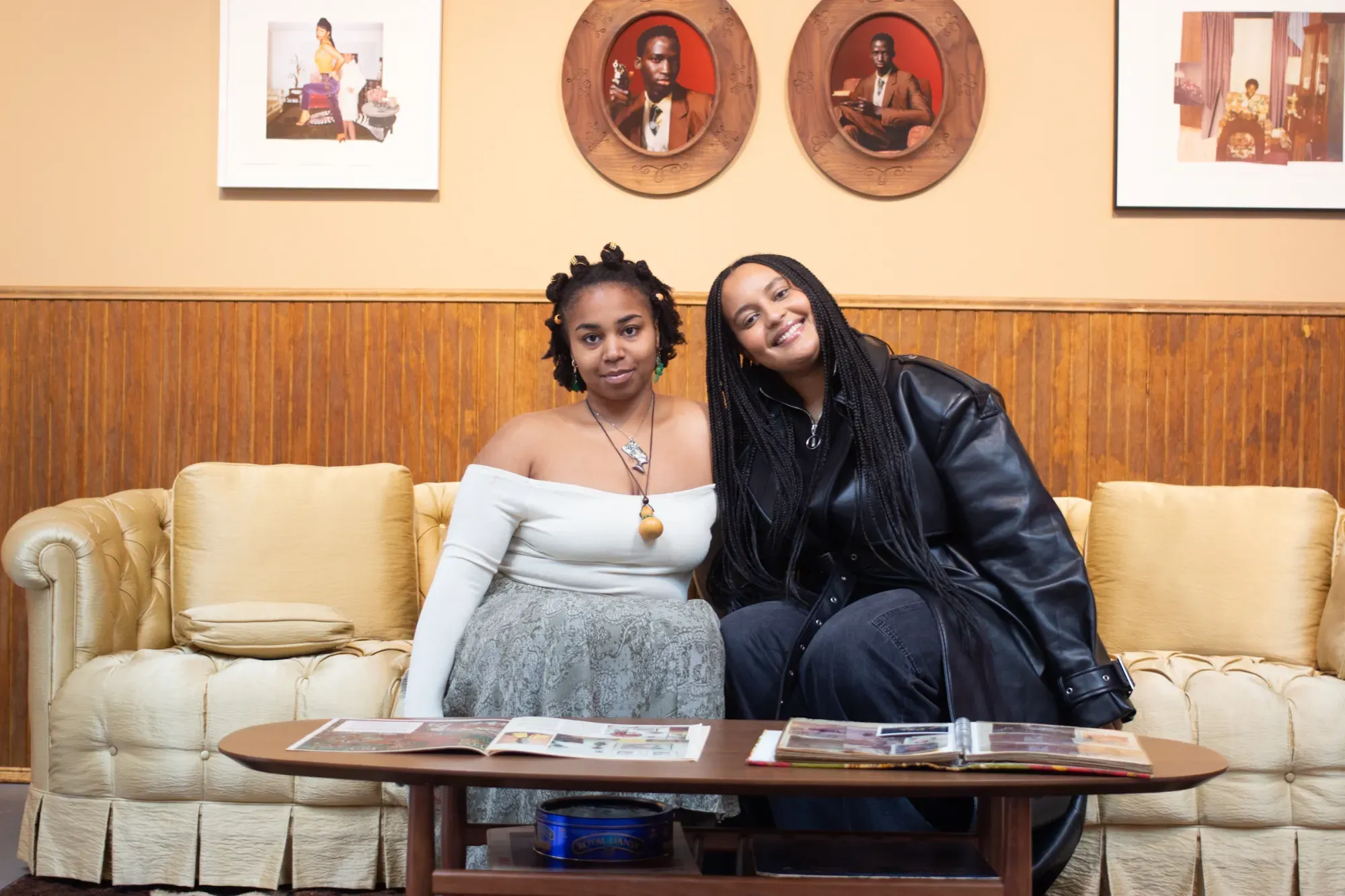
For curators Juanita Sunday and Tara Fay Coleman, that work has been a month in the making, for the install alone. Sunday talked me through the amount of design work the show called for, including custom stained wood paneling and the creation of temporary walls. The result was an exhibit that felt like a living room.
Attendees could sit on the couch in the center of the gallery and flip through books. Or they could watch Chris Friday’s video installation Did you eat? on a boxy CRT television and fill a green bag with the same hand-rolled ceramic “rice” shown on screen. These were points of invitation, coupling the work with the guests’ own personal knowledge and experiences.
“I want people to feel warm,” Sunday said. In one sense, the show was timeless. In another, it was rooted in the aesthetics of the ’70s, an era Sunday said carries “a really strong visual language, particularly for Black people.”
The space, the curators noticed, naturally picked up the colors in the artworks as the show reached its final form.
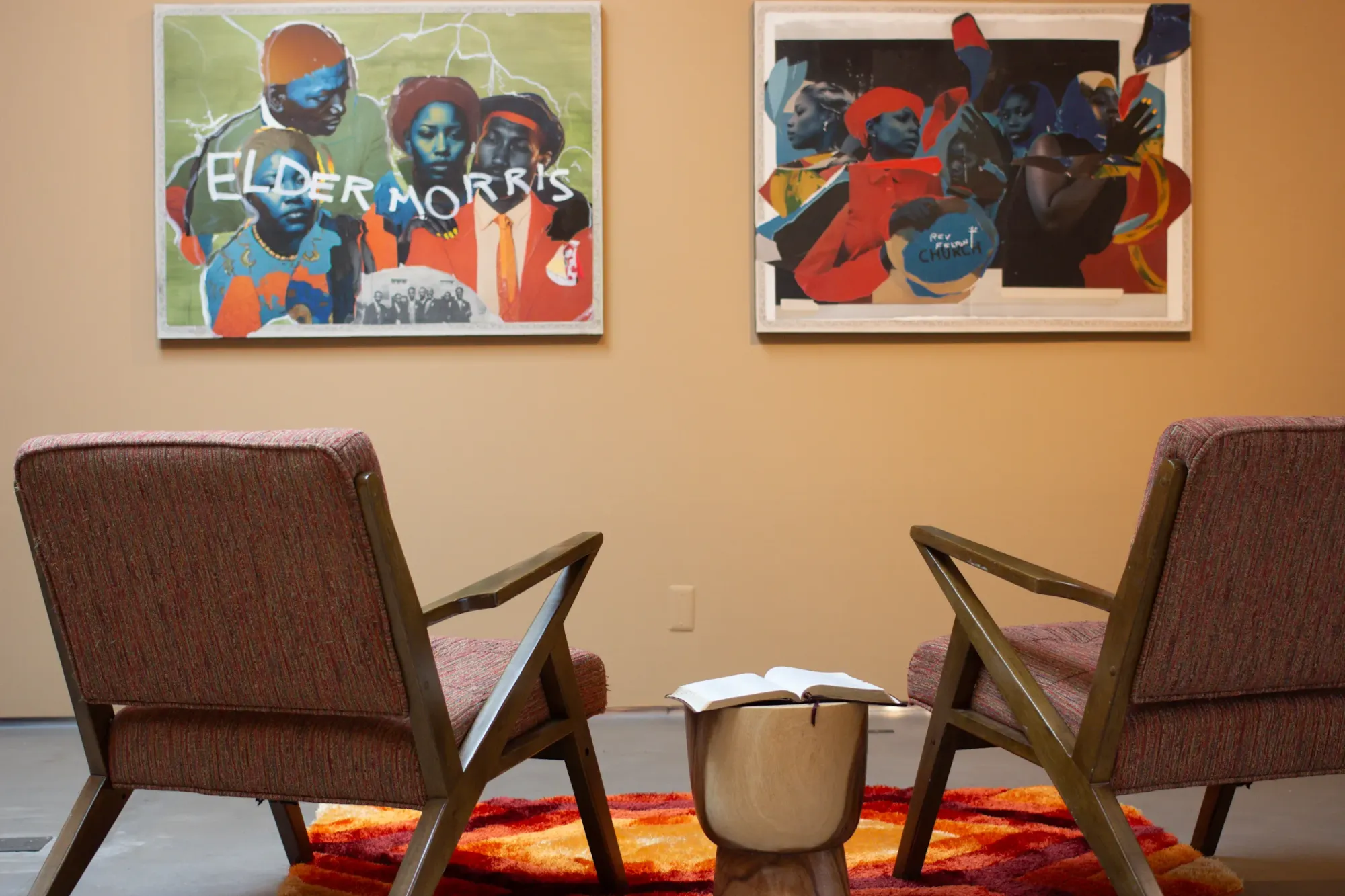
The oranges and reds of Shawn Theodore’s collage, acrylic, and ink pieces Elder Morris and Sunday Service at Rev. Felton’s, placed side by side on a wall in front of a pair of low chairs, echo the pattern in the rug the chairs were sitting on. Jomo Tariku’s sculpture Meedo Chair features a vibrant accent of tangerine lining the edges, its comb-like legs evoking the ‘Black is Beautiful’ movement of the ’60s.
Shades of green in Brionne’s piece anchor it in the calm, welcoming array of greens and browns making up the gallery design. The woman’s head is in her hand, and her elbow is supported by the couch. Sunlight from a window falls at the same angle as the woman’s naturally tilted form. Everywhere inside the world of this artwork, there is somewhere to land.
For Sunday, the show is a continuation of what curator Arvia Walker set into motion with her show Reverence: An Archival Altar, which ran from June to November of last year in the same gallery space at NXTHVN. The design of both exhibits took special notice of the audience’s experience of ease and belonging in the space. I watched Saturday afternoon as attendees ran into people they hadn’t seen in months, sinking immediately into familiar conversation.
A couple hours in, over 200 people had walked through NXTHVN’s doors.
“It’s very humbling,” Coleman said of the packed opening reception. “I mean, it’s beautiful. I’m just holding a lot of space for gratitude.”
Normally someone who gravitates toward white walls and less immersive setups, Coleman said she came to embrace color for this show. “I learned so much from my co-curator,” she said. Though she and Sunday were approaching the design from different angles, they were “both thinking about community, how community will receive it.”
Coleman came to New Haven from Pittsburgh for NXTHVN’s curatorial fellowship, a program she shares with Sunday. “I’ve met the best people here,” Coleman said of her time in New Haven so far.
One of Sunday’s hopes for the show was that it would “spark memories for people.”
From Annie Lee’s Blue Monday to its print in Williams’ grandmother’s home to Brionne’s 10-foot Where the Body Lands and the mix of memory and connection wrapping the two pieces together in Williams’ mind, Glory‘s vision is well in the works.


