
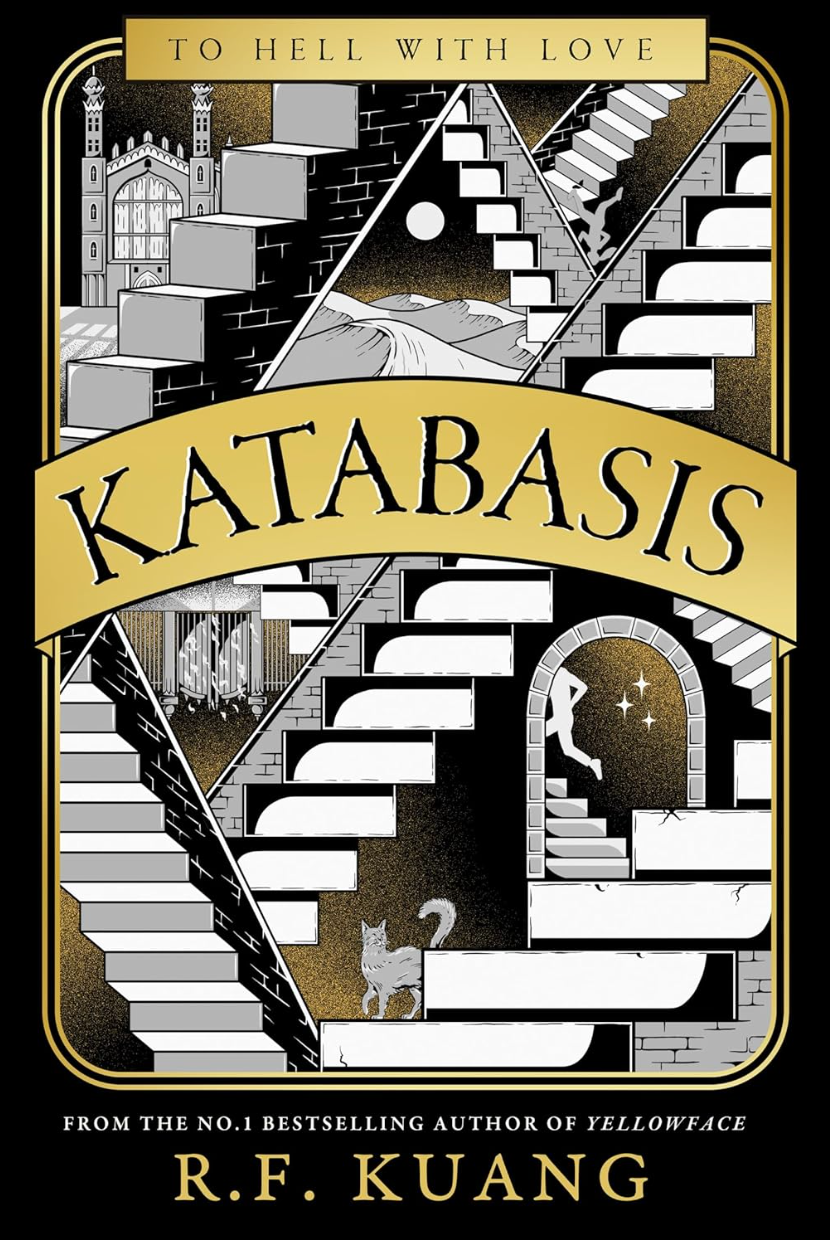
Katabasis
By R.F. Kuang
Harper Voyager
Hell is graduate school. Or at least, according to R.F. Kuang, the first few circles are.
In her latest novel, Katabasis, Kuang follows two Cambridge PhDs as they journey to the underworld, only to face a reflection of the world from which they came. In the fall of 2018, I myself arrived at the University of Cambridge as a newly minted master’s student but, in a few short weeks, I came to the same conclusion and promptly dropped out. I was there to research postcolonial Britain, a topic Kuang deftly explores in her novel Babel, so I was thrilled when I read the jacket copy for Katabasis.
Protagonists Alice Law and Peter Murdoch aren’t in Hell for sins committed on Earth (in fact, they’re not even dead). They travel there to rescue their advisor upon his untimely demise – not because they think he deserves it, but because they need his coveted recommendation to secure prestigious positions in the field of “analytic magick.” Turns out even magicians can’t escape the brutality of the academic job market.
Of course, these aren’t the first literary heroes to embark on a “katabasis,” or journey to Hades. Orpheus ventured to save his doomed love Eurydice, Virgil went to consult his father in the Aeneid, and Dante Alighieri travels to Hell under Virgil’s watchful eye in his Inferno. Katabasis largely follows this tradition, though the text reads more like Percy Jackson than poetry. Readers who cringe at the thought of struggling through ancient verse need not be concerned.
What I did struggle with is how, when it comes to the relationships between the central characters, much is told, but not nearly as much is shown. Crucial elements are shared through exposition rather than action: the complexity of Alice’s connection to their advisor, Professor Grimes, why Alice resents Peter, and what exactly would drive two seemingly intelligent adults to risk their souls in Hell solely for the promise of a future job.
The ideas, rather than the characters that voice them, are the novel’s greatest strength. In this world, magic isn’t powered by some otherworldly spiritual source, but through paradoxes of language and logic. Perhaps the greatest achievement of Katabasis is how it constructs a fantasy built not on suspension of disbelief, but the contradictory truths that comprise existence in the “real” world. Kuang shines as she describes the linguistic legerdemain of Peter and Alice’s work. In one scene, a magician writes “the next statement is false” followed by “the preceding statement is true,” which we learn is “a practical joke within the department that often had undergraduates stepping back and forth on the stairways, stuck like rocking horses.” In another, one of Zeno’s paradoxes of motion (that any distance divided in half continuously will never become zero), renders its victims totally immobilized. While I doubted the veracity of certain characters’ decisions and interactions with one another, I never doubted the world in which they exist.
One key question the novel raises is what makes life worth living. Alice’s singular goal on Earth is to become a tenured professor of “analytic magick” at an esteemed institution. Yet throughout the story, our protagonist finds her worldview challenged by Hell’s more permanent residents: the Shades doomed to traverse its courts for eternity. These damned souls, many of whom also spent much of their lives in academia, don’t covet earthly success, but instead desire the mundanity that Peter and Alice take for granted. One late student tells them she wishes to “sit outside...have a cup of tea, Assam, with lots of milk and a swirl of honey. And a cinnamon bun. With raisins.” Another Shade peppers Alice with questions about the living: “He hungered for the tangible, the material. He became resentful when he felt she had wasted her time above.” Perhaps this is because the greatest damnation in Kuang’s Hell is its central paradox: Hell is where time is endless, but nothing ever changes. I went on a walk after finishing Katabasis. It was autumn then, and I admired the evolution around me: verdant leaves transformed to ochre, lording above their fallen peers, which crumbled into dust under my feet. These are the moments the Shades of Katabasis ache for, and when I find myself striving for a better apartment, angling for a promotion, or even wishing I could write a more impressive book review, I hope I’ll still remember that.


