
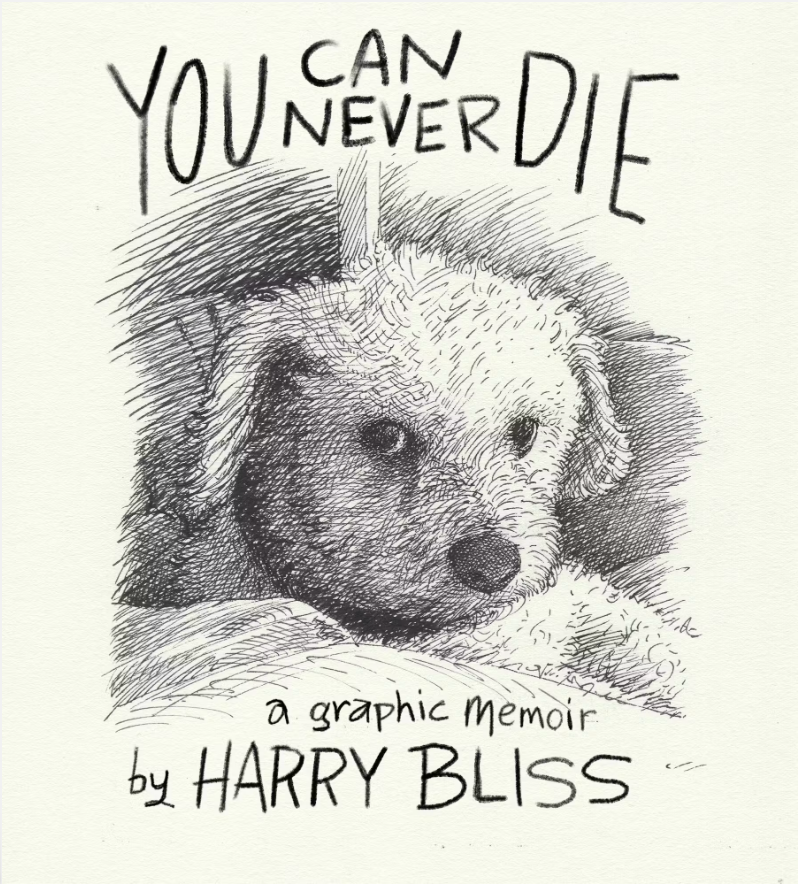
"You Can Never Die"
by Harry Bliss
Celadon Books
Just a few months after my father died, my beloved orange-and-white cat suffered partial paralysis from a blood clot, and I suddenly found myself saying goodbye to him, too. In some ways, the latter hit me even harder, because for nearly a decade, the cat had been a part of my family’s home life, day-in and day-out. He’d offered quiet comfort and companionship every day, and slept snuggled against my leg each night. I was his person, and his absence felt painfully palpable to me.
To non-pet people, the idea that grieving an animal could be remotely comparable to grieving a parent likely seems preposterous. But artist Harry Bliss – best known for his New Yorker cartoons and covers, and his work as a children’s picture book illustrator – candidly plumbs the depths of pet grief where it concerns his dog of 17 years, Penny, in his graphic memoir, “You Can Never Die.”
In one passage, he writes, “Every time I cut the lawn and I come upon Penny’s grave, something in me morphs. … I feel lost. I don’t know what brings about these waves of sadness – why they come when they do. I only know that I am sad now for her. I wish my dog were here with me in this bed. Will the missing her be a forever ache?”
Penny’s loss is far from the only personal ground covered in this 400-page collection of bracingly honest short essays, journal pages and sketches, cartoons, and photographs. As Bliss explains in his opening note (“I don’t like the word introduction”), “I would like you to better understand me, connect with me. … My relationship with (Penny) altered the way I understand and carry on in an unanticipated and profound way. There are other reflections … giving my baby up for adoption, communing with trees, comic books, life-drawing classes, virginity, drugs, the Mafia, two hours with Andrew Wyeth, making books with Steve Martin, working with a famous porn star (great guy), and other reflections that, honestly, I should have been incarcerated for.”
Bliss' book casts a broad net, as this list suggests. But Penny is the thematic (and visual) anchor he keeps returning to, and the loss that ultimately informs the author’s experience as he approaches the loss of his parents, with whom he’s always had a strained and complicated relationship.
As Bliss’ 93-year-old father (who’d also been an artist) moves into another son’s home to live out his last days in hospice, Bliss goes to visit his mother at the hospital: “The drugs my mother is taking to ‘help’ her with her dementia is making her both better and worse at the same time. She seems to be less combative, but more sedated and out of it. As a son who had to put up with years of manipulative, controlling, unsolicited mother advice, I’d wished for a more sedated mom. But not like this.”
These perspectives come near the book’s conclusion. I confess that in the early going, I’d wondered if the book’s length was excessive, and whether Bliss could achieve a sense of cohesion while touching on so many different topics and memories.
But by the book’s end, I experienced the feeling I often do when I’ve been working at a watercolor painting for a couple of hours: a sense of awe when what initially looked like colorful blobs and layers snap into sharp focus, and the image suddenly comes together – in this case, to provide a comprehensive sense of one person’s lived experience of grief, gratitude, art-making, and wonder.
For as Bliss explains, it makes sense that his abusive, chaotic childhood resulted in his desire in adulthood to spend large portions of time in solitude, in nature, often with just Penny – and later, a new dog named Junior – for company.
While dividing his time between J.D. Salinger’s former home in Cornish, New Hampshire, and the house he shares with his wife in Burlington, Vermont, Bliss reflects on all he sees and does, including his impulse to make art: “I understand now that I am trying to hold onto a moment, covet the vision and keep it close so I’ll never forget it. … I keep Moleskin journals for this very reason. At first, I simply wrote and drew things in these journals – cartoon ideas, dreams, psychedelic experiences. But after eight years and twenty-eight-plus journals I now realize that the underlying reason for putting it all down on paper is so I can recall my life. I make art in a desperate attempt to hold on to this life.”
And, I would argue, to connect with others in a meaningful way. Or else, why publish a deeply personal work like "You Can Never Die"? Yes, it may feel at times like a shaggy dog of a book. But as we all know, sometimes overlooked, under-disciplined mutts like these become the loves of our lives.


