Visualizing Change
Artists: Jarrod Beck, Paul Farmer, Pat Brentano, Linda Lee Nicholas
Guido Garaycochea, Marianne Barcellona, Anthony Heinz May, Perri Lynch Howard
David Madacsi, Alice Momm, Emilia Dubicki, Andrea Cukier
Feb. 26 – April 11, 2026
On View at ClimateHaven, by appointment
770 Chapel St.
New Haven
Opening reception Feb. 26, 2026
Part II opening at Chester Gallery on Friday, Mar. 6th, 2026, from 5 – 8 p.m.
Hours: Wed. – Sat. 12 – 5 p.m.; also by appointment
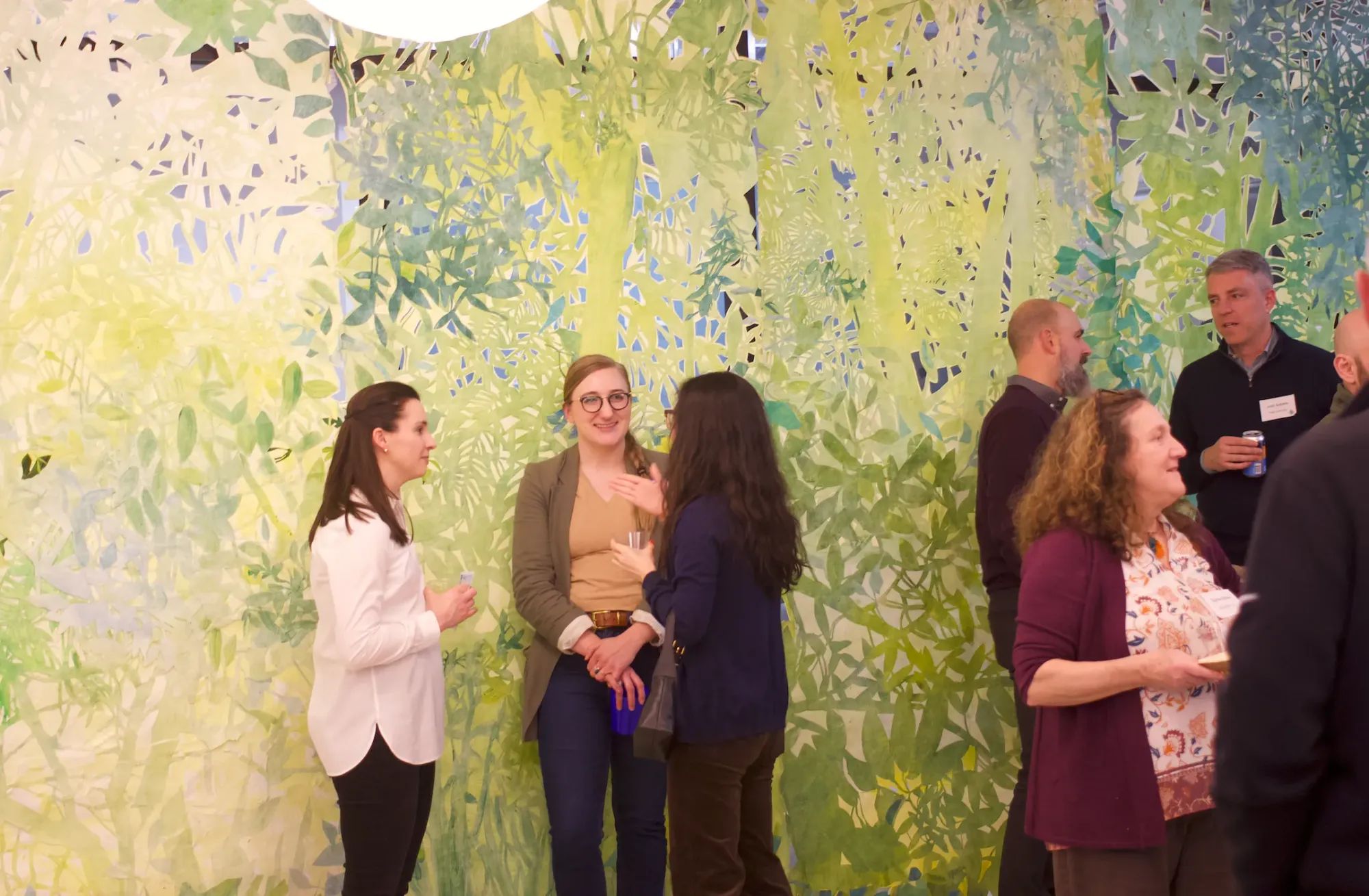
Warm, vibrant greens formed a dazzling array of vegetative life. I peered between the leaves of the forest to find … the office breakroom.
I was at environmental start-up platform ClimateHaven’s quarterly networking event, Green Drinks. Whizzing past my head were words like “revenue,” “volatility,” and “scaling the solution.”
I was, as always, on a mission to find the art.
I didn’t have to go far. This iteration of Green Drinks had a partner: I-Park, an artist residency in East Haddam. Curator Nancy Pinney of Chester Gallery worked with them to put together pieces from artists who had participated in the past 25 years of I-Park’s programming.
The result was a 12-artist show called Visualizing Change, which opened at this quarter’s Green Drinks Thursday night.
I spent most of the event returning again and again to a four-panel installation called “Endangered Habitat” by Pat Brentano. It consisted of layers of house wrap material Tyvek that Brentano had painted, then cut. Brush strokes continued somewhere beyond the sharp edges. The Eric-Carle-like textures drew me in.
Unsure where to linger in between my visits to “Endangered Habitat,” I started nesting. I walked toward a painting inside an enclosed cubicle. There was a rolling chair, so I sat down. There was a desk, so I opened my notebook and started writing this article. Before I knew it, a crowd had gathered just beyond the cubicle walls, and speeches were starting.
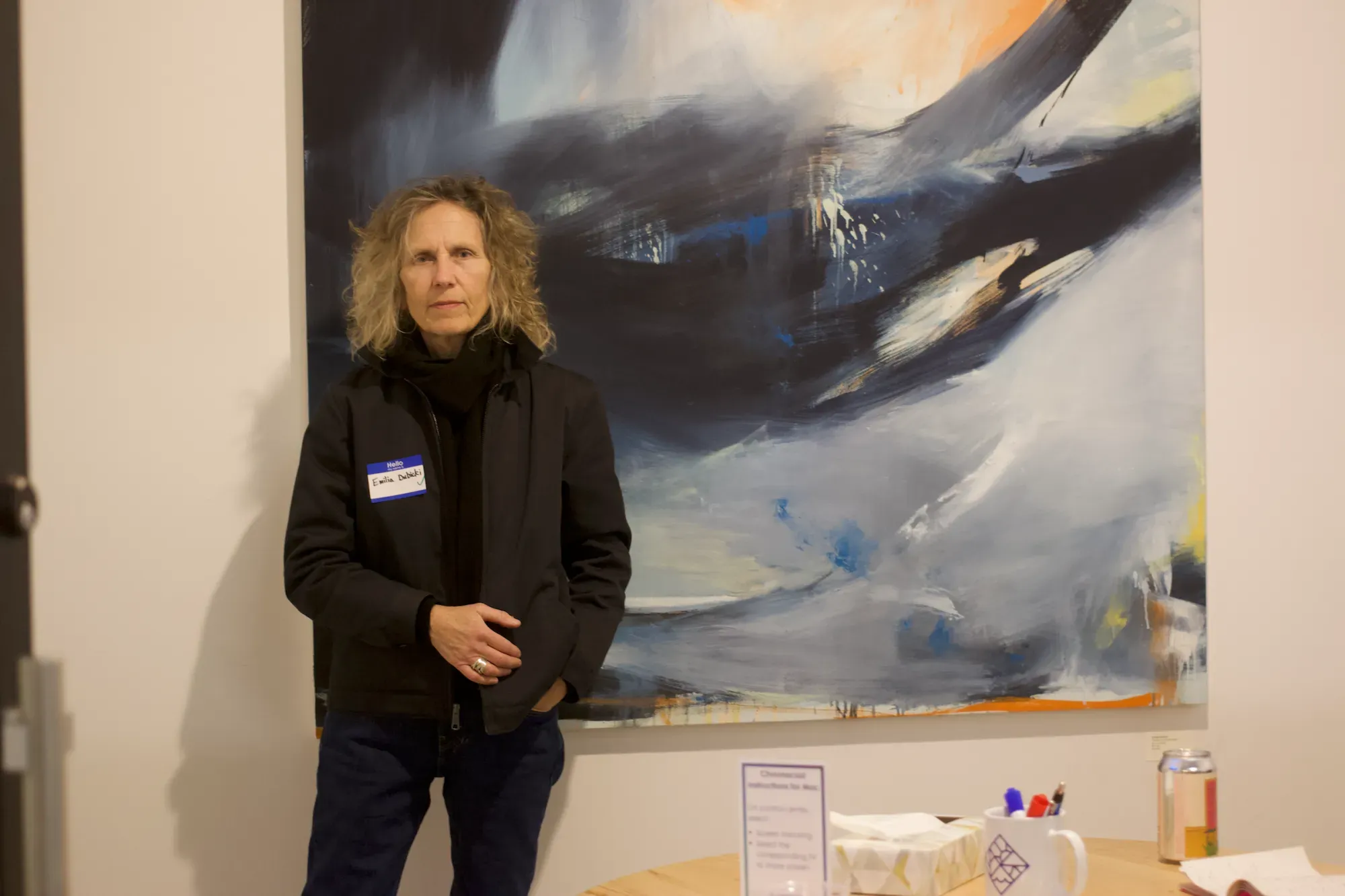
I cozied up inside as information poured through the glass walls and open door. Org president Ryan Dings announced Climate Haven would expand in April, building out 7,000 square feet of space for incubation and innovation. To my right, the gray-blues and whooshing strokes of Emilia Dubicki’s abstract oceanic painting “Chasing a Summer Night” told a tale older than us all.
“It’s at the end of my street,” Dubicki said of the water by her home in Morris Cove.
David Madacsi’s found-object sculptures held actual nests. When I asked where his found objects came from, he said, “Some of them float in.” We headed toward his works.
“There’s a nest that fell in my yard,” he said, pointing to a very small bird’s nest resting on a long rectangular column of driftwood that had been eaten away by the sands of time.
Madasci was living in Mystic when he found the wood. “Next door to me was wetlands,” he said. The driftwood had just “floated in.”
I commented on the object’s even sides, asking Madasci if he cut it. Nope—the wood must have been, he said, some kind of post before. I thought about the form’s journey, from the natural curves of a tree to the clean edges of a post to the organic holes of a forgotten piece of matter. Suspended from the bottom of the driftwood was a pendulum, evoking time.
Madasci told me titles are very important to him; this piece was titled “Still. Life.” Not still life! Still. Life.
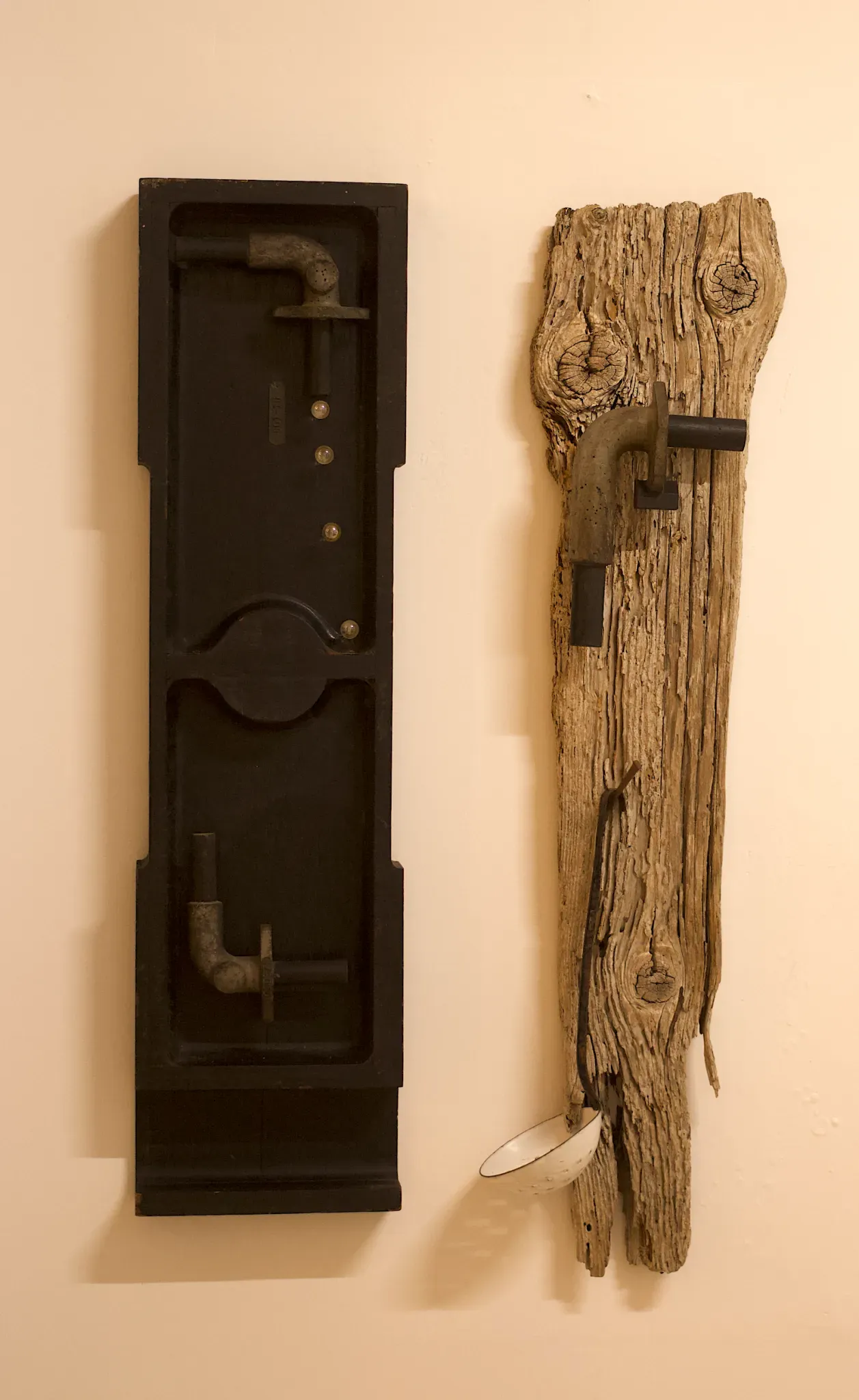
His title for the work across from that one (and a decade and a half older than it) was even trippier. The piece was a diptych, with casting patterns from a foundry, pipes, and glistening baubles of “water” flowing from one half to the next. Madasci remembers putting it together: “I had the sense that there was something missing.”
In his kitchen hung pots, pans, and other household items. “I looked up,” he said, “and there was this strainer.” It was perfect. He put it right in.
The finished work’s title? “Water Planet Artifact.” A future civilization might discover it and understand that it was from a water planet—“the only one we know about,” Madasci noted.
As we were talking, Madasci reached up and adjusted the angle of an element on another artwork of his. “I almost never know where I’m going,” he said. Another bird’s nest sat in the center. We talked about the multitude of nests animals make. Even humans call making a home “nesting.” I peered at the title.
“Nesting Place.”
Of course, nests don’t make themselves. At the opening, I encountered with Jessica Nevins, I-Park chef for the past three years. For one month at a time, she fixes dinner every night for the eight-person cohorts.
Nevins is trained as an opera singer. Music took her all the way to Italy, where she studied for four years. She came back with more than just polished pipes; she had fallen in love with food. Fresh ingredients, knowing what’s in season—these are considerations she came to embrace in her life in Italy. Now, she expresses herself in the culinary arts.
I asked Nevins if she still ever sings opera. She asked me to imagine a tulip.
One of the I-Park artists, Ted Efremoff, had made a large tulip-shaped megaphone on a pond one day and asked Nevins to sing into it. She chose “Summertime,” from the opera Porgy and Bess.
“And the livin’ is easy…,” I half-hummed.
“That’s the one,” she said.
Nancy Pinney, Visualizing Change’s curator, started in I-Park as a photographer and videographer. When I met her at the show, she was on a roll of 4 a.m. wake times, midnight bedtimes, all of her equipment being towed (and then returned) along with her rental van, and installing a show in the aftermath of a blizzard.
“Monday was my big day to install,” she said.
Twenty inches of snow said: Not so fast.
Pinney squeezed the install into the following two days, and the show went on.
She looked around at the work. “For me, this is the fun part,” she said. “It’s better than I imagined.” I asked her about the green Tyvek cutouts, and she took me right to her safely retrieved laptop, where she emailed me a statement from the artist.
I wove my way back to Brentano’s piece. This time, I saw something that I hadn’t noticed before. It was green, like everything else, but its distinct shape gave it away as an animal. A water bird. A heron maybe, or an egret.
Later that night, I opened Pinney’s email to read Brentano’s statement. The first sentence had me floored.
“Birds have no arms,” Brentano had written.
She went on: “They cannot speak. They build nests, hunt for food and defend their young with their beaks. They are delicate creatures that defy gravity and fill the forest with idiosyncratic song.” Then she talked about the danger these creatures are in and the fight to preserve their habitats.
Visualizing Change’s art had provided nests for me all night. I resolved to learn more about the nests of the creatures these artists (and everyone in the room, really) were advocating for. We all need somewhere to land.