
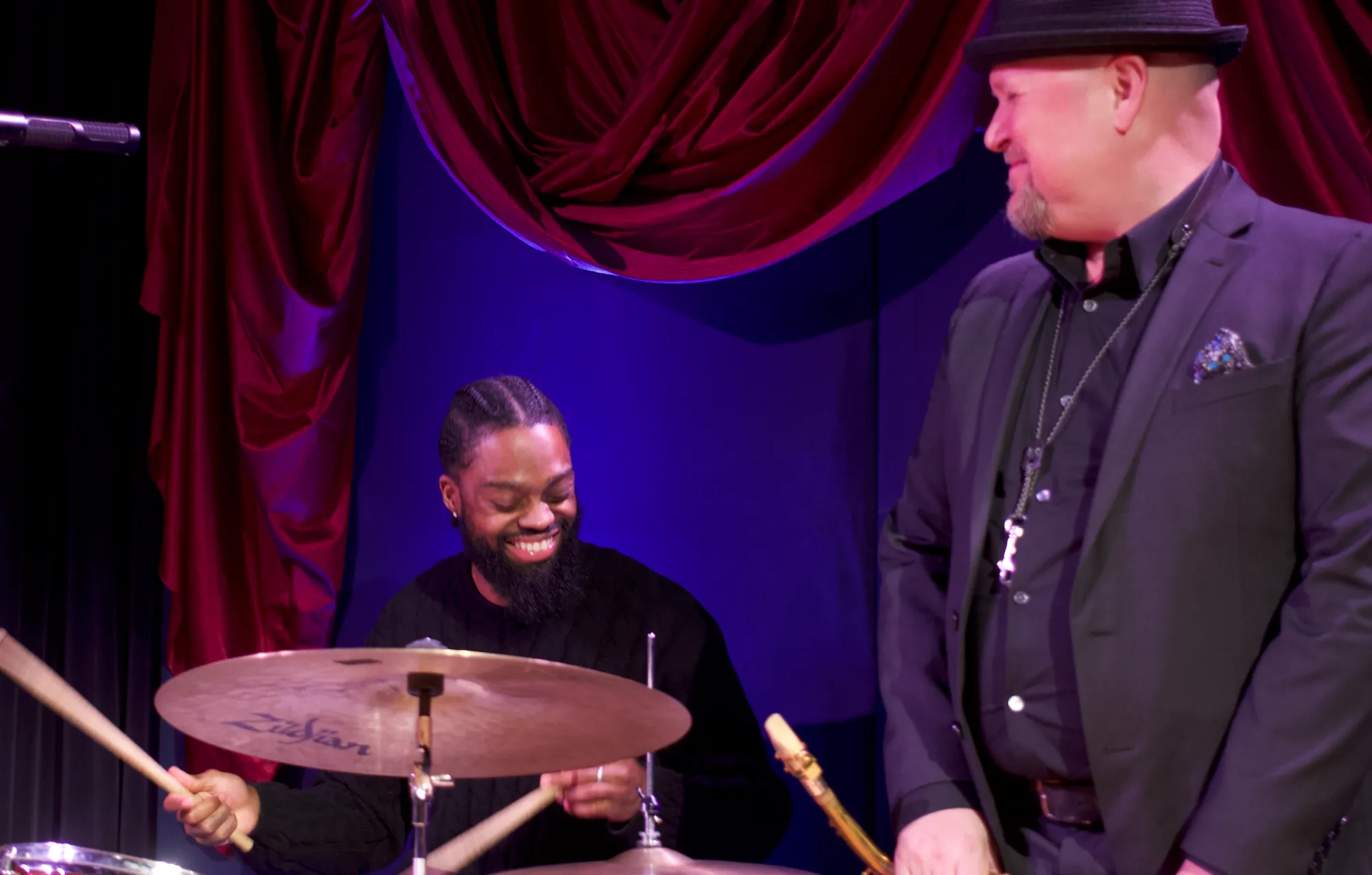
Ian Hendrickson-Smith and Friends
Al Street on guitar, Eric Finland on organ, David Hawkins on drums
Neighborhood Music School
New Haven
Dec. 5
The band warmed up the room within seconds, a runaway train with saxophonist Ian Hendrickson-Smith smiling at the controls. They were masters of buildup, repeating phrases over and over without the hint of a flinch.
I was watching Hendrickson-Smith, who has won six Grammys and toured with likes of The Roots and Amy Winehouse, and his jazz/funk/soul band at the latest installment of Neighborhood Music School‘s “Live at NMS” series. Guitar, organ, saxophone, and drums came together for funky dissonance and smooth resolutions in front of a packed room.
David Hawkins drummed himself into a trance, gazing above the crowd and into the distance as his hands created cathedrals of sound, only to tear down those walls in waves of ear-splitting expert demolition. He used the drumsticks at all kinds of angles, dampening and modifying the vibrations. At times, he used his bare hands to strike the drums like a conga. He ended his solo with a quick head tilt, and that was that.
Where Hawkins kept his cool, the crowd lost it. They went wild, screaming and whistling.
“One more time for David Hawkins,” Hendrickson-Smith lied. It would not be just “one more” round of applause for the drummer. The crowd wouldn’t have it. Neither would Hendrickson-Smith, who went on to lead the crowd in a third cheer.
Then Hendrickson-Smith gathered the raucous mood into a somber moment, telling the crowd he needed to speak to something serious. He waited until the room quieted down, using the silence to set the stage for his announcement. A hush fell over the festivities. Hendrickson-Smith opened his mouth:
“That was David Hawkins on the drums!” The audience broke into laughter and gave a fourth round of applause for the virtuoso on drums.
Hendrickson-Smith’s saxophone danced across every note, leading with a light touch. Eric Finland added a ‘60s synthy sound with the organ, keeping his feet on the pedals and hands flying across the keys.
Al Street on guitar teased the crowd, hitting an impossible lick and then hitting it a few more times, just for fun. It was a super funky show, reminding the crowd that jazz can and will take you to extremes.
Inside an amp-like black box behind Finland, I could see something spinning behind a grille. Was it a fan? Maybe it was a computer fan, I thought, saving the machine from overheating. The guess didn’t feel quite right, but it was all I could work with for the time being.
The four-part outfit was a slight reconfiguration of the house band at a venue Hendrickson-Smith once ran with his wife in Brewster, N.Y., which closed due to what Hendrickson-Smith described as an unfortunate situation with a corrupt individual—a tale as old as the music business. The venue was called Uncle Cheef, and the band was called Grease Patrol.
Minus one saxophonist and with a drummer swapped, Friday night’s band was Grease Patrol with a slick twist.
Finland pushed power chords on the keys. The organ sound was nostalgic and pretty, emitting a warm, textured fuzz evoking CRT televisions, cassette tapes, and corduroy; there is something so comforting about a good grain. I would come to learn later the sound’s vibrating edges were an effect of the spinning “fan” in the mysterious black box.
“We want you to leave here better than you showed up,” Hendrickson-Smith told the crowd. He encouraged us to let our hair down. “If you have any, go ahead,” the fashionably bald saxophonist continued.
When he wasn’t playing, Hendrickson-Smith got out of the way, literally. He would walk off to the side, grinning and sharing glances with Hawkins as he let the rest of his band shine.
Hawkins, meanwhile, barely rested for a second, keeping the motor of the music moving across every hill and valley the other band members drove him to. When his drum set started running away from the rug, Hendrickson-Smith knew exactly when to rest a foot on the metal stand and when to take it off.
Originally from Omaha, Nebraska, Hawkins started drumming when he was 2, “on the pots and pans.” As he grew up, he started playing in church, exploring gospel, rock, and hip-hop. In high school he discovered jazz.
It was a matter of fate, it seemed: Omaha was a pivotal stop on the transcontinental Union Pacific Rail Road line, bringing jazz greats like Duke Ellington through the midwest to infuse the Nebraska city with swing and blues over the years. Like the city itself, Hawkins wouldn’t be left untouched by jazz’s irresistible melodies.
A mentor who had spent time in New York in the ’90s helped Hawkins along his path, sharing what Hawkins called an “interconnectedness” and sense of perspective. “He opened my eyes to the bigger world out there,” the drummer said.
Hawkins moved to New York in his mid-twenties and played Uncle Cheef’s opening night a year later; now 29, he’s steadily making his dreams come true.
“Hope you’re having as much fun as we are,” Hendrickson-Smith said in between songs. “It feels almost illegal up here.”
After the set, Finland told me about the organ he was playing, which was first sold as a “take-home pipe organ” for a primarily Black church audience (and would later be taken up by rock bands like the Grateful Dead). To reach a sweet spot of godliness and practicality, the makers added a speaker: the box I had been eyeing since the beginning of the set.
Inside, an actual horn spins at a speed the player can control, creating a Doppler effect “like a train leaving the station,” Finland described. And with Street, Hawkins, and Hendrickson-Smith chugging along by his side, it was full steam ahead.
“A lot of that’s just connection,” Street said of the wordless communication constantly bouncing back and forth between the band members. The music featured heavy improvisation, and while the musicians expressed shock at each other’s daring, they were never caught off-guard.
“We’re not only professional compatriots, but we’re, like, actual friends,” Hendrickson-Smith said. The real-life chemistry “adds a layer of trust.”
That (chemical?) bond will come in handy soon. Hendrickson-Smith is now preparing to announce the triumphant re-opening of Uncle Cheef, just one more stop on the house musicians’ wild musical ride.


