
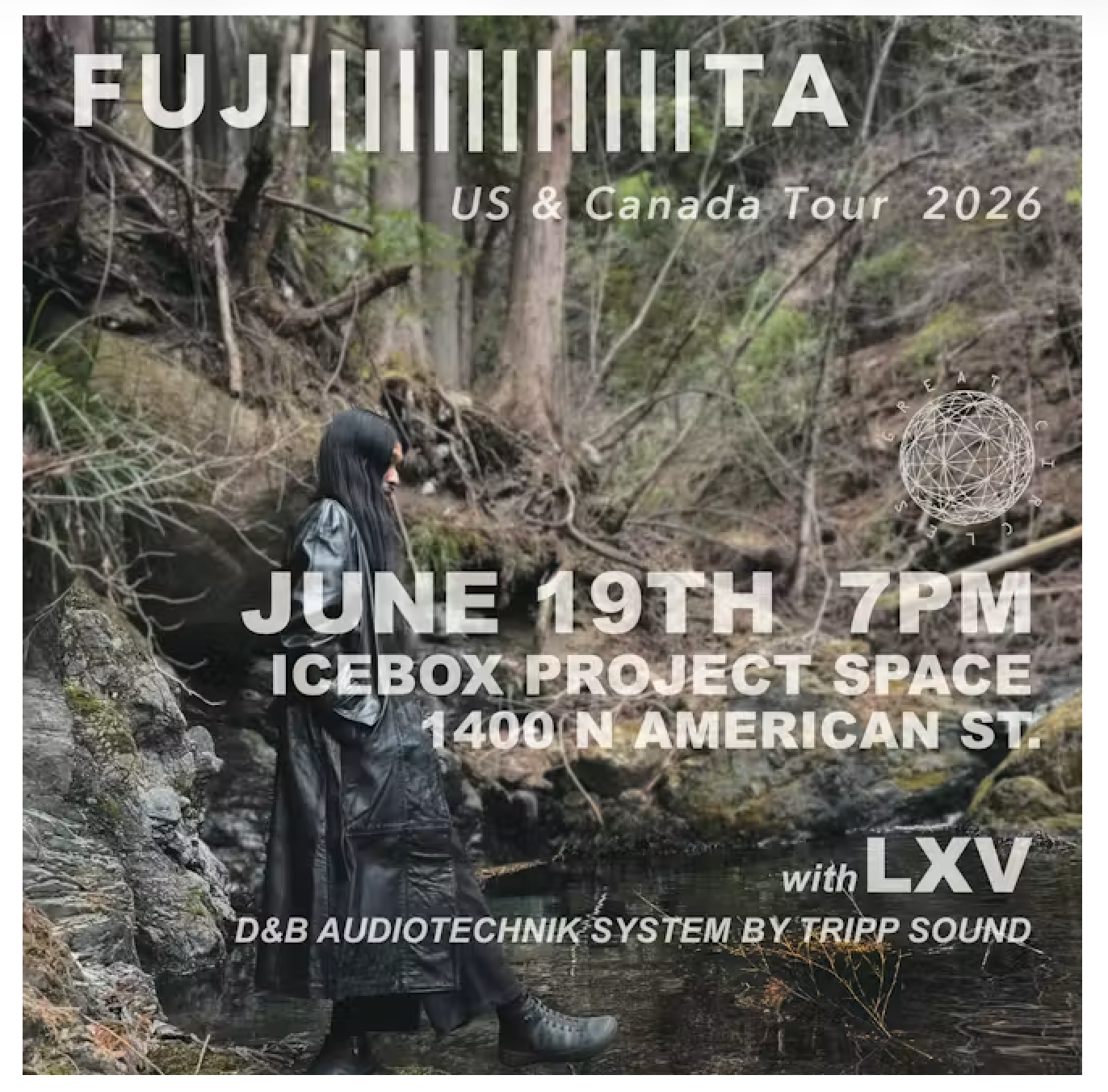
FUJI||||||||||TA
Ice Box Project Space
1400 N American St.
Philadelphia
June 19, 2026
Philadelphia has a long but under discussed history with noise and experimental music. The Sun Ra Arkestra has been active in the city since 1968, the band still acting as a living testament to Ra’s ability to push jazz to its most extreme possibilities. From the Interim Experimental Music Ensemble’s concerts at Nexus gallery in the '70s, to the city’s rich underground electronic tape-trading scene, all the way up to Maverick labels like Bad Master records in the 2000s, Philly has grown and hosted a wealth of adventurous music throughout the years.
Staying true to this tradition, on Friday, June 19, Great Circles — a radio station and record store in East Kensington — hosted a night of experimental sounds at Ice Box Project Space. As one of the most exciting art spaces in the city, Ice Box is a neighborhood gem, where some of the finest music, performance and visual art can be experienced. First up was LXV, the musical nom de plume of Philly-based sound artist David Sutton. Sutton’s gear was set up on a table lit by two beams of white light projected through a cloud of purple light and fog. The early part of the set was marked by thick sheets of noise and a pulsating drone underpinned by a massive kick drum-like sound. At many points throughout the set, the sheer density of the music would be nearly overwhelming before it would relent, leaving us with a momentary respite of freely-moving high frequencies. Before long, Sutton would bring back the full weight of the music as sound would rush back like a sudden wave of noise pouring out of the massive sound system.
Following a brief, 20 minute intermission, FUJI||||||||||TA returned to close the evening. FUJI||||||||||TA, aka Yosuke Fujita, is a Japanese experimental sound artist and pipe-organ builder who has been combining gagaku (a form of traditional Japanese classical music) with experimental sounds in a way that is both deeply human and otherworldly. It was a little difficult for me to see exactly what Fujita was playing, but he appeared to be blowing air from an airbrush into a long pipe that rested across the table in front of him. The sound was like the wooshing of a plane taking off, followed by the faint yet heavy boom of a distant thunder clap.
As the tempo of his playing picked up, the patterns began to resemble a jazz drummer playing way outside the confines of meter. The booms were like thudding kick drums while the airy wooshes were like an odd approximation of snares and cymbals. When Fujita started the set cloaked in darkness, about 10 minutes in, the lights returned. This time with no warm, muted purple — just two sharp tusks of white light cutting through the black box space. Through the low ever-present hums, and the sharp juts of scraping noises, Fujita played air and percussive noises with total command and sureness. At one point, he began scatting and screaming while playing rapid percussive strikes on the pipe. The interplay between the percussion and the staccato vocals immediately reminded me of a funhouse mirror version of George Kranz’s 1984 underground dance hit “Din Daa Daa." The music that was played tonight may defy easy boxes and genre tags, but it did not come out of nowhere. There is a rich tradition of unruly and uncategorizable sounds that we all owe a debt to, and that tradition has always had a home and a willing audience here in Philadelphia.


