
From Winchester to War: The Story of Lewis Hazzard of the 29th Connecticut
Lunch and Learn Series
Connecticut Museum of Culture and History
Virtual
June 24, 2026
Does it matter if anyone remembers the way you die? After all, you’re just as dead.
It does matter, actually, because death is part of a whole life. When we’re looking at history, separating one’s life from their death leads to an incomplete, and often flat-out wrong, picture of history and the people who made it.
Sandra Taitt-Eady, as a well-known genealogist and researcher here in Connecticut, knows this well. She gave a presentation Tuesday evening for the Connecticut Museum of Culture and History about Lewis Hazzard, an African American man who volunteered with the 29th Connecticut Regiment and died during the war.
Hazzard’s death is where the story begins. While her research typically focuses on Caribbean history, a letter she discovered from Hazzard to his mother led her to study his life and correct a historical wrong.
According to her research, the Hazzard family may have originated in Rhode Island before moving to Winsted, Connecticut. Little is known about Lewis Hazzard’s life before he enlisted with the 29th in 1863, where he was promoted to corporal. He wrote the letter to his mother on May 20, 1864, and died soon thereafter.
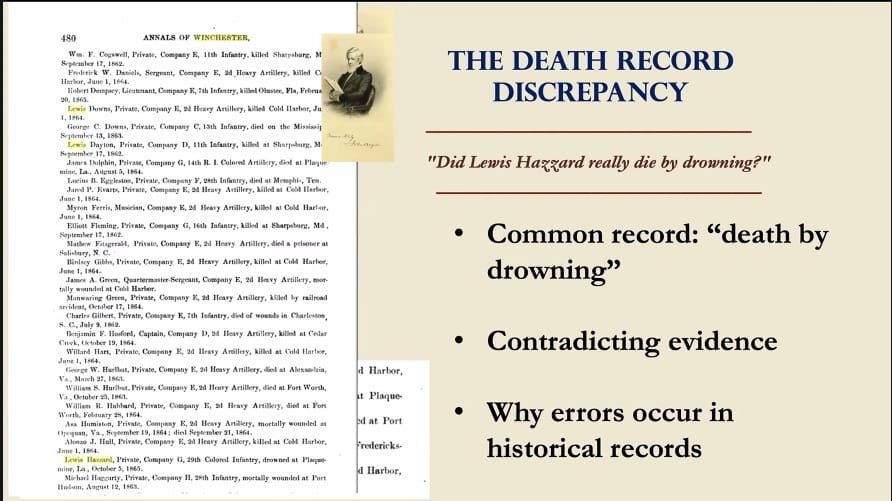
But how did Lewis Hazzard die? That’s where Taitt-Eady’s work comes in to fix a historical mistake. In her research, Taitt-Eady referenced the Annals of Winsted, where the author listed that Hazzard died by drowning in Louisiana on Oct. 5, 1865. She kept digging though, utilizing her skills as a researcher to go beyond the first answer she found. By going directly to the primary sources, she found a military record that showed Hazzard was really killed in battle near Richmond, Virginia, on Oct. 27, 1864.
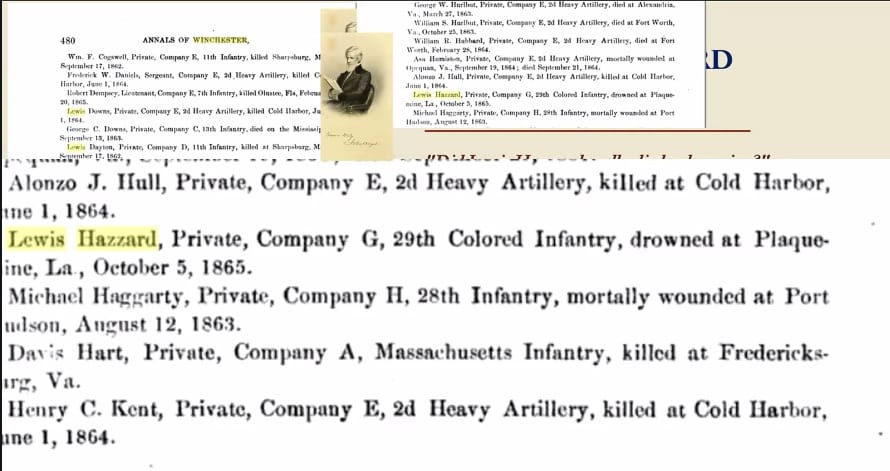
Taitt-Eaddy raised important questions about the accuracy of secondary sources. We've been taught since grade school to only depend on “reliable” sources for information. For most of us in our day-to-day lives, books are the ultimate reliable source– anyone can write anything on the internet, but only accurate information is published, or so the thinking goes.
But even fact and history exist within a context. The context of the United States has often disregarded African Americans' experience and history. There are so many things about our past that we don’t know because no one bothered to write them down accurately, if at all. The contemporaneous erasure of Lewis Hazzard’s battlefield death, despite the existence of primary source documents to the contrary, is just the latest example.
We should honor Hazzard’s death also because he gave his life in the glorious cause of African American freedom from bondage. Every person deserves enough respect for their loved ones and descendants to know the truth about them. The record of Hazzard’s death potentially speaks volumes about him. Saying that a man who volunteered to go to war drowned says something very different about him than saying he died in battle on the outskirts of the Confederate capitol.
I’m not saying Lewis Hazzard led a gallant charge against entrenched rebels; all Taitt-Eady could find was that he was killed in a skirmish. That’s all I need, though: the truth. I don’t need to imagine him as a larger-than-life warrior, but I also don’t need to imagine him facedown in a pond. Lewis Hazzard was a man who chose to face death for the cause of freedom, and he paid the ultimate price to ensure the rights of others.
That’s heroic, and we owe it to him to recognize it. Taitt-Eaddy has made sure to set the record straight so that we all know who Hazzard really was.
NEXT
Jamil goes to Trinity College for the return of the summer music series.


