
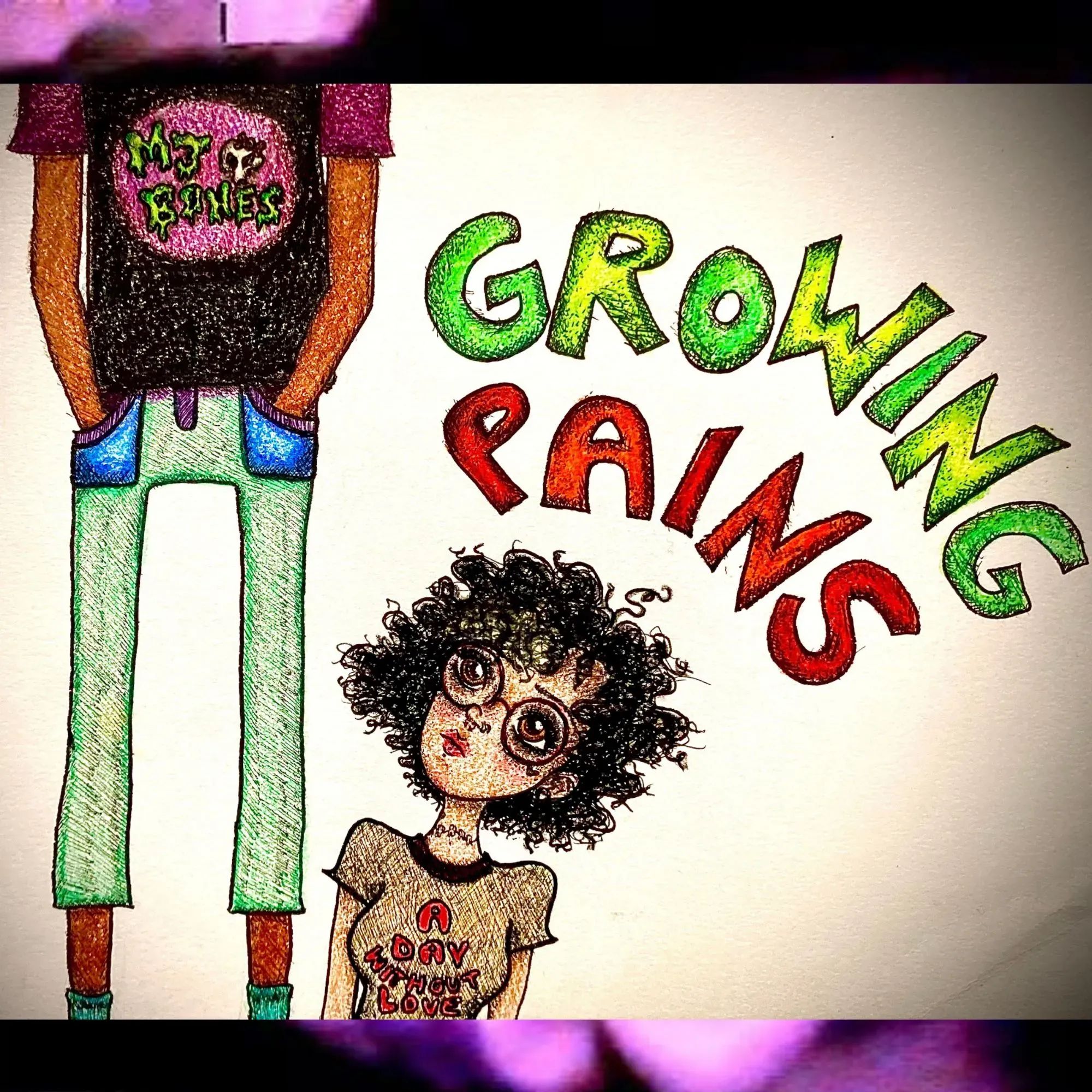
Growing Pains
By A Day Without Love and MJ Bones
In 2021, then-Michigan artist MJ Bones played a tour date at Volume Two (AKA Never Ending Books) on State Street in New Haven. Their van broke down, and they had to stay a few extra days in the Elm City. They ended up discovering what would become, in their words, “a place to land.”
By the time I caught up with them in that same community space Tuesday afternoon, Bones had moved to New Haven, built a base in the local scene, and played with heroes like Kimya Dawson who now feel more like friends. People afflicted with a “brain-rot, industry mindset,” Bones said, “they don’t think that this is possible.” They said this with no malice, just honest observation.
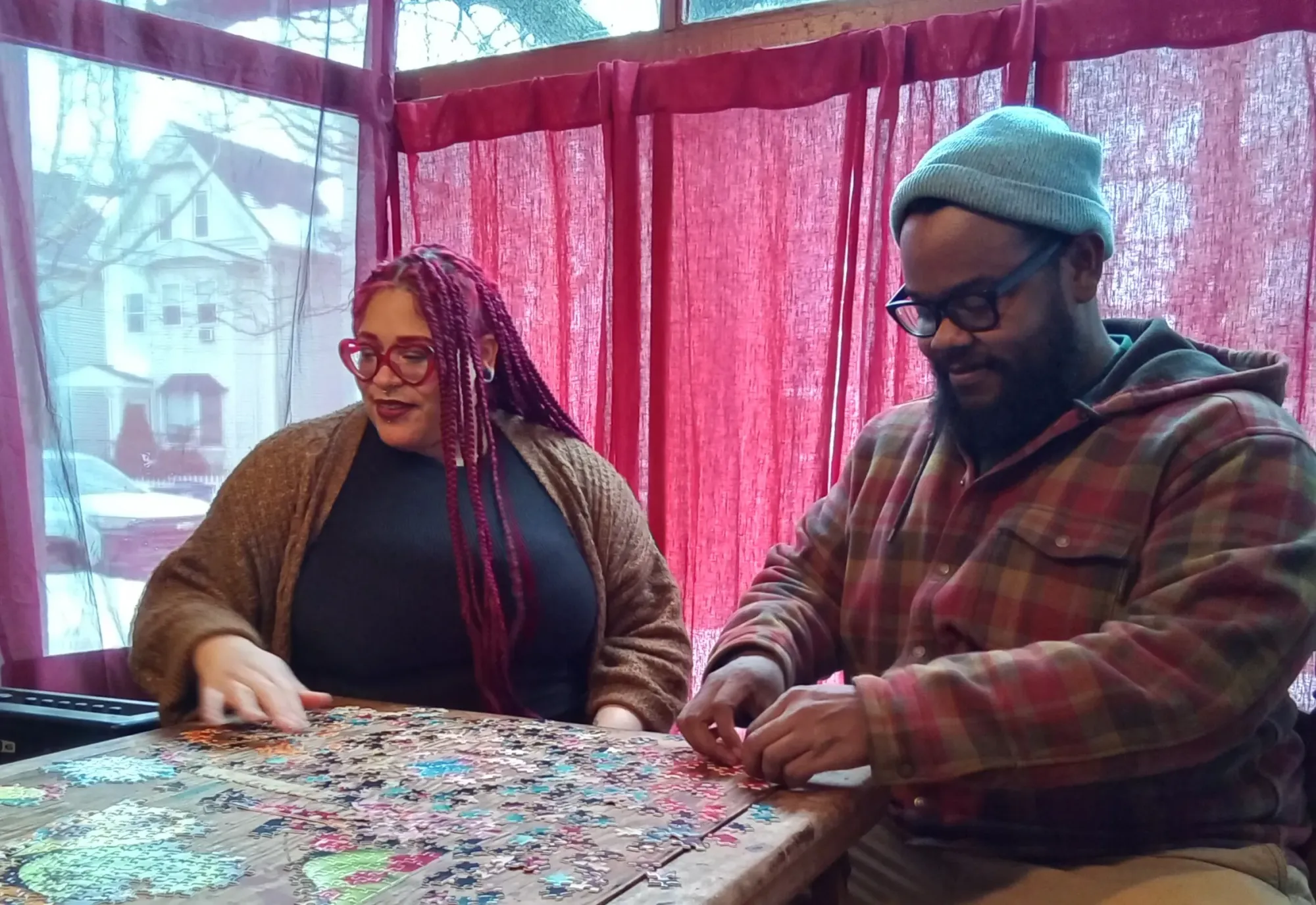
They were sitting with Massachusetts artist Brian Walker, who goes by A Day Without Love in his music. The two are celebrating their new first EP together, Growing Pains. It’s a contemplative, down-to-earth offering in a new genre artists like Walker and Bones are carving out for themselves: folk punk. Taking the no-frills, message-heavy elements of both of its parent genres, together with aesthetic qualities invoking the rhythms of long-held traditions, Growing Pains tells personal stories that fall right out the nest into the big wide world.
In the first song off the EP, “Identity,” Walker sings about how his music is perceived, based on what it’s about. Happier tunes result in commercial success, while gritty realities can be a little too real. In the context of the Growing Pains theme, it feels like Walker is reflecting on this phenomenon from a future point, both processing and commenting on it at the same time. And between that multiplicity of selves, the experience is less lonely.
In the chorus, Walker sings,
Change is hard
when you do your part
Change will hurt
when you’re taken apart
It’s a tale of a solitary journey, but its repetition near the end of the track comes with unexpected company.
Bones’ song on the EP, “Death Becomes Me,” features the familiar vocal layers that give their music its quintessential depth.
In school, Bones was a theater kid. They were inspired by the Greek chorus in musical Legally Blonde and started layering their own vocals in their songs.
Until recently, the harmonies were mostly a solo endeavor. For “Death Becomes Me,” Bones asked their partner, Zach Fontanez, to add some guitar. Then they took a chance, telling Fontanez, “You know, the mic’s still on.” It was, Bones said, a lesson in trust.
Fontanez’s voice blends gracefully with Bones’ as they sing the refrain together:
sweet decay
comfort me
I listened to the EP on my current go-to platform, Bandcamp. In fact, that’s the only platform the project is on. For the past few months, Bones has been Bandcamp-exclusive, taking their music off Spotify, Apple Music, and Amazon. The Spotify exit was precipitated by an advertisement they heard for ICE (Immigration and Customs Enforcement) on the platform.
I asked about the inherent political drive behind the genre of music they play.
“I would say it’s the ‘punk’ part of folk punk, but it’s also the ‘folk’ part,” Bones said. “Folk is people.” It’s impossible to separate politics from the real lives they affect.
To Walker, folk is “storytelling of communal and/or cultural struggle.” Or cultural experience. He looked back at Black American spirituals and noted their chord progressions.
“It’s literally OG folk music, and we’re still doing it today.”
Folk, he said, tells of the cultural experiences of a given time. He contrasts it with the goals of capitalism, which evoke sensations that are “curated and not actualized.”
Black art traditions, added Bones, have long relied on oral histories, poems, and mythos. “To me, folk is roots music.” They cautioned against industry pressure to reduce folk to a sound—a certain twang or type of instrument.
People don’t acknowledge that a Black person invented the banjo, Walker added.
“It taught white people how to have rhythm,” Walker said about the folk music commercial boom of a decade ago. He noted the co-optation of certain words, taken only for their surface-level meanings: “All those songs about trains and drinking whiskey erase what Harriet Tubman fought for.”
“Train-hopping was an escape from slavery,” he said. White musicians misunderstood the metaphor, using it in their own songs to represent the troubled transition to adulthood and leaving town. Walker saw the value in this meaning but pointed out the magnitude of what was lost along the way.
Volume Two’s front door jingled, announcing the arrival of a stranger who had come with a box of books. Bones helped them out. Five years after the scene of Bones’ first foray into New Haven DIY culture, they are now among the group of artists and friends who help run the space.
These days, the power they find in themself, their community, and their friendships are what they hold most valuable. Knowing someone will bring them soup when they’re sick. Mutual aid. “That’s what I’m in it for.”
Like “when you were stranded,” Bones said to Walker.
“Which time?” he said.
They tossed the details back and forth. The point was, Walker could ask for help, safe in the knowledge his community would respond.
After more than a dozen years making music, Walker has seen all sides of the machine. As he put it, he’s been with a label, not been with a label, had an agent, not had an agent, been in rooms, not been in rooms…throughout the journey, he’s seen the “dissonance between happiness and extreme displeasure” in people who seem to have it all.
“Are you satisfied with what you’ve created? The people that love you, do you love them?” These are the questions that guide Walker now, more than the distinction between industry and independent.
Bones keeps those considerations at the forefront too, and the love comes through loud and clear. They infuse it in their music, alchemizing pain into a sense of solidarity and “saying the quiet part out loud,” even if it’s shameful or scary. People come up to them after their sets to say they felt seen.
For Marcelline Moon, Bones’ off-stage identity, MJ Bones allows them to tap into a place that feels inaccessible in the day-to-day. MJ is the “keeper of my secrets,” they said. “The person who can pull back that veil.”
Every time Bones repeats the sweet decay line in their song, they test the balance between stepping bravely ahead and leaning on others. Fontanez’s backing vocals provide a nest of safety, as does the simple fact that we know we are listening. It doesn’t seem like Bones is looking back to check that we’re still there. It’s a lesson in trust.
In the very last iteration of the refrain, Fontanez breaks from the words themselves and supports with “ahhs” instead. The harmonies feel all-encompassing, ready to hold whatever is on Bones’ heart.
While Bones’ vocal landscape stuns by splitting open, Walker’s brings his voice in lockstep with notes by trumpet player Nick Paraggio. The return of the chorus in “Identity” has the trumpet playing the melody in perfect sync with the words. The effect is a uniquely human feel to the instrument. It transforms the chorus, using the storytelling nature of the folk punk sound to turn the trumpet into a friend.
Punk people need to expand the horns, Walker said. He’s on a mission to make it so.
Bones is thinking of “other Black kids coming up in the scene, always, always.” On a personal level, they’re thinking of their little sisters (including one little brother who gets grouped in—Bones is the oldest of seven). In order to find a new place in the world, Bones had to fly the coop. Now, they’re proud to be someone their siblings can look up to.
“They’re my forever audience,” Bones said. And they all do music now, too.


