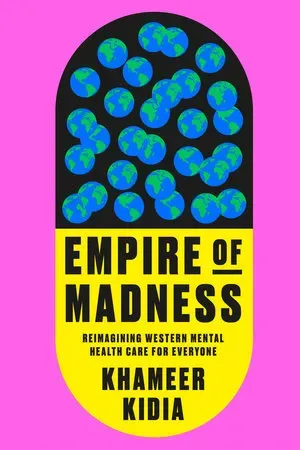

Empire of Madness
By Khameer Kidia
Crown Publishing, Penguin Random House
February 2026
Among the many prescriptions available for mental health right now, one doctor’s Rx looks a bit different from the rest: Reparations, medical debt cancellation, and an end to wealth hoarding are some of the global treatments Khameer Kidia suggests in his new book Empire of Madness.
Don’t get it twisted; Kidia is not against psychiatric medication. As a practicing doctor, he writes prescriptions for them on the regular.
“But the role we give them is outsized,” he explained on a phone call with me Tuesday afternoon.
He walked me through a scenario.
A patient is asked to fill out a form, the commonly used nine-question PHQ-9 (Patient Health Questionnaire). If they score high enough, the next step might be medication. The doctor doesn’t want the treatment to be “lost to follow-up,” Kidia said; it could be hard for the patient to come back. So the doctor gets them started on the meds right away.
This should all work in the opposite direction, Kidia said.
“The diagnoses are not causative,” he said. A patient is not depressed because they have depression. The labels are just a useful way to group patterns.
Doctors then treat the diagnosis without addressing the cause, which could be social, economic, or linked with another ailment. “Because we don’t have enough time, we skip that step,” he continued. “And what happens is we also skip that step cognitively.” The effect for the patient is that there appears to be a compelling reason to discount social factors (e.g. they are unscientific and should not be taken seriously), when the real reason is a lack of clinic time.
When I remarked on Kidia’s ability to so clearly illustrate this process, he sidestepped the praise and brought the conversation back down to earth.
“I know it because I’ve done it,” he reminded me.
Kidia’s critical self-reflection was, in fact, one of my favorite aspects of the book.
In one real-life story from the book, Kidia tries to find alternatives for chemical restraints for an elderly patient, Geraldine, who keeps getting out of bed, risking a fall. He knows that all she really needs is a “sitter,” a person designated to sit with a patient, but there are no sitters on duty that night. The overwhelming push in the hospital is for him to prescribe an antipsychotic medication called Haldol, which comes with risks for the elderly. He tries to hold off. But when he is attending to another patient on the brink of life and death and gets a message that Geraldine is “agitated again,” he makes the call for Haldol.
In recounting this, he does not defend his decision, which is made out of a consideration of time during a crisis for the other patient. If it were a character investigation, this could be an excuse. But that’s not what Kidia seems to be interested in. He is looking at the design of the system itself.
If we look at Kidia’s situation with Geraldine using an imaginative lens (which, it seems, Kidia is urging us to do), we can start to separate the fundamental from the situational. Compared to finding a sitter, a physical restraint is a quicker decision to make in the moment, especially a moment split between patients. If the situation were simply different, like if there were sitters available that night, the justification would not apply. So we see how the reason has no backing beyond the specific constraints of the scene at hand.
If we zoom out, we see how, over time, an accumulation of quick decisions made by medical professionals in positions of authority can lead to a system that prioritizes whatever happens to be more efficient, infusing these options with a false sense of trust.
Throughout the book, any time Kidia paints a picture suspiciously too rosy of an intervention or solution, it turns out to be a setup for a nuanced critique. This is especially apparent as he describes his efforts to apply his Western medical training to communities back home in Zimbabwe. He realizes that free medical programs there, while life-changing, serve as testing grounds for medical developments to then be used by the West. A workshop he holds with other Zimbabwean doctors based on Western methods seems promising but proves irrelevant. Kidia takes the reader through the journey of first believing uncritically, because he once did too. We realize how normal that feels.
In his process to shake things up, Kidia brings together historical analysis, patient stories, and personal accounts of his own life and family. When he discusses hoarding, he brings us into a scene normally associated with it—a patient’s home so filled with clutter it becomes a health hazard. This kind of hoarding is pathologized. Responsibility falls on the patient and care team to treat the disorder, and as many of us know personally, this is a long and difficult task.
Kidia doesn’t stop there. He takes us through extractive large-scale hoarding practices of land, money, and resources, starting with a shift in the definition of “land” for peasants in twelfth-century England. He talks about billionaires who receive accolades for their hoards. He points out that, because this kind of hoarding is not seen as a pathology, the route to treatment is obscured.
It’s an observation that reminded me immediately of Martinican writer Aimé Césaire, who writes in his 1950 Discourse on Colonialism that “a civilization which justifies colonization—and therefore force—is already a sick civilization, a civilization which is morally diseased….”
Césaire served as a mentor and peer to another Martinican writer, Frantz Fanon, a psychiatrist who exposed the psychic tolls of colonization in his 1961 landmark work The Wretched of the Earth. In 1988, Zimbabwean writer Tsitsi Dangaremba published a novel called Nervous Conditions, with the title borrowed from Fanon’s Wretched.
Fast forward to 2020, when Kidia declined a big faculty job at a university, deciding instead to do part-time clinical work and “spend the rest of the year reading,” as he told me on the phone. The thoughts he would have during this time would serve as the basis for Empire of Madness.
One of those books he pored over was Dangaremba’s Nervous Conditions. He describes it in Empire of Madness as a semi-autobiographical story of a “girl from a rural village who is sent to a white school where she must contend with the psychological harm of forced assimilation into white education and culture.” Kidia draws a parallel to his own mother, who attended some of the same schools in Zimbabwe as Dangaremba and has experienced lifelong effects of mental distress. Kidia’s book is dedicated, simply, “For Mum.”
We ended the call talking about the here and now.
“Watching violence happen is incredibly challenging for me,” he said. In the past few weeks, he’s been moved to tears several times over ICE brutality in Minneapolis.
It’s a distortion, he went on. Something that “should not be a part of our naturalized lives.”
When I asked Kidia about the psychological effects of resisting colonialism, he noted both the lack of good data on it (after a big protest, psych researchers will quiz attendees, who often respond that they are indeed still anxious, because the conditions haven’t changed yet) and the lived knowledge that active resistance is a worthwhile effort towards health, with or without the numbers.
In his words, protest is “taking action in our own lives to improve the very social conditions that make us unwell in the first place.”
What’s useful to me right now is not so much the hope that Kidia’s vision of a more integrated mental health landscape will come to fruition in the very-near future—though books like Empire of Madness could be a step in that direction. It’s the analytical tool of Kidia’s imagination, which he offers as a way to be more honest about what actually works to improve people’s prognoses, what is just the best we have for the time being, and why it matters to make the distinction.