
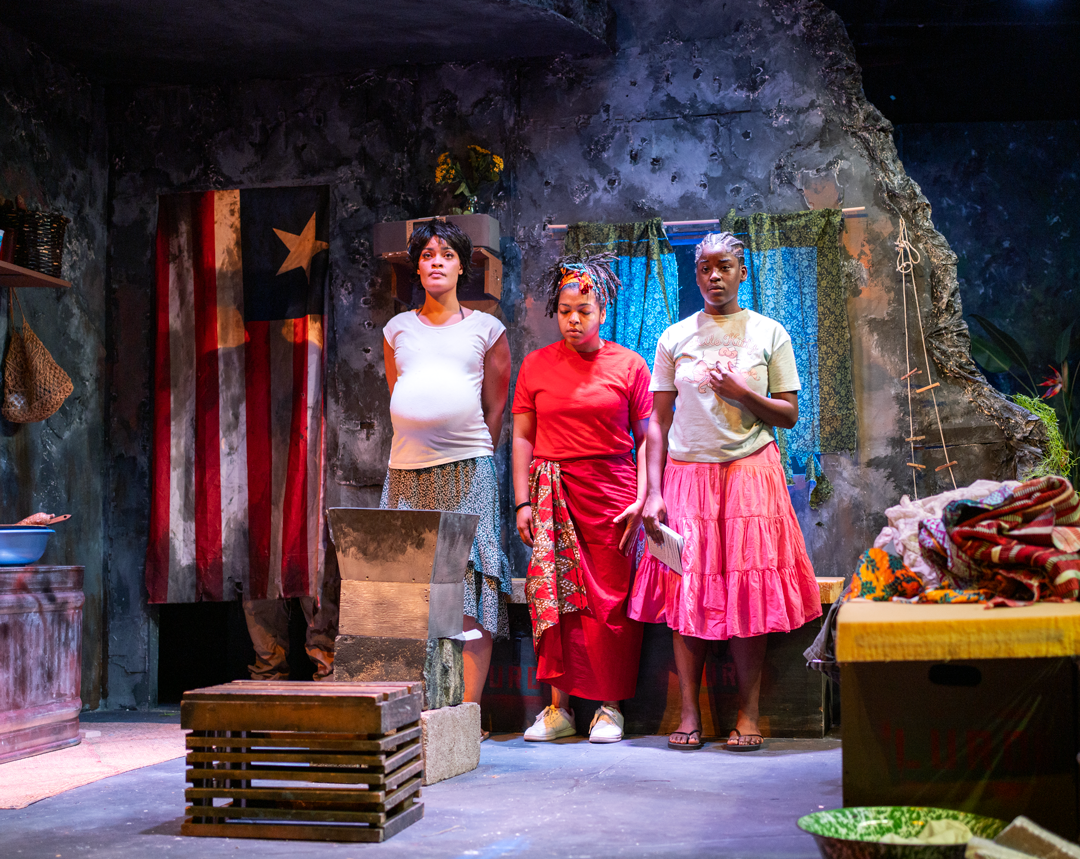
"Eclipsed"
Detroit Repertory Theatre
Detroit, Mich.
March 28, 2026
To eat or be eaten – that is the crux of the reality in which we find ourselves in 2003 Liberia as a female in Danai Gurira’s “Eclipsed” at Detroit Repertory Theatre. The country is at the tail end of its second civil war and pits women as prey or predator – a “choice” in a world where all women are prey, and no scenario is humane or just.
The story is set in a one-room shack inside a compound of a commanding officer of the rebel LURD army. It follows the lives of five women and the choices they make to survive. We meet “Number One” (Shonique White) and “Number Three” (Shannon Christine), young women kidnapped as girls following the destruction of their villages to become “wives” – sex slaves – for a commanding officer. We also meet a 15-year-old girl on the run who soon becomes “Number Four” (X’ydee Alexander).
Later, tough, rifle-strapped “Number Two” (Danae Ross) returns, offering “Number Four” an alternative life to join her as a soldier where she can make her own rules and where having a gun means no man can “jump” her unless she wants them to. We soon learn that fantasy life is, indeed, a fantasy. Soldiers are expected to perpetrate the cruelty that had been done unto them if they want to avoid a return to sexual servitude. Throughout it all, peacekeeper Rita (Stacey Herring) visits the women, reminding them of their value and offering her own alternative of education and freedom.
Expertly portrayed and directed by DRT, “Eclipsed” is a powerful play. It exposes a part of history about which most of us are unfamiliar. It reminds us of the depths of misogyny that continue to exist across the world, where women are viewed solely as objects to serve men and are stripped of their individual identities.
It’s also an exploration of the long-term effects that oppression has on the women. We see how the misogyny becomes internalized. The women themselves begin to forget who they are and their self-worth, to the point where they refer to each other in their relation to the man who oppresses them. “Number One” is hesitant to share her real name and accept an opportunity for a better life. She finds herself lost when even the horrible world she lives in – essentially the only one she’s ever known – is shattered. “Number Two,” having earned her war name of “Disgruntled,” is on the opposite end, with a new identity that brings her as close as possible to the brutality of the male regime. She repeats the goal of the rebellion, emphasizing their plans to dress Liberian President Charles Taylor as a woman before deposing him – the most blatant demonstration of internalized misogyny. Through “Number Four,” we explore the internal conflict of how to survive as a woman during the Liberian civil war, forcing us to ponder the choice ourselves, whether to break or to be broken.
Despite the difficulty of the subject matter, “Eclipsed” is not as difficult a watch as you might think. The story is gripping. None of the war violence is portrayed on stage, mainly because no men appear on stage. Through the distant sounds of gunfire, the anticipatory fear expressed on the women’s faces, and the subtle, bloody bath water thrown out after their time with their commanding officer, we get a clear picture of the brutality of their existence without being graphic.
There are also moments of levity. The women play and bicker among each other. After they receive a tattered book about Bill Clinton, we laugh at their understanding of his presidency and American politics. It highlights the funny – yet sad – discrepancy between how the two cultures value women when they fail to understand why Clinton’s having a “Number Two” (Monica Lewinsky) would cause so many problems.
Directed by Shavonne Coleman, the cast is excellent. White and Ross, in their professional debuts, masterly portray the opposite natures of their respective characters. As the leader of the wives, White is the tough yet protective big sister who captures the nuances of being beaten down but not yet broken. In “Number One"'s’ vulnerable moments, White is raw, subtly breaking our hearts as we watch the caged bird struggle to fly through the open window, questioning her self-worth. As “Number Two,” Ross is charismatic and strong; you understand her appeal and yet become increasingly terrified of her as the show progresses.
Torn between the two, Alexander as “Number Four” has the biggest character change of the cast. You watch how a brutal regime destroys a soul; her monologue coming to terms with the consequences of a particularly horrendous action is one of the most difficult parts of the show to watch.
Christine and Herring are much-needed balms. As “Number Three,” Christine offers comic relief, finding as many little joys as she can despite her circumstances. Herring, as Rita, is our only sense of hope. She has suffered the least among the women. Her strength is soft and uplifting – an opposite to “Number Two’s” – and you feel her love and protection you desperately want the girls to accept.
Every person, deep down, has some light within her, the spark that makes her human. “Eclipsed” exposes what happens when another entity attempts to block that figurative sun, encompassing it in darkness. It’s a battle of self vs. survival, of how much of our identities we’re capable of or willing to give up to endure, and at what cost. “Eclipsed” makes me grateful I have yet to find myself in such a situation and hope I never do.


