
Death of a Salesman
Hartford Stage
Hartford
March 6, 2026
I didn’t expect to feel sympathy for Willy Loman.
Now that I think about it, sympathy isn’t the right word. Or maybe it is, but not sympathy for him. As his family and friends stood before his grave at the end of Death of a Salesman, played to a nearly packed audience at Hartford Stage, I was moved to tears, but I still can’t explain why.
Maybe it was the catharsis of seeing the madness of the Loman family come to an end. I hope that it’s not a spoiler that the titular salesman does in fact die. It’s not just he who dies, though, but the entire way that a family has navigated him and themselves as a result of his peculiarities.
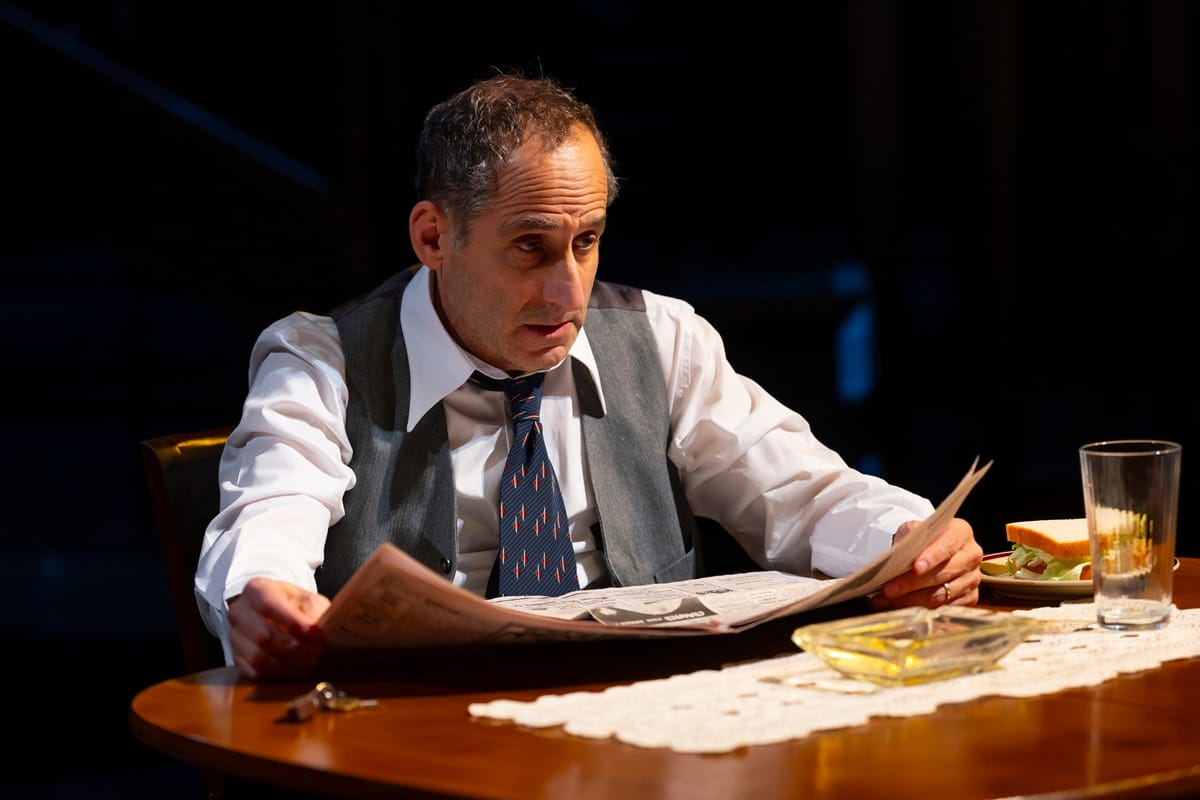
Death of a Salesman is relatively simple plot-wise: Willy Loman (Peter Jacobson) and his eldest son Biff (Samuel H. Levine) both return home to pursue new business opportunities, while wife Linda (Adrianne Krstansky) and youngest son Happy (Max Katz) cheer them on. Yet these ventures are poor covers for the unraveling lives of Willy and Biff.
One of the great talents of Arthur Miller is his ability to bring thoroughly unlikeable characters to life with the full love and embodiment that heroes and author stand-ins receive. The Lomans, to a person, are arrogant, judgmental, prideful liars who cut through the world like buzzsaws. Ironically, Willy’s insistence on being liked makes him one of the most genuinely despicable people I’ve ever seen on a stage. It’s true that perhaps the world owes him more than it’s given him, but not nearly as much as he expects. He takes out those unfulfilled expectations on everyone around him.
His family, while victims of his vicissitudes, are hardly innocent. Biff has allowed carrying the family secret to transform him from an affable ne’er-do-well to a man who has fully embraced being a loser as if it's his destiny. Happy, appropriately named, is a womanizer who lies almost reflexively, always to keep everyone around him pleased and the family’s gears greased. Linda’s constant coddling of Willy looks like a survival mechanism at first, and it is – but not for her. It’s to keep the tatters of Willy together, but maybe some reality would have saved him long ago from his slow descent.
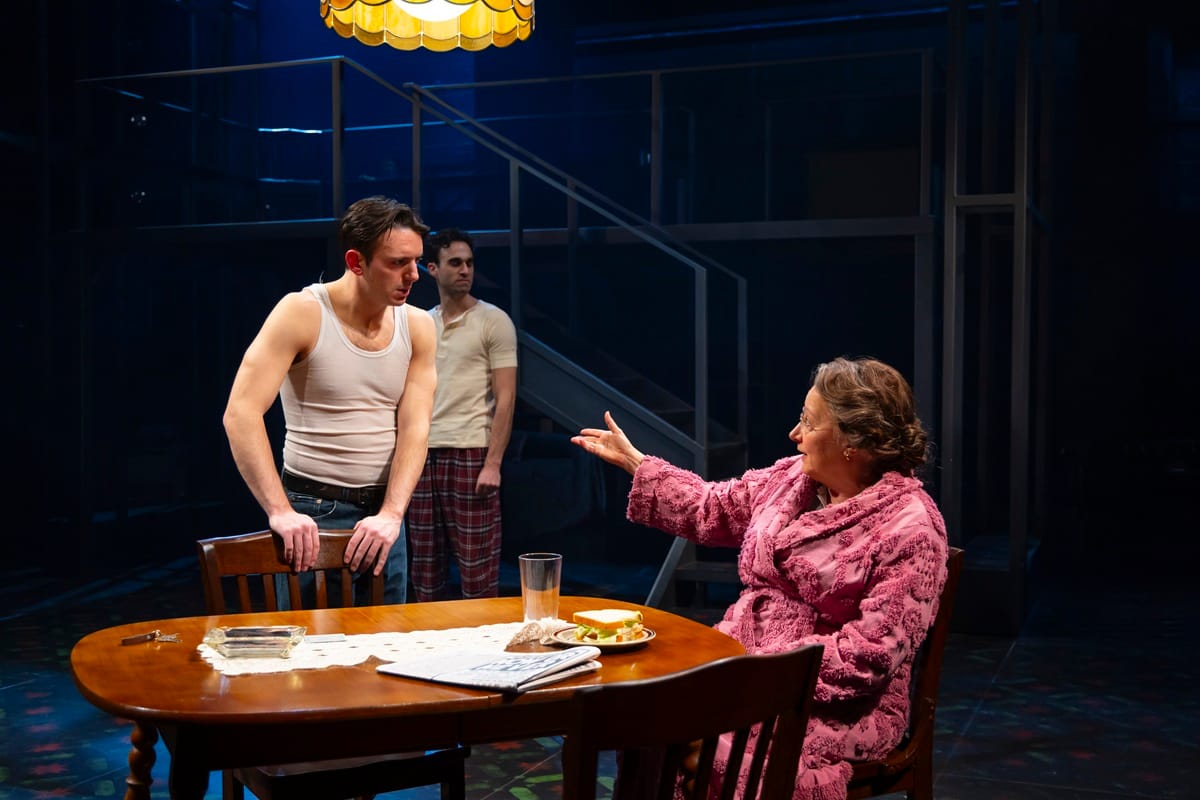
As the play progresses, these personalities assume their own gravity, spinning and pulling each other in towards an event horizon of misery and self-destruction. Yes, Willy is losing his mind, and Biff is worn down from the weight of his father’s misdeeds. But one gets the feeling that even if everything were perfect in the Loman household, these still would not be people you’d want to spend any time with. It’s a remarkable feat to be so enthralled by their inevitable failures.
That’s thanks in no small part to the erformances of the cast. Peter Jacobson makes Willy Loman into a dynamo of chaotic energy, self-assured in his belief that he’s more important than he has any right to claim. Samuel H. Levine makes sad sack Biff a pitiable trainwreck in the best sense, capturing the moment a man becomes a failure. Max Katz’s Happy is a used car salesman, a snake oil peddler who uses his charming smile to pave the road of everyone’s destruction with no concern for anyone’s well being. And Adrianne Krstansky’s turn as long-suffering wife Linda reveals through her powerful stage presence and booming voice when the time comes that she’s as much of a manipulator as anyone else in the Loman family.
I don’t think it was sympathy I felt at the end of Death of a Salesman, but a kind of relief. The craziness of this family has ended, and that’s a good thing for them and for the audience. Despite how wonderful the performance was, I don’t think I could have spent another minute with Willy Loman, a testament to the outstanding writing of Arthur Miller.
NEXT
Death of a Salesman continues at Hartford Stage through March 29.
Jamil goes to Bloomfield for a live performance of African American history.


