
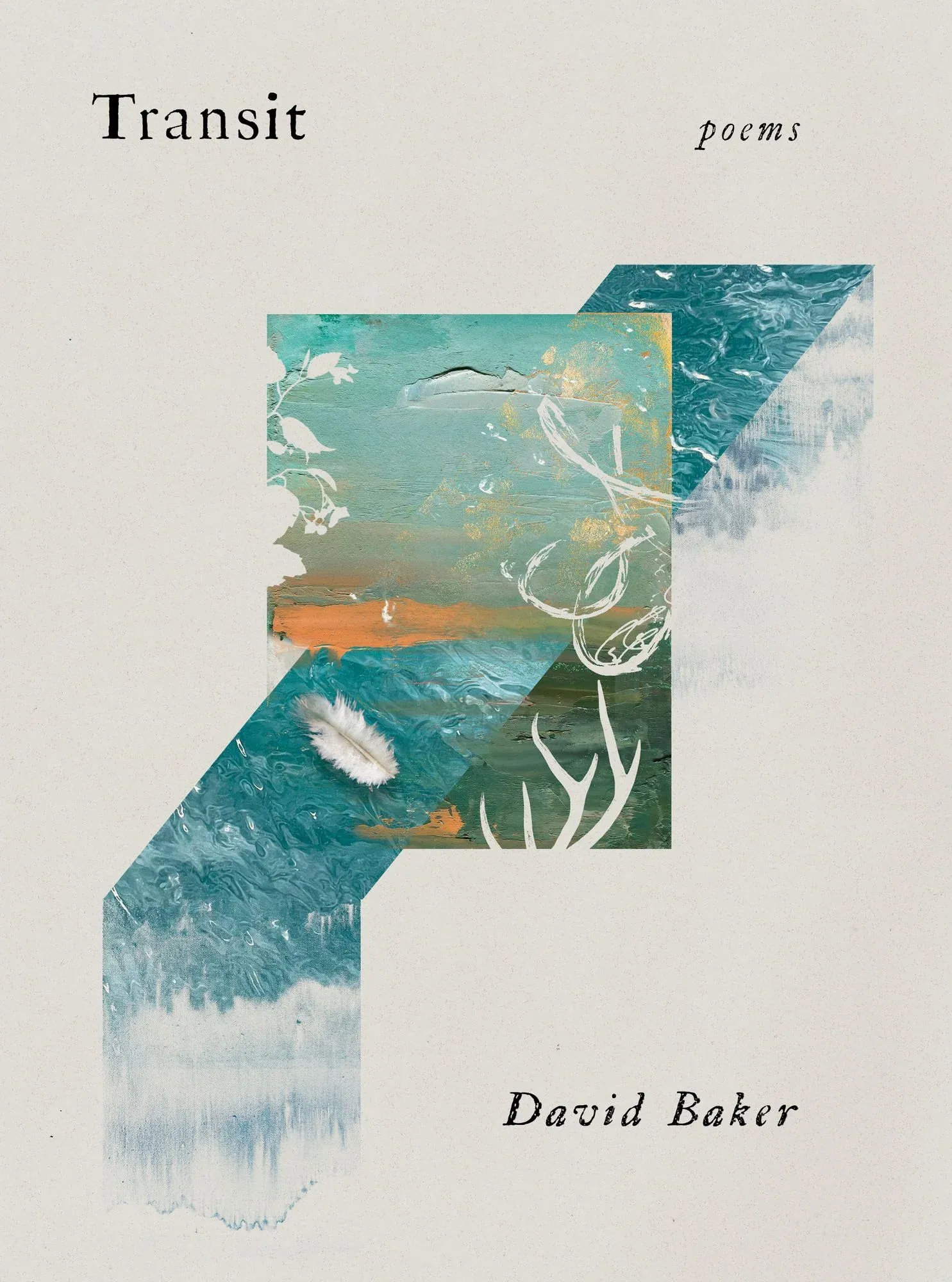
Transit
Poems By David Baker
W.W. Norton & Co.
Last month, a friend and I toured Harvard’s collection of glass flowers—hyperrealistic reproductions of plant specimens that were previously used as teaching tools. They’re exquisite works of art. No detail is below notice; no subtlety is left unrendered. Like Transit, the newest collection by Denison University Professor Emeritus David Baker, the glass flowers were vivid and precise. Yet, after a while, I became slightly unnerved by the flowers’ perfection. Rendered at peak bloom, they’re stuck forever in a stage of aesthetic perfection, divorced from the cycles of rot and renewal inherent to their nature. Regarding the display cases, I moved through the biospheres of the world, but not through time.
The same can be said for the movements that give Transit its name. While the poems contain plenty of voyages to cities, seashores, vacation homes, and woodland paths, the poems feel like a sealed-off room—too abstract to feel real. Most poems are devoted to images of the natural world, seen as the speaker passes through a landscape. We see glimpses of life, like bits of conversation about an influential jazz record or a minor car accident, but the poems remain at a high level of abstraction.
This isn’t to say that Baker’s poems are frivolous. His ear is attuned to the music of the English language. It’s a pleasure to hear the melodies in his lines. The poems in Transit are as carefully assembled as Harvard’s glass flowers, the stress of syllables wonderfully accounted for. Baker possesses an impressive mastery of plant names both common and scientific, weaving them together for effect. My favorite poem in the collection is “Lilac Tree and Lichen,” in which plant names bounce off each other to create a guttural rhythm reminiscent of the illness the poem describes:
I could taste it in the corners of my mouth.
My fevers. Like green-white tips of flowers.
on our tree, each cluster of foam, each panicle
a palmful. For a year the doctors couldn’t say
what to call it. It was my illness. Named by
symptoms only, my fever-few, my blackthorn.
Yet, beyond sound, I wasn’t moved by the poems in Transit. They felt too scientific, sharp like a scalpel pressed to a specimen. Indeed, Baker frequently includes Latin taxonomic names (e.g., Pseudogymnoascus destructans and Syringa reticulata) along with specialized scientific words (e.g. “radiolarian chert” and “tubal elongations”) that lend a clinical air.
There were times when the poems’ emotional distance felt uncomfortable. Take “Six Glasses of Water,” about a community struggling with water pollution after a train derailment spilled toxic waste into a river. This is likely a reference to the 2023 rail disaster in East Palestine, Ohio, a tragedy of human greed, whose sad tune will continue to play out in health effects for decades. Yet I find Baker’s poem too unspecific to express more than general observation, which feels insufficient for a tragedy like this. Take the back half of the poem, which contains most of its direct references to the pollution:
No one’s coming to help us. Pollution
plumes float beyond a burning. The high pines
stand out against the weird yellow sky.
Or do we imagine that. My friend Andy—
…
says farms. Dips a vial for trace pesticides.
The creek fidgets and spins off at an eddy.
We skim a quiet surface for algae.
For strides, seed husks, nothings like these—
…
The governor takes a sip. He takes two—
Who is Andy? Is he a scientistic, a resident, a farmer? We don’t know, nor do we have an indication of the pollution’s damage. If anything, the damage is downplayed—the “weird yellow sky” may be “imagined.” The lack of specificity, and of emotional remarks, felt odd to me.
I was even more perturbed by “The Colonists,” which first appeared in The American Poetry Review. In the poem, we find the speaker on vacation. It begins with a description of the rocky coast and then turns to a goofy text exchange about a worm. The next six quick stanzas describe the general layout and history of the unnamed vacation spot, before describing the history of slavery in the region thusly:
Sugarcane water a day. Dick, 25, able field negro, £140…
Daub walls, thatched-cane roofs, the rain.
Now we’re here
on vacation. We’ve ordered a la carte. We walk the ankle-
turning cobbled matted with blade cactus and sea sedge
and cool our—
I think Baker is trying to make an ironic contrast between the suffering of the past and the breezy vacation the speaker is trying to enjoy. However, I find it off-putting to add a few lines about slavery without seriously engaging with the topic. It’s jarring, to have it so quickly juxtaposed with the aforementioned worm video and then, directly after, a bat sighting during a cocktail hour.
Although I found Baker’s poems difficult to connect with emotionally, there’s no doubt that he’s a keen observer of nature. I believe this collection would appeal to those who enjoy digging deep into the specifics of the natural world.


