
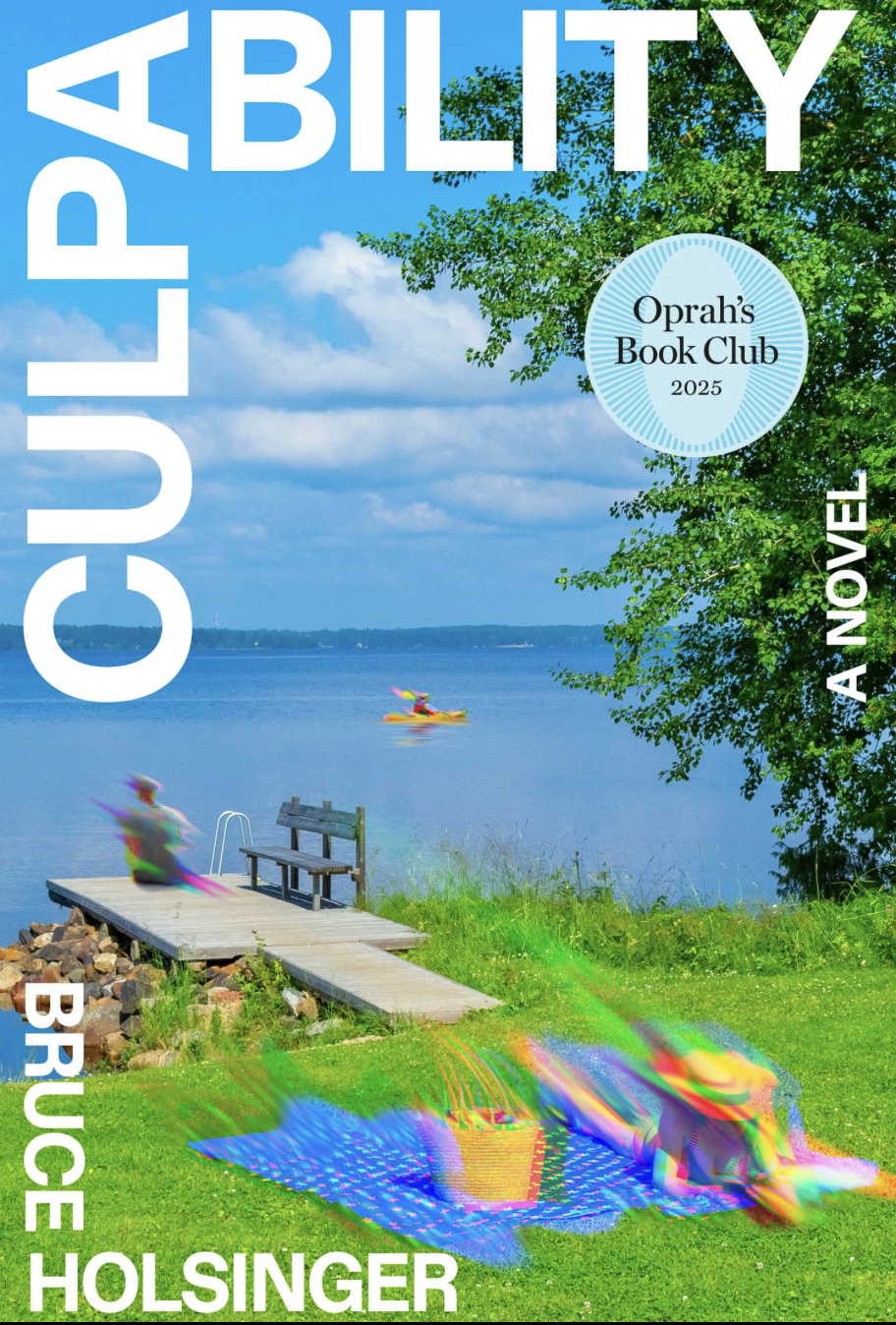
"Culpability"
By Bruce Holsinger
Spiegel & Grau
When you’re a parent, one challenge during the toddler years involves teaching your child to take responsibility for the reckless, hurtful, or rude things they sometimes do (even when it’s an accident) and to say “I’m sorry.” Unfortunately, acts of contrition don’t get any easier as they grow up: Many adults end up all but incapable of accepting blame, particularly when legal consequences are on the line.
How might AI make this problem even worse? By providing a go-to scapegoat. But as Bruce Holsinger’s novel “Culpability” points out, AI can also be what rats us out with a precision that far outstrips human capabilities.
At the story’s start, a family of five is road tripping in an autonomous vehicle to 17 year old Charlie’s lacrosse tournament. When Charlie’s sister Alice, 13, suddenly screams from the back seat for Charlie to stop, to avoid a potential collision, he yanks on the steering wheel, thereby overriding the computer system, and the minivan crashes into another car.
Miraculously, the family members all survive. But as they leave the scene in ambulances, they see “a Honda Accord, the hood and grill accordioned almost to the windshield. The fire that engulfed the Honda has been extinguished by now. A lone tendril of smoke rises from the wreckage.”
Narrated by father and husband (and lawyer) Noah, who’d been answering email in the passenger seat when the accident occurred, “Culpability” follows the family as they recover, both physically and emotionally. Because the elderly couple in the other car died, the police have questions, which continue to haunt Noah’s family one month after the accident, when they all travel (with Noah driving this time) to spend a week at a lakeside rental.
It’s a place they’ve vacationed before, “but the opposite bank has been transformed. The inlet’s eastern side forms part of a single property, we learned from a neighbor last summer. Ninety acres with a large house barely visible from the water, with its own cove off the bay. … Where once the waterfront on that side featured a happy tangle of roots, stony sand, and marsh grass, it now appears barren and shorn, the shoreline denuded of native flora. Excavators have reordered the large rocks once splayed naturally along the sand into an intimidating border wall that reaches all the way up the inlet and around the point.”
Noah soon learns that this new lakeside fortress is owned by Daniel Monet, an Elon Musk-like figure whose tech business interests suggest a possible tie to Lorelei, Noah’s wife and a world-renowned, MacArthur grant-winning scholar in the field of AI design and ethics.
Lorelei’s casual interaction with Daniel unnerves Noah, as does Alice’s screen obsession (she texts regularly with an AI “friend”), spunky 10 year old Izzy’s sudden moodiness, and Charlie’s spiral from being a top UNC lacrosse recruit to an adrift, out-of-shape, often-high teen.
When Monet’s young daughter Eurydice spies Charlie on a paddleboard, though, her attraction to him is obvious and immediate. She later heads over to visit Charlie, and Noah tells her he’s still asleep, noting, “Her smile lights up the inlet. Good lord but Charlie’s in trouble. The water humps along the edge of her board as it skims along. An ankle bracelet rests above Eurydice’s left foot and a tattoo spirals around the opposite calf: a winged dragon, breathing fire up toward her knee.”
Does this suggest that Eurydice is trouble, or simply fierce?
That’s just one of many questions that motorize Holsinger’s plot, which thrums along at a satisfyingly brisk pace.
“Culpability” also ventures so far afield into the high drama of what unfolds between Charlie and Eurydice that it feels like two novels slammed into one. You’ll get swept along on its current, but you’ll also at some point wonder, “So … that whole car accident thing … ”
Technically speaking, Holsinger does tie the novel’s major threads all together; but just as Delaware Police Detective Lacey Morrissey finds herself tagging along as Noah’s family deals with yet another, entirely different dire emergency, and thus feels bewildered and frustrated, the reader starts to share her sense of “OK, how did we get here again?”
For in the novel's early chapters, I got excited about a narrative that might really tackle some of the thorny ethical issues surrounding AI. But then I ended up feeling like a “bait and switch” happened, where “Culpability” had started taking me down one road, then suddenly, unexpectedly took a hard left.
Fitting given the book's opening scene, I suppose, and I actually did get absorbed in its suspenseful second storyline.
But it still wasn’t exactly where I’d wanted to go, or thought we were going.


