
Neighborhood Voices Together
Neighborhood Music School
New Haven
Mar. 8, 2026
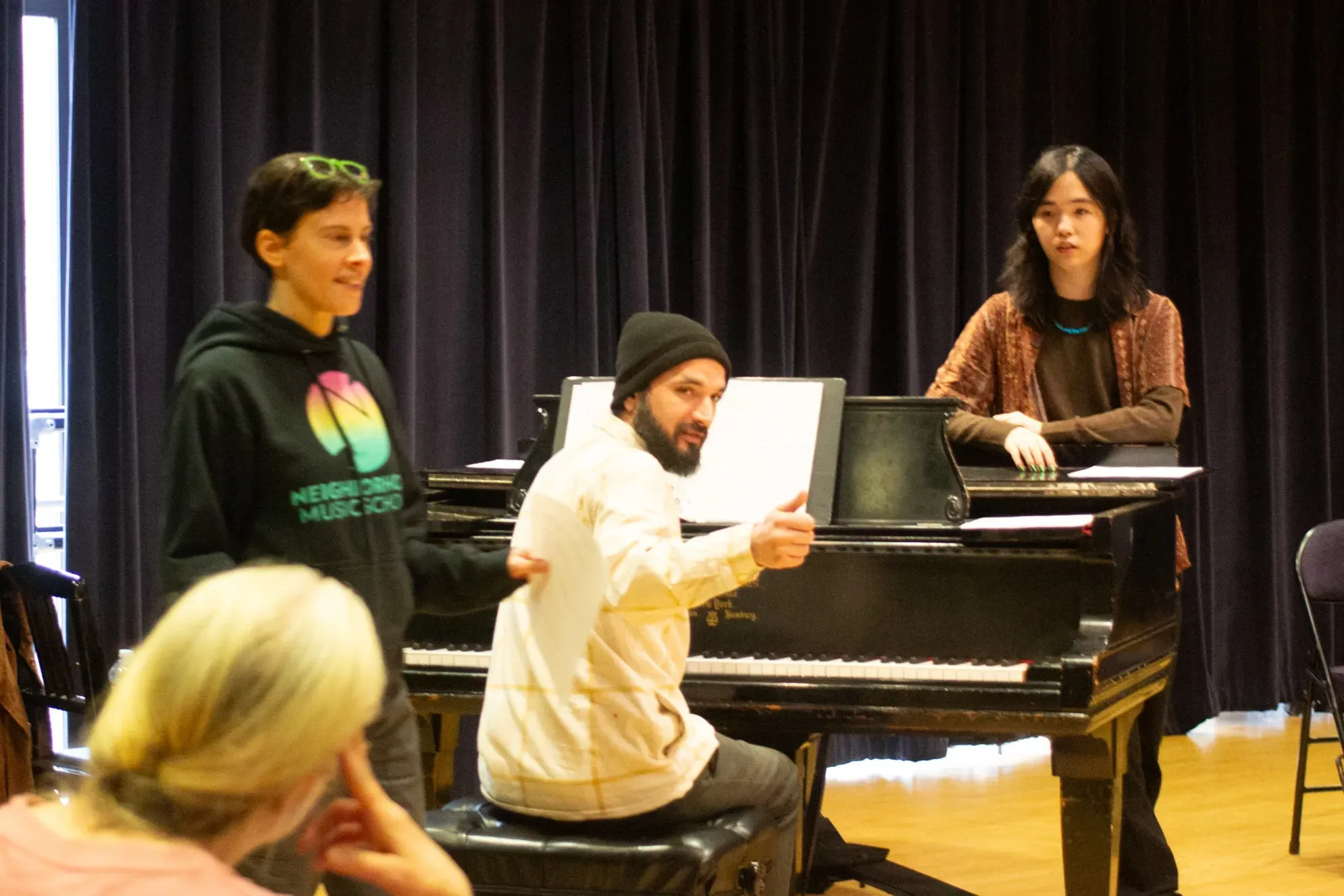
I glanced down at the lyrics sheets in my hand, walking toward a semicircle of singers in folding chairs. Neighborhood Music School (NMS) on Audubon Street had opened their recital hall doors Sunday afternoon for a free community sing-along to “raise our voices in harmony and build community through song.”
Among hope-filled songs like John Lennon and Yoko Ono’s “Imagine” and Bob Marley’s “Three Little Birds” was one that asked a simple question: What’s going on?
It was the 4 Non Blondes’ 1992 hit “What’s Up.” NMS sing-along leader Lauren Messina asked for a show of hands from whoever was familiar with the song already. Some in the crowd shook their heads, their hands at their sides.
“You’ll know it,” assistant Myles Carter-Solomon reassured them. If not at the verse, for sure at the chorus.
25 years and my life is still
Tryin’ to get up that great big hill of hope,
For a destination
I realized quickly when I knew I should
That the world was made up of this brotherhood of man
For whatever that means
At 25, my mother left Korea to help her family run a Chinese restaurant in a food court in a mall in Iowa. She says she felt old, like the decisions in her life had already been made. At 28, I am leaving the U.S. to live in Korea, and I feel young. I lilted through the 4 Non Blondes’ first verse, reacquainting myself with the drama of its melody.
And so I cry sometimes when I’m lying in bed
Just to get it all out what’s in my head
And I, I am feeling a little peculiar
High note city.
It was thrilling to just go for it, nothing to lose. The community sing-along was, I felt, like karaoke with lower stakes. A tight net of voices were there to catch me if I stumbled.
It felt right to sing about crying in bed, a classic activity in the midst of global war and livestreamed genocide. For me and many people I know, it takes an almost unsustainable level of restraint to not cry. It was nice to admit it for a moment, even if we were just “singing along.”
And so I wake in the moring and I step outside
And I take a deep breath and I get real high
And I scream from the top of my lungs,
“What’s going on?”
Yes, the scream! The question. And the deep breath.
Filling my lungs and leaning into the performance, I felt that singing was a sweet way to trick yourself into deep breaths. And that’s the kind of regulation that comes in handy when you are trying to stay focused in a disturbing world.
And I say hey-ey-ey,
Hey-ey-ey,
I said, “Hey, a-what’s going on?”
And I say hey-ey-ey,
Hey-ey-ey,
I said, “Hey, a-what’s going on?”
This was the moment we had all been waiting for. Messina praised the community singers for their zeal.
“That also tells me that a lot of you guys are like, ‘What’s going on?'” she said.
I asked her later if the sing-along was in response to politics and global news (like the U.S. and Israel’s attacks on Iran, or ICE raids ripping apart families). She said the idea had come from seeing activists use song in their demonstrations. If they were singing to fight for human rights, surely a music school could put together some tunes.
When I was last in Korea, it was Christmastime. The country was impeaching its president, who had declared (and quickly took back, after immense pressure) martial law. I took photos in the cold as a sea of people belted out every winter holiday song imaginable, with lyrics changed to fit the current situation. “Impeachment is the answer,” we sang in Korean, to the cheery tune of “Feliz Navidad.”
Does art make a difference? Some artists say yes, art takes on the vital task of reminding us what we are fighting for. Others play it humble, saying their craft simply does not do what other forms of resistance might. Still others linger in the balance, wanting to believe and amassing evidence to convince others of art’s relevance in material change.
Scream-singing “What’s going on?” to a room full of understanding faces, I didn’t need to be convinced. Singing this line was not going to change legislation or halt military proceedings. But it was giving me back my heart, which I know is really going to come in handy someday. A sense of self, a denormalization of political decisions — these are all important tools against the manufacture of consent (e.g. for war).
Ooh, ooh, ooh, ooh, ooh, ooh
Little kids rocked back and forth to the steady beat. I recognized both their wild energy and the feeling of music lending it a shape. We weren’t so different, the toddlers and the adults. Music helped us stay focused in the present.
And I try
Oh my God, do I try
I try all the time
In this instition
And I pray,
Oh my God, do I pray
I pray every single day,
For revolution
At this point, the singers in the room let loose, borrowing 4 Non Blondes lead singer Linda Perry’s stage presence along with her words. Or perhaps they were channeling over-the-top comic character He-man from viral 2005 video “HEYYEYAAEYAAAEYAEYAA,” which served as many zillenials’ surreal first introduction to the song.
Andreas Pappas, piano accompanist for the sing-along and Neighborhood Music School instructor for piano, drums, and ensemble, said the event is destined to happen again. In the meantime, maybe it would do us all some good to take a deep breath (maybe get real high, maybe not) and scream from the top of our lungs, “What’s going on?”


